
When you’re out in the wild or off-grid, you usually bring a battery to keep your essential gear running. And if you want a way to top it up, the most accessible energy source is the sun. Just lay out a solar panel, plug in the cable, and your battery gets juiced back up. But how long does that actually take? Will it be fully charged before the sun goes down or before it gets dark? Let’s dive into that.
100Ah vs. 12V: Are These Two Questions Asking the Same Thing?
When I tried searching for answers, I realized that not only people, but even search engines sometimes get confused. If you look up “How long will a 200W solar panel take to charge a 100Ah battery?” you’ll often get results for “How long will a 200W solar panel take to charge a 12V battery?” These two questions approach things from different angles, but at their core, they’re both trying to figure out the charge time for a fixed amount of battery capacity. And when it comes to “100Ah” and “12V,” many people run into these two numbers all the time when calculating charge times, but they always mix them up. The truth is, these two figures mean different things, and neither question is complete on its own.
- 100Ah stands for battery capacity – it defines how much charge the battery can hold. If you only know the voltage, we in the industry usually default to assuming it’s a 12V battery, so you can still kind of work out the time.
- But 12V is the voltage – voltage determines system compatibility; it’s a fixed value. A battery labeled 12V could be 100Ah, 50Ah, or 200Ah, so just saying “12V battery” makes it hard to get accurate data and calculate the time.
Only when you put these two together do you get the complete battery spec – like 12V 100Ah – which is the common parameter we see, and only then can you calculate a reasonably accurate charge time.
How to Calculate Solar Charge Time
To get a reasonably accurate estimate, you need to fill in those incomplete figures we mentioned earlier. And the calculation isn’t just simple multiplication or division either – because in real-world use, you have to factor in sunlight, environment, equipment conversion efficiency, and various other elements that directly affect charging speed and duration. Plus, this method isn’t just for 12V 100Ah batteries; you can use it as a reference for other capacities and voltages too.
Step 1: Calculate the battery’s total energy
As we mentioned earlier, numbers like 100Ah and 12V are incomplete by themselves, so first we need to convert the battery’s capacity into a usable energy unit: watt-hours (Wh). Of course, if you already have this spec, you can skip straight to Step 2.
General formula: Battery capacity (Wh) = Battery voltage (V) x Amp-hour rating (Ah)
Total energy of a 12V 100Ah battery (Wh) = 12V x 100Ah = 1,200Wh
Step 2: Calculate the solar panel’s actual output
Although the panel is labeled 200W, that’s really just a lab-tested nominal value. In reality, conditions are much more complex, and it’s hard to maintain a full 200W output. Things like off-angle positioning, drifting clouds, rising ground temperature, atmospheric refraction, or dust and debris can all affect the panel’s output. So in our industry, we usually estimate actual output at around 80%. Of course, if you want to learn more about the real output of a 200W panel, you can check out our related article.
General formula: Actual solar panel power (W) = Nominal power x 80%
Actual power of a 200W panel for a 12V 100Ah battery = 200W x 0.80 = 160W
Step 3: Account for overall system losses
And it’s not just the panel that has losses – the other devices in the charging chain also consume power, such as the charge controller (MPPT conversion efficiency), line resistance losses, and the absorption losses during the battery’s chemical charging process. These typically extend your actual charge time by about 15%. So the system loss factor is x1.15.
Real-world actual charge time: 1,200Wh ÷ 160W x 1.15 = 8.6 hours
This isn’t just guesswork – it’s widely accepted physical and engineering data from the PV and off-grid energy storage industry. And based on real user feedback, actual experience does indeed land around this number, sometimes even a bit slower.
We looked at feedback from a camper who used a 200W panel to charge our 1210Wh PF1500 portable power station. He said that around noon, charging was the most stable and fastest, but as the sun angle changed in the morning and evening, and with brief temperature spikes and fluctuating light during the day, the overall output was not completely steady. On the first day, with about 5–6 hours of effective sunlight, he got roughly 900Wh of charge, filling the power station to about 70%–80%. Then the next morning, after another 2 hours or so of sun, the unit showed fully charged. So a full charge takes close to 9 hours – pretty much in line with our estimate, maybe even longer.
How Long to Charge Different 12V Batteries with a 200W Panel?
Now that you know the calculation, using the same 200W panel for different capacity 12V batteries will naturally give very different charge times. Check out the table below:
| Battery Spec (12V) | Total Energy (Wh) | Ideal Theoretical Time | Real-World Actual Time |
| 12V 50Ah | 600Wh | 3h | 4h–5h |
| 12V 100Ah | 1200wh | 6h | 8.5h–9.5h |
| 12V 200Ah | 2400wh | 12h | 17h–19h |
For a small 50Ah battery, a good afternoon of sun will easily top it off. But for a large 200Ah unit, you’d better bring extra panels – otherwise, you’ll be waiting two days to see if it ever fills up.
How Long to Charge a 100Ah Battery with Different Solar Panel Sizes?
Of course, if we flip it around – fix the battery at 12V 100Ah (i.e., 1200Wh) and increase the solar panel wattage – does that cut the time significantly? We can apply the same formula to get the corresponding times:
| Solar Panel Power | Actual Effective Output (at 80%) | Ideal Theoretical Time | Real-World Actual Time |
| 100w | 80w | 12h | 17h–19h |
| 200w | 160w | 6h | 8.5h–9.5h |
| 300w | 240w | 4h | 5.5h–6.5h |
| 400w | 320w | 3h | 4h–4.5h |
So if you’re heading somewhere with limited sunlight hours, bring a higher-wattage panel – it’ll top up your battery in no time.
Real-World Factors That Slow Down Solar Charging
There are actually many factors that affect solar charging, but we just don’t pay attention to them most of the time.
1. Weather and sunlight are the most direct and fundamental factors. Direct noon sunlight gives the highest intensity and fastest charging; morning/evening angles or lower winter sun heights cause irradiance to drop sharply. Not to mention cloudy or rainy days.
2. Dust, leaves, or debris on the panel surface also reduce output.
3. Temperature affects both the solar panel and the battery. A panel’s power output decreases as temperature rises – typically, output drops by about 0.3% to 0.5% per 1°C increase. So on a hot day, efficiency can actually be lower than in cooler conditions. Batteries also have low-temperature limits and high-temperature protection – lithium batteries charge very slowly below 0°C, and the BMS may even limit charging to protect the battery. Likewise, if it’s too hot, the controller or battery may reduce current to prevent overheating.
4. The controller and matching are also critical. MPPT and PWM are both solar charge controllers – their job is to safely and efficiently transfer power from the panel into the battery. But the way they do it makes a huge difference. MPPT tracks the panel’s optimum operating point in real time, achieving over 95% efficiency. PWM is older technology – it essentially pulls the panel voltage down to battery voltage, wasting 20%–30% of energy, though it’s cheaper. Also, the panel’s voltage needs to match the battery system – too low and the controller won’t kick in, too high and it’ll fry the controller. So always double‑check that the voltages are compatible before buying.
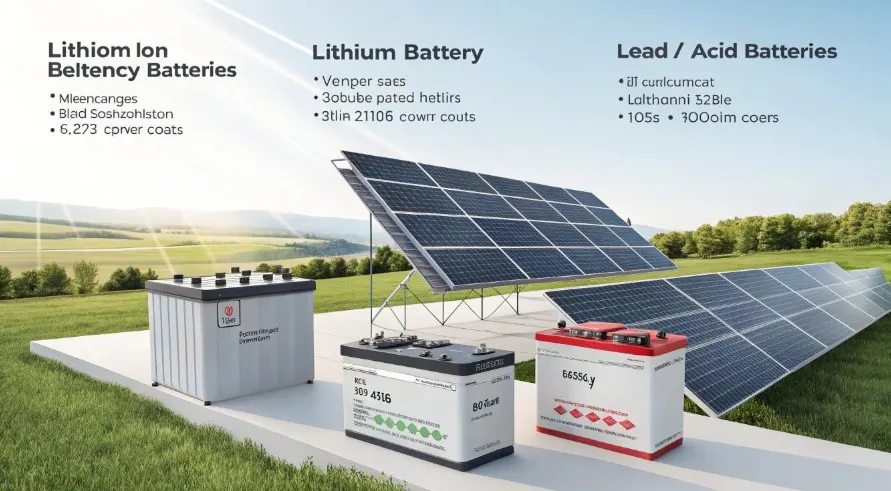
5. Battery type also affects charging. LiFePO₄ supports 100% depth of discharge – meaning you can drain it completely before recharging; it’s highly efficient and only slows down near the very end. Traditional lead-acid batteries are typically recommended to be discharged only 50%, and after they reach 80% charge, the rate drops dramatically – that last 20% can take hours.

Real-World Scenario: Charging While Running Appliances
You might think that’s all, but have you ever considered – when we’re off-grid without power, are we really just sitting around waiting for the panel to charge the battery before using anything? What about the router or fridge you brought? They need continuous power to keep running. This is a blind spot in many solar-charging tutorials – they assume the battery is being charged in a static, no‑load state. But in reality, no one on a camping trip turns off the car fridge holding their food or the router keeping them connected just to charge the battery. So you can’t just look at total input. While the solar panel is charging the battery, it’s also powering other devices. The power that actually enters the battery isn’t the panel’s total output – it’s what’s left after subtracting the load consumption.
- Load consumption scenario
Take a 45W car fridge and a 15W outdoor router as an example:
The fridge compressor doesn’t run continuously – it cycles on and off once it hits the set temperature. Estimating a 50% duty cycle, average power consumption is about 22.5W. The router needs to maintain network connectivity and runs continuously, drawing about 12W–15W. Combined, the average hourly consumption is roughly 35W.
- Net charging power calculation
Following our earlier estimates with losses and weather, let’s say the 200W panel’s actual effective output is 160W. After powering the continuously running devices, the net power going into the battery is: 160W – 35W = 125W
- Actual charge time
Applying the 15% overall system loss to the 1200Wh battery, charging while using it takes: 1200Wh ÷ 125W × 1.15 ≈ 11 hours – that long to get a full charge.
So compared to charging without any load, using it at the same time adds a significant amount of charge time. And if you’re in a place with less than ideal sunlight, you might not even finish charging – or you might just barely break even.
We recommend pre‑cooling your fridge, freezing food ahead of time, and downloading offline media before you leave to reduce nighttime router usage. These small habits can effectively cut down on extra power consumption during your trip and save you some charging time.
When you use a 200W solar panel to charge a 12V 100Ah battery, don’t just look at the theoretical numbers. Out in the real outdoors, high temperatures reduce panel efficiency, sun angles change, cables have losses, and on top of that, you’re running loads like a fridge and router – so a full charge will easily take 8.5 to 11 hours or even longer.
So when planning your system, think about your use case in advance. For a weekend camping trip, staying at the site for two days, mainly powering small devices like phones and camp lights, with no big appliances running continuously – 200W is generally enough. But if you need to keep a car fridge and router running all day, or if your location gets less than 5 effective sunlight hours per day, and you still want a full charge from empty within one day – then go straight for 300W to 400W panels, with plenty of headroom. Otherwise, you might end up using power faster than you can replenish it, and you’ll be left staring at a dead battery with nothing to do.