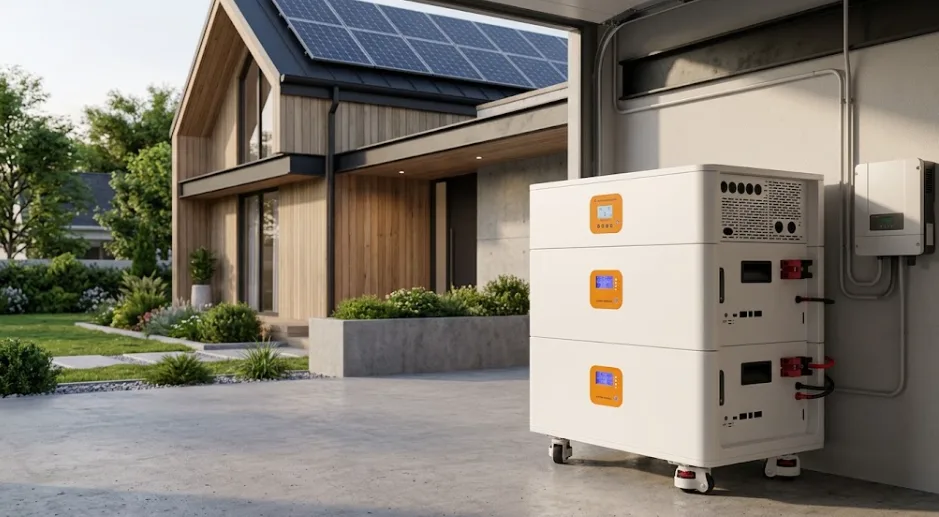

As a power conversion device, an inverter‘s core function is to convert the DC power produced by batteries or solar panels into the AC power needed by household appliances. This is especially true for bidirectional conversion, which involves quite a few stages of current conversion. So the most important thing when choosing a battery to feed an inverter is that it must have deep-cycle capability.
What Should You Consider When Choosing an Inverter Battery for Your Home?
To answer this question, we need to look at the conditions in two parts: internal and external. “Internal” refers to the non-negotiable hardware matching requirements, and “external” refers to your own household usage scenario.
The Battery Must Match the Inverter
The inverter is the main output device, so it absolutely has to match the battery. 1. The battery’s nominal voltage and operating voltage range must fall within the battery voltage range supported by the inverter. If the inverter says 12V, 24V, or 48V, you have to buy a battery with the corresponding voltage. For example, if you buy a 48V inverter but pair it with a 12V battery, not only will it not work, but it could also burn out the equipment. 2. The battery’s maximum output power must also match the inverter. A battery’s ability to deliver power has a limit. If you buy a high-power inverter but pair it with a battery with weaker output capability, and you need to run several high-power appliances at the same time but the battery can’t supply enough, the battery’s protection system will cut power instantly, causing the whole system to black out and shut down. 3. If your battery is a lithium battery, you also need to pay attention to communication matching between the inverter and the battery’s BMS system. They need to “talk” through protocols such as CAN or RS485. With proper communication, the inverter can accurately read all the battery’s information, thereby optimizing the charge and discharge strategy and ensuring safety.
Conditions You Should Consider
Before choosing a battery, I think understanding your home’s actual usage conditions may be more important than looking at all sorts of random specs. A lot of times people see one blogger say this parameter works better, or another reviewer’s comments say that one is better, but once they buy it, it doesn’t really feel like a good fit. So forget the specs for a moment and objectively assess your own conditions first:
1. How often the power goes out in your area and how heavily you’ll use the system
This is an important prerequisite for choosing a battery. Do you live somewhere with frequent outages, or is it just occasional electrical issues? This directly determines whether you should buy a highly durable workhorse or a cheap backup power source for occasional use.
2. Where the battery will be placed and the ambient temperature
Environment determines the safety baseline. You need to decide whether the battery will go indoors in the living room, bedroom, or enclosed balcony, or outdoors in a garage or warehouse. If you want it indoors, your requirements for the battery must be higher: it must meet hard safety requirements such as no toxic gas, no leakage, and good stability. But if it goes outdoors, you have to consider whether the area has extreme heat or subzero cold, and whether the battery can withstand that weather.
3. Willingness to do routine maintenance
Different types of batteries have completely different maintenance needs. You need to consider whether you’re the kind of person willing to check battery water levels and manually add distilled water every few months to save money, or the set-and-forget type who wants to put it in a corner and not touch it except when needed.
4. Budget and replacement cycle
Do you want something cheap that will need replacing before long, or do you want to spend more upfront on a battery that can last 10+ years?
What Types of Batteries Are Suitable for Home Inverters?
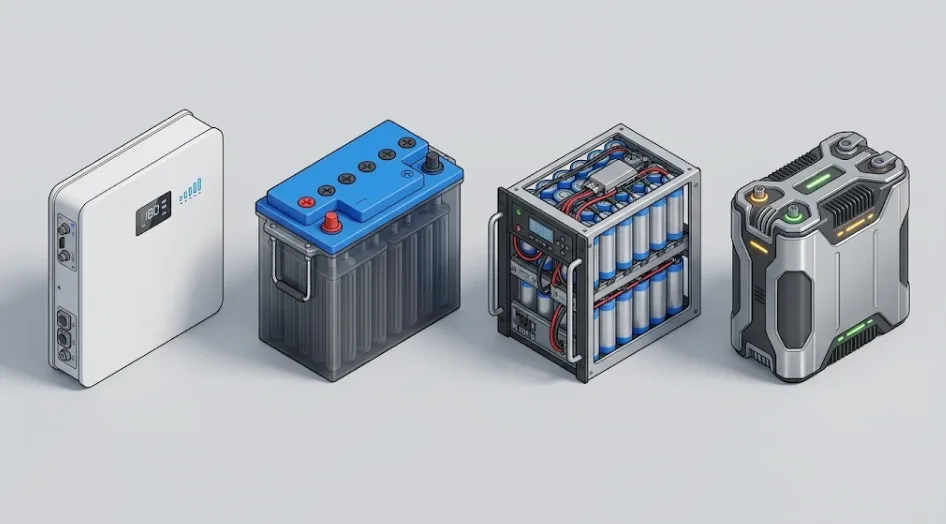
Lithium Iron Phosphate (LiFePO4)
The internal chemical structure of lithium iron phosphate batteries is especially stable, with a thermal runaway temperature of about 270°C, so they are not prone to catching fire. If you want to install the battery indoors, this type is the first choice. At the same time, LiFePO4 also has a long cycle life—over 3,500 cycles—so even if you deeply charge and discharge it once a day, it can last 10 years. Its deep-discharge capability is strong: you can use 80%–100% of its capacity, so for batteries with the same nominal capacity, LFP can release more actual power.
Lead-Acid Batteries
Lead-acid batteries are a traditional technology. They have a price advantage over other batteries, the technology is mature, and inverter compatibility is relatively broad—many hybrid inverters support lead-acid batteries. However, their cycle life is usually only 500–1,500 cycles; under frequent charging and discharging they may last 2–3 years, but at lower frequency as a backup battery they can still last 3–5 years. If you want to maintain the battery so it lasts longer, it’s recommended to discharge only about 50% during use, because its capacity utilization is not high. If it is overcharged, water electrolysis will occur, so it needs to be installed with ventilation.
Lithium Ternary (NMC) Batteries
Ternary lithium batteries have the highest energy density among these batteries, which means they can store more power in the same weight or space. Their cold resistance is also better than that of lithium iron phosphate, making them more suitable for people in cold regions. The only downside is that their safety is not as high, their average cycle count is lower than that of lithium iron phosphate, and they cost more.
Sodium-Ion Batteries
Sodium-ion batteries can be considered an emerging technology in recent years and are seen as a strong complement to lithium-ion batteries. Their safety and low-temperature performance are even better than those of lithium iron phosphate, and they can still work at -30°C or even -40°C. Sodium resources are abundant, so in theory costs should be lower. However, the technology is not fully mature yet, it is rarely used in home scenarios, its energy density is lower than that of lithium-ion batteries, and at the same capacity it is larger in size.
Generally speaking, when looking at the overall picture, the vast majority of households will choose lithium iron phosphate. Compared objectively, it really is the safest choice. Of course, if you’re not a long-term thinker and have a limited budget, lead-acid batteries are also worth considering.
How Big a Battery Do You Actually Need?
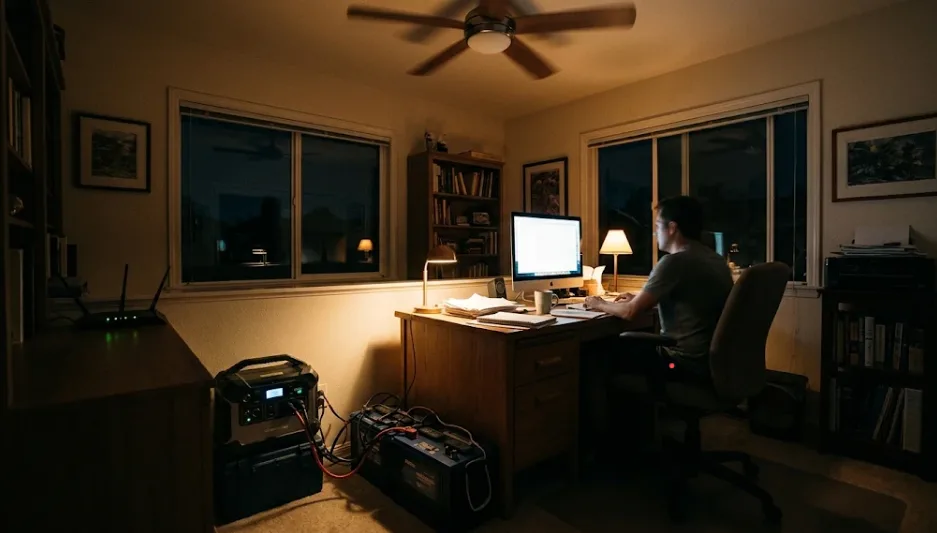
When I do market research on Reddit, I often see new users complain: “I calculated it perfectly—I have 1200Wh of power, so why didn’t it even last 1 hour?” And this isn’t an isolated case. One of my customers in the Philippines, because his home loses power all the time, decided to put together his own home emergency backup system and came to us to buy components separately. He had planned everything out before buying: when the power went out at home, he only needed to run one desktop computer of about 300W, two ceiling fans (about 150W), and a modem/router (about 30W), totaling less than 500W. He specifically bought a 1000W pure sine wave inverter and carefully chose a 12V 100Ah deep-cycle lead-acid battery. By his calculation: 12V x 100Ah = 1200Wh. With 500W of equipment, it should easily last more than 2 hours—enough for him to save his work files, enjoy the fans, and wait for the power to come back.
But when the power actually went out, just over 50 minutes later, the inverter started beeping and then shut off completely. The computer didn’t have time to save, and the number on the battery voltage meter had already dropped below 11V. He thought he had bought a counterfeit battery with an overstated capacity and was so angry that he came straight to us. It wasn’t until after we explained it to him and he posted his setup on a forum for help that the veteran electricians in the comments all said the same thing—he realized he had been misled by the theoretical capacity on the spec sheet.
The numbers on the spec sheet are real, but they are indeed measured by the manufacturer under standardized conditions in a lab, and in actual use there will be losses. Generally, to prevent lead-acid batteries from being ruined by plate sulfation, the inverter usually triggers low-voltage protection and forces a shutdown when the battery is about 50% depleted. Also, converting DC to AC generates heat, and the inverter’s own operation and conversion will consume about 10%–15% of the power.
From the example above, it’s easy to see that the battery size you need is actually closely tied to your needs. You just need to list your needs, then add an estimate for losses and leave a little extra battery buffer—that’s roughly the battery capacity you need.
Formula: Battery nominal capacity ≈ Load energy demand ÷ (DoD × Inverter efficiency × Wiring/temperature/aging factor)
After calculating the total watt-hours (Wh) this way, remember to divide by your inverter’s system voltage (12V/24V/48V)—that gives you the battery amp-hours (Ah) you need to buy, so don’t mix them up.
Add up the power of the appliances you must use during an outage and multiply by the number of hours you want them to run to calculate your electricity demand. Then look at the battery type: if you use a lead-acid battery, divide by 0.5 because it needs to keep half of its charge in reserve; if you use a lithium iron phosphate battery, divide by 0.9 because it can be deeply discharged. Finally, divide by the inverter efficiency, which is about 0.9, and leave an extra 10%–20% margin. That way, when you choose battery capacity, you probably won’t run into the other person’s predicament above.
How Much Does a Battery Cost? Which Option Is Cheaper Over the Long Run?
Anyone who has looked into it knows that lithium iron phosphate batteries really do cost 2–3 times as much as other batteries, and that is exactly the key point that makes people hesitate. Even if the battery can last that long, will their equipment last that long? Can it really pay for itself over 10 years?
True, an inverter is an electronic device packed with circuit boards inside, and its normal lifespan is only about 5 to 8 years. Not to mention that you might upgrade to high-power appliances later, and the existing inverter could be at risk of being phased out at any time. If buying a lithium iron phosphate battery really had to last a full 10 years just to break even, then it would indeed be a very risky gamble.
But the truth is, you don’t need to use a lithium battery for a full 10 years to break even at all!! How long it takes to pay for itself depends entirely on how often you use it.
- Scenario A: Your home has power outages almost every day, or you have solar panels and charge/discharge every day
Real payback time: about 2.5 to 3 years.
If your area experiences planned outages every day, or you charge the battery with solar power every day, the battery’s cycle frequency will be relatively high. Over a year, it might go through hundreds of charge-discharge cycles. In this case, you can’t just look at how much the battery costs upfront—you also have to consider how long it will actually last you. Traditional lead-acid batteries are cheap, but they don’t handle long-term deep discharging well. If they go through fairly frequent charge and discharge every day, their capacity will degrade faster, and you may need to think about replacing them after just a few years. Lithium iron phosphate is different—it’s inherently well suited to scenarios with frequent charging and discharging, can deliver higher actual usable capacity, and typically has a longer cycle life.
So it’s actually the more cost-effective choice to spend more upfront on lithium iron phosphate. After all, you can’t just focus on the first purchase price—you also have to count how many times you might need to replace the battery in the years ahead.
- Scenario B: The grid is very stable, with only 5–10 outages a year, and the battery is only for emergency backup
Real payback time: Never
This is the trap that many beginners who only look at recommended specs online fall into most easily. A dozen or so outages a year means only a dozen or so cycles a year. At that frequency, even the cheapest AGM or tubular lead-acid battery can sit in the corner and last a solid 4 to 5 years. If you buy a lithium iron phosphate battery with great specs under these conditions, that’s a loss—it will never pay for itself, because it simply won’t be used that many times. But a battery doesn’t only die when it hits its cycle limit—it also slowly ages even when it’s not being used. So just buy a cheap lead-acid battery honestly; it’s neither wasteful nor paying for overkill specs you’ll never use.
- Scenario C: The inverter is placed in a garage below 0°C, or in an unventilated metal shed above 45°C
Real payback time: None. And if you buy the wrong battery, it will be ruined outright.
After reading the above, you probably haven’t forgotten that lithium iron phosphate batteries are not cold-resistant at all. In this situation, don’t even think about payback—look at your installation environment. Lithium batteries generally get permanently damaged internally if charged directly below 0°C. If you’re putting it in a cold garage, unless you’re willing to spend about $100 more on a special lithium battery with low-temperature self-heating, do not buy one. In extreme cold, either pay extra for a self-heating lithium battery or simply stick with lead-acid; and in a hot, stuffy environment above 45°C, any battery will age faster. So just buy a cheap, tough tubular lead-acid battery—replacing it when it dies won’t hurt as much.
Of course, if you really plan to keep this inverter system for the long term, let’s stretch the timeline to 10 years and see which one actually saves more money.
Keep in mind that generally, to make lead-acid batteries last longer, you can only use 50% of their charge, while lithium batteries can use 85%–90%. This means that if you want to get the same amount of actual usable capacity as one $600 lithium battery, you actually need to buy nearly two lead-acid batteries at around $250 each. In other words, to get the same actual usable capacity, lead-acid batteries need a larger nominal capacity, which narrows the upfront cost gap. But the 10-year total cost also depends on actual battery lifespan and the number of replacements. Lead-acid batteries may need to be replaced multiple times, while lithium iron phosphate may last much longer.
| Comparison Dimension | Traditional Deep-Cycle / Tubular Lead-Acid Battery | LiFePO4 Lithium Iron Phosphate Battery |
| Initial price per battery | ~$250 | ~$600 |
| Usable capacity (DoD) | Only 50% | 85%–90% |
| Average service life | Scrapped after about 3 years (500–800 cycles) | No problem lasting a full 10 years (3,000+ cycles) |
| Number of replacements within 10 years | 2 replacements | 0 |
| Total hardware cost over 10 years | Starting at $750 (up to $1,320 if calculated by equivalent usable capacity) | $600 (initial purchase cost only) |
In summary, to choose a good battery to pair with a home inverter, there is no absolute best battery—only the battery that best fits your home.
If your area has power outages every day, go straight with lithium iron phosphate; if you only have a few occasional outages a year, spending a few hundred dollars on a tubular lead-acid or AGM battery for emergency backup is enough.