Last fall, I went to a friend’s suburban home to help fix a few things. His backyard shed wasn’t very large, about a dozen square meters, but it was packed with a table saw, an angle grinder, and a few lights. He occasionally wanted to spend weekends doing some woodworking or making repairs in there. The problem was that he hadn’t run any electrical wiring when he built the shed. If he wanted to run a power line from the home’s electrical panel to the backyard, he would have to dig up the lawn, install conduit, and bury the cable, and the electrician’s quote was expensive.
After hearing about his problem, I suggested that an off-grid solar system could solve it. I quickly helped him figure out his power needs and develop a setup that was suitable for his shed.
So, if you’re dealing with the same problem, let’s work through it step by step: how to calculate your shed’s actual power needs, how many solar panels you need, whether a battery is necessary or optional, and what a complete off-grid setup for a shed looks like.
Can I Power My Shed With Solar?
The answer is absolutely yes, and for most small sheds, solar power is one of the simplest and most cost-effective ways to get electricity.
A standalone shed has completely different power needs from a main house. You don’t need to worry about central air conditioning, water heaters, or washing machines, which are all high-power appliances. Common devices in a shed, such as LED lights, drills, angle grinders, phones, laptops, and fans, generally don’t require much power.
Choosing between running a power line and using solar is something many shed owners struggle with. Running a line to a backyard shed can cost anywhere from a few thousand dollars to more than $10,000 if the shed is far from the main house, requires trenching and conduit, and involves an electrician connecting it to the electrical panel. In some areas, you may also need to obtain permits and have the electrical work inspected. A solar power system doesn’t require trenching or an electrician, and a few-hundred-watt off-grid setup can be relatively affordable and ready to use once installed.
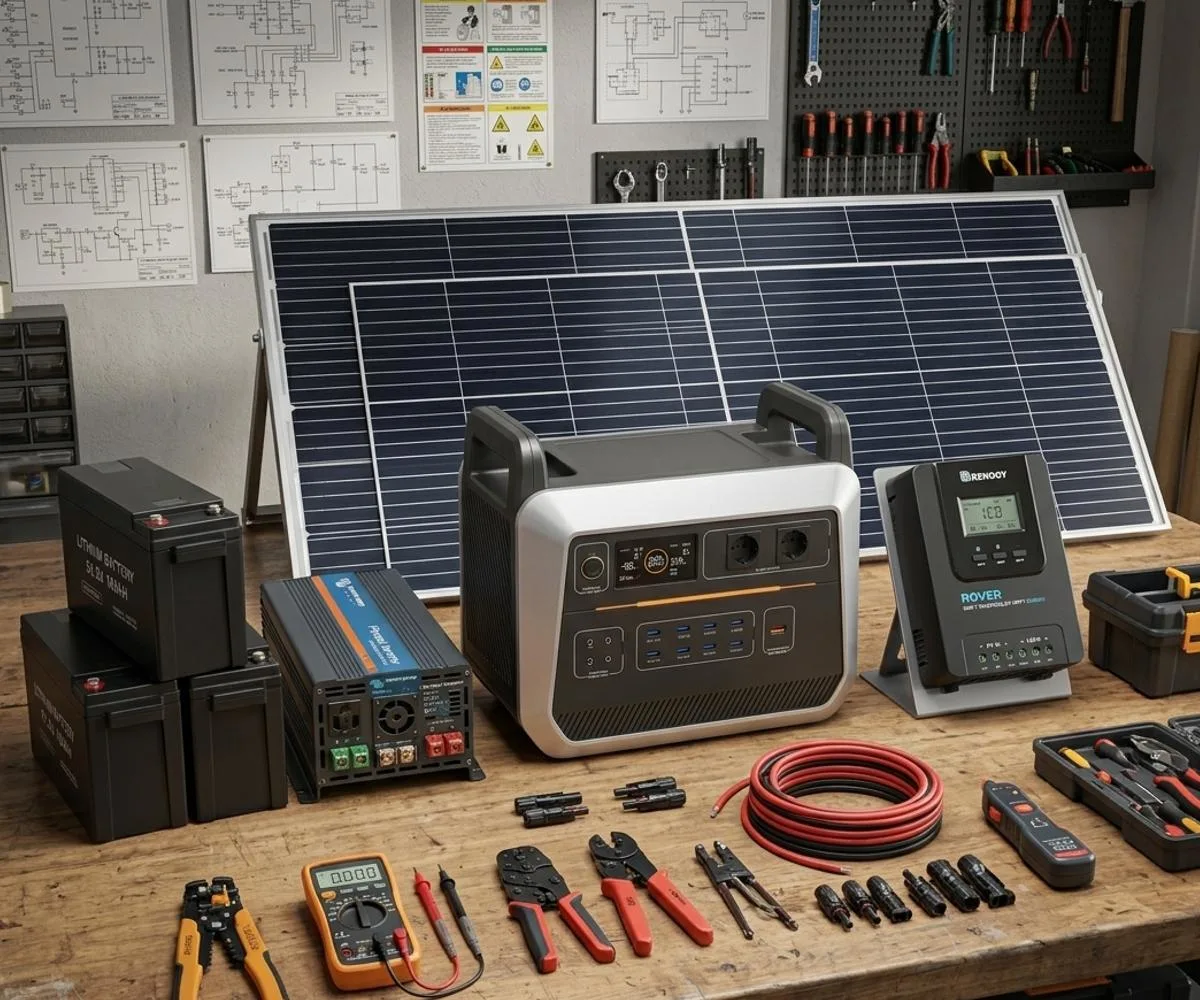
The basic logic of a solar power system for a shed is simple: solar panels generate electricity, the battery stores it, and the inverter converts it into a form you can use.
Solar panels generate electricity during the day and send it through a charge controller to the battery. The battery stores DC electricity, but your tool chargers, laptop, and LED lights may require AC power. That’s where the inverter comes in, converting DC electricity into AC power for these devices.
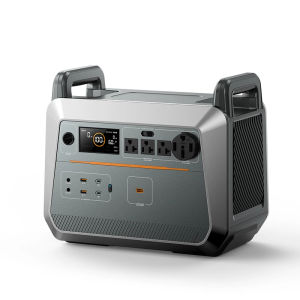
If you use a portable power station, it has essentially combined the battery, inverter, and charge controller into a single unit. You simply connect the solar panels to the power station’s solar input, then plug your devices into its AC outlets or USB ports. This is the simplest way to power a shed, with no need to wire the system yourself, buy a separate charge controller, or match different voltage requirements.
How Much Solar Power Does Your Shed Actually Need?
There’s no one-size-fits-all answer to this question. It depends on what you use your shed for and what equipment you need to power.
Step 1: List the devices you use in your shed
Most sheds have fairly simple power needs, usually falling into a few common categories:
- Lighting: 1–3 LED lights, about 10W each, used for 2–4 hours a day, consuming roughly 60–120Wh per day
- Tool charging: Battery chargers for drills, angle grinders, flashlights, and other tools, using around 100–300Wh per day
- Power tools in use: A drill (about 500W), angle grinder (about 800W), or small saw (about 1000W), but these are usually used for short periods, sometimes totaling only a few minutes to several minutes a day
- Charging electronics: Phones, laptops, and Bluetooth speakers, using around 50–150Wh per day
- Small fan or heater: A small fan may use about 30W in summer, while a small heater may use around 800W in winter
Step 2: Add up your daily energy consumption
Suppose your shed uses: three LED lights at 30W × 3 hours = 90Wh; about 150Wh for charging a drill battery; around 100Wh for charging a phone and laptop; and about 60Wh for occasional use of a small fan. That adds up to roughly 400Wh per day. This is the amount of energy your solar system needs to replace each day.
If you also plan to use an electric heater or run high-power tools continuously in the shed, daily energy consumption can quickly reach 1–2kWh or more. In that case, the system needs to be scaled up accordingly.
| Shed Type | Typical Use | Common Devices | Daily Energy Use (Estimated) | Recommended Battery Capacity | Recommended Inverter Power |
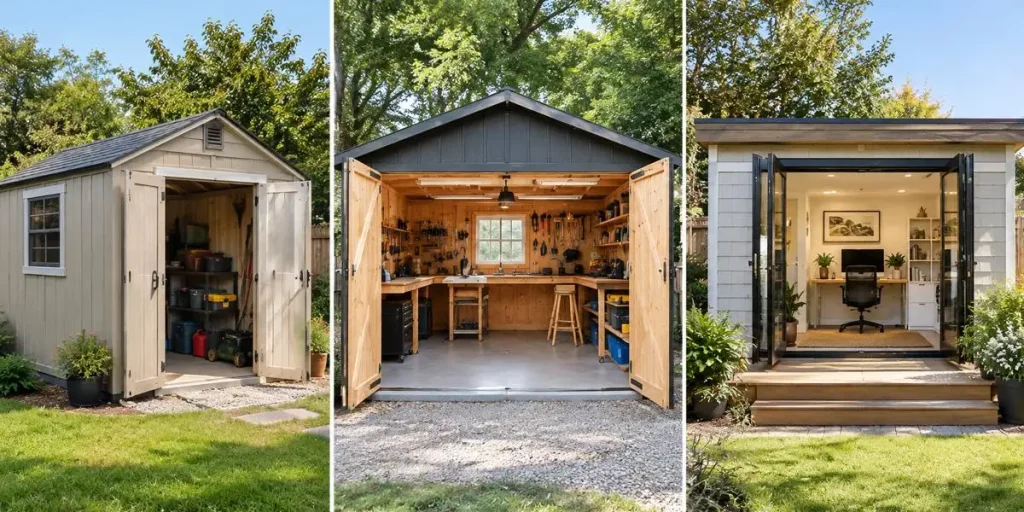
| Storage Shed | Storing tools, lawn equipment, and miscellaneous items; occasionally entering the shed to get something | LED lights, phone charging, occasional power tool use (short periods) | About 100–300Wh/day | Battery may not be necessary | 300–500W |
| Workshop Shed | Woodworking, repairs, and DIY projects; frequent use | LED lights, table saw/drill/angle grinder (intermittent use), fan/small heater (short periods), radio/charging | About 0.5–1.5kWh/day | 1.2kWh | 1000–2000W |
| Office Shed | Working from home, writing, and video meetings for several hours a day | Laptop, monitor, router, LED lights, phone charging, small fan/heater (intermittent), coffee maker (short periods) | About 1–2kWh/day | 1.2–2.4kWh | 1000–2000W |
A storage shed has the lowest power demand. In many cases, you may not even need a battery. If you only enter the shed during the day to grab something or use a drill briefly, the solar panels can supply power directly. If you also want to use lights at night, adding a small battery makes the setup more practical.
A workshop shed has the most variable power demand. Tools such as table saws and angle grinders can draw more than 2000W at startup, so the inverter’s peak power should be high enough to handle these surges.
An office shed has relatively stable power consumption but tends to run for longer periods. A laptop, monitor, and router running for 8 hours a day can use nearly 1kWh of electricity. Add lighting and other small appliances, and 1–2kWh per day is a common range. If you need a small heater in winter, energy consumption can increase significantly, so both battery capacity and solar panel capacity should be increased accordingly.
How Many Solar Panels Do You Need to Power a Shed?
In the previous section, we calculated the daily energy consumption of three common shed types. Now, we can use those numbers to work backward and determine how much solar panel capacity you need.
The formula for calculating solar panel capacity is simple:
Required total solar panel capacity (W) = Daily energy consumption (Wh) ÷ Average daily peak sun hours (h) ÷ System efficiency
Here, system efficiency does not refer to the conversion efficiency of the solar panels themselves. Instead, it is a combined estimate of various losses during actual operation. The output of a solar system can be affected by inverter efficiency, cable and connection losses, dust, shading, module mismatch, temperature, and other factors. NREL’s PVWatts model incorporates these factors into its system loss calculations. Under its default settings, the overall DC-to-AC derate factor is about 0.77. Therefore, when making a preliminary estimate for a small solar power system for a shed, you can use 0.7–0.8 as a relatively conservative system efficiency range. In other words, the theoretical panel capacity you calculate needs to be increased by about 30% to account for actual losses.
Average daily peak sun hours are a key variable. In most parts of the United States, average daily peak sun hours range from 3.5 to 5.5 hours. The Southwest (Arizona and Southern California) tends to have higher values, at around 5–5.5 hours, while the Northeast and Northwest tend to have lower values, at around 3.5–4 hours. You can use a middle value based on your location for the estimate.
So, based on the shed types from the previous section, we can work backward to estimate the required solar panel capacity:
| Shed Type | Daily Energy Consumption | Based on 4 Hours of Sunlight | After Considering 0.75 System Efficiency | Recommended Solar Panel Setup |
| Storage Shed | 0.1–0.3kWh | 25–75W | 33–100W | 1 × 100W panel |
| Workshop Shed | 0.5–1.5kWh | 125–375W | 167–500W | 2–3 × 200W panels |
| Office Shed | 1–2kWh | 250–500W | 333–667W | 3–4 × 200W panels |
One more thing to keep in mind is that the total solar panel capacity you configure cannot exceed the rated maximum solar input power of the portable power station.
For example, if a portable power station has a maximum solar input of 400W and you buy two 300W panels and connect them in series, the total power is 600W. The power station will only accept 400W, so the extra 200W will simply be wasted. More seriously, if the total open-circuit voltage of the panels connected in series exceeds the power station’s maximum input voltage, it could directly damage the controller.
So, before choosing your panels, first check two numbers: maximum input power (W) and maximum input voltage (V). Keep the total panel power close to, but no higher than, the maximum input limit, and leave a 20% margin for the total voltage when connecting panels in series.
Do You Need a Battery for a Solar-Powered Shed?
It actually depends on when you use electricity and whether you have any devices that need to stay powered continuously. You can refer to the following situations:
| Your Situation | Do You Need a Battery? | Reason |
| You only use electricity during the day and not at night | No | The solar panels can power the loads directly, and it’s fine if there’s nowhere to send the excess power |
| You also need to use lights or charge devices at night | Yes | The electricity generated during the day needs to be stored so you can use it at night |
| You have devices that need to run continuously (such as security cameras, routers, or aquarium air pumps) | Yes | These devices can’t wait for sunlight and will stop when the power goes out |
| Your area is often cloudy, so the solar panels may not generate enough power during the day | Recommended | A battery can provide a buffer and help you get through cloudy periods using stored energy |
| You only occasionally go into the shed to get tools or use a drill | Not necessary | You can use the equipment when there is sunlight and simply use it at another time when there isn’t |
How to Choose a Solar Power Kit for Your Shed
When setting up solar power for your shed, you don’t necessarily need to buy a bunch of separate solar panels, charge controllers, inverters, and batteries and put them together yourself. A combination of solar panels and a portable power station is currently the simplest and most flexible option. You only need to buy a portable power station with a solar input port and pair it with one or two solar panels, then plug them in and use them.
We’ve already covered battery capacity, output power, and solar input power earlier, so we won’t go into detail here. These specifications are clearly listed on the product details page of a portable power station, so you just need to choose based on your needs. Let’s take a look at what else you should consider when choosing solar power for your shed.
Battery Type
Lithium iron phosphate (LiFePO4) batteries are currently the mainstream battery type for portable power stations. They offer a long cycle life, good safety, and support deep discharge. LiFePO4 batteries typically have a cycle life of more than 3,000 cycles. Assuming one full charge and discharge cycle per day, they can last 8–10 years, which is more than enough for an intermittently used shed.
Number and Types of Ports
This determines which devices you can power and how many devices you can power at the same time. At a minimum, you need: AC outlets (for AC tools and appliances), USB-A and USB-C ports (for charging phones, tablets, and laptops), and a car charging port (12V DC output for vehicle devices or DC lighting). For a workshop shed, it’s recommended to choose a model with at least two AC outlets, so you can plug in tools and lighting at the same time. An office shed should ideally have more USB-C ports. A storage shed doesn’t have high port requirements; one AC outlet and two USB ports are generally enough.
Portability
For a shed, portability is not a top priority since the power station can stay inside the shed and doesn’t need to be moved frequently. However, if you need to bring it back into the house to charge or move it between different locations, you should still consider its weight or choose a model with a handle or wheels. If the power station will stay in the shed permanently, you can be less concerned about weight and prioritize capacity and power instead.
Can You Heat a Shed With Solar Power?
Of course, but your solar system needs to have enough power to cover the heating equipment’s power requirements. And heating is the most power-hungry use in a solar power system for a shed.
Heating is fundamentally different from other electrical loads. Whether you use an electric heater, infrared heater, or heat pump, the power consumption can easily reach 1000W to 1500W. And unlike devices that only run for a few minutes, heaters often need to run continuously for several hours or even all night. This means heating can increase your shed’s electricity consumption by an order of magnitude.
For example: A 1500W electric heater running for 4 hours consumes 6kWh. As we calculated earlier, a workshop shed or office shed typically uses only 1–2kWh of electricity per day. Adding heating can increase daily energy consumption by three to six times. This means both the solar panel and battery capacity need to be increased accordingly, otherwise the system simply won’t be able to keep up.
If you really want to use solar power for heating, there are four options:
First, significantly increase the system size. Both the solar panel capacity and battery capacity need to be several times larger than a standard setup. This option is not very cost-effective and can end up costing more than running a power line from the grid.
Second, change your heating method. Use an electric blanket instead of an electric heater, or wear warmer clothes and properly insulate and seal the shed. If you can reduce the heating demand to a few dozen watts, solar power can handle it.
Third, use fuel-based heating. Propane heaters, wood stoves, and kerosene heaters don’t consume electricity and can also provide more effective heating. Solar power only needs to handle lighting and charging, while heating is handled by fuel. The downside is that they require ventilation and produce emissions, so they are not suitable for long-term use in an enclosed space.
Fourth, only heat the shed when there is sunlight. When the solar panels are generating electricity during the day, you can run the electric heater directly without going through the battery, eliminating charging and discharging losses and reducing battery costs.
Solar power can heat a shed, but heating is a major energy consumer. Building a system that can support an electric heater will cost several times more than a setup for other electrical loads. If you only need heating occasionally in winter, improving insulation first and then using a low-power heating device is a more practical approach.
Building an Off-Grid Solar Shed With Battery Storage
The previous sections covered your power needs, solar panels, batteries, and how to choose a solar power kit separately. In this section, we’ll bring everything together and provide a complete off-grid solar setup for a shed.
Step 1: Determine Your Power Needs
As calculated earlier, a workshop shed or office shed typically uses 1–2kWh of electricity per day. If you also occasionally use high-power tools such as a table saw or drill, the inverter’s peak power needs to cover their startup power requirements.
Step 2: Choose Your Solar Panels
Based on 4 hours of average daily peak sun hours and a system efficiency of 0.75, a daily energy consumption of 1–2kWh requires 400–800W of solar panels. Considering shorter winter daylight hours, cloudy and rainy weather, and the effects of dust, it is recommended to size up and use 600–800W of solar panels.
Step 3: Choose Your Battery/Portable Power Station
Battery capacity determines how long your shed can run without sunlight. Based on a daily energy consumption of 1–2kWh and a goal of having enough power for 1 day, the battery’s rated capacity should be 1.2–2.4kWh. If you want enough power for 2 days to deal with consecutive cloudy or rainy days, double the capacity to 2.4–4.8kWh.
Step 4: Choose Your Inverter
The inverter converts the DC electricity stored in the battery into AC electricity needed by household appliances. An off-grid inverter must support off-grid operation and have enough peak power to handle the startup surge of motor-driven equipment such as drills, table saws, and water pumps.
A portable power station already integrates the battery and inverter, so it is the most convenient and straightforward option.
Which Solar Setup Is Right for Your Shed?
The previous sections broke down the different configurations. Below, we’ll recommend a suitable solar power system for each type of shed. The recommendations below use Piforz products as reference options, but each scenario also explains when you don’t need to buy such a high-end setup.
Storage sheds have very simple power needs: lighting, phone charging, and occasionally running a small fan or charging a power tool. Daily energy consumption is only around 0.1–0.3kWh.
Reference setup: Piforz GT200 (240Wh), paired with one 100W portable solar panel. On a sunny day, it can replenish a full day’s energy consumption in about half a day.
When you don’t need such a high-end setup: If you only occasionally go into the shed to get something or turn on a light, a regular power bank and a USB camping light will be enough. The value of the PF200 is that you don’t need to bring the light back home to charge it every time. It can stay powered in the shed and also handle occasional power needs.
Workshop sheds typically use intermittent power tools such as drills, small saws, and angle grinders. These tools don’t run for long at a time, but their startup power can be relatively high, and you may need to use them several times a day.
Reference setup: Piforz GT500 (518Wh) or GT1500 (1210Wh). The GT500 is suitable for lighter use focused on drills and lighting; if you also need to run a small air compressor or use a saw frequently, the GT1500’s 1500W rated output is a safer choice. Pair it with 400–600W of solar panels.
When you don’t need such a high-end setup: If you only occasionally do some small DIY projects in the shed or use a drill, the GT500 is more than enough. The extra capacity and power are only worth paying for if you actually use high-power tools frequently.
Office sheds have power needs that are closer to those of a home: a laptop, monitor, router, desk lamp, and possibly a small refrigerator or coffee maker. These devices don’t consume much power individually, but they run for long periods, so daily energy consumption of 1–2kWh is common.
Reference setup: Piforz GT1500 (1210Wh) or ST2000 (2073Wh, with 1.5-hour fast charging). The ST2000’s fast-charging feature is particularly useful in this scenario. You can plug it into a wall outlet during your lunch break and continue using it in the afternoon.
When you don’t need such a high-end setup: If you only occasionally work in the shed for half a day, a laptop and router can be handled by the GT500. But if you use the shed as a fixed workspace for most of the day, it makes sense to go directly for a model with 1500Wh or more, so you don’t have to keep moving it back and forth.
Sheds that need heating use heaters, which are continuous high-power loads. A 1500W heater running for 8 hours requires 12kWh. This scenario is already beyond the comfortable range of a portable power station.
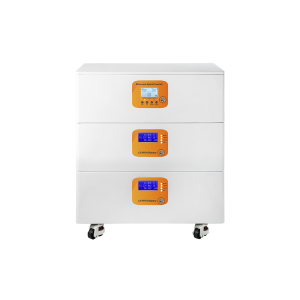
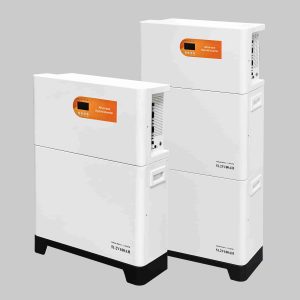
Reference setup: A scalable home energy storage system such as the Piforz PT3650S (starting at 4992Wh and expandable to 30kWh), paired with three or more 500W fixed solar panels. If the shed is used regularly for long periods, it is recommended to go directly with a permanently installed solar-plus-storage system rather than a portable power station.
When you don’t need such a high-end setup: If you only occasionally spend an hour or two in the shed during winter, wearing warmer clothes is cheaper than installing a battery. As we mentioned earlier, there are also several other ways to handle heating.
My friend’s tool shed setup eventually became a reality. He installed three 200W solar panels and a Piforz GT1500 portable power station, spending less than $1,500 in total. He finished the installation over a single weekend. Now he can use his table saw, angle grinder, and lights normally, and he doesn’t have to worry about running out of power when he occasionally works in the shed at night. Most importantly, he didn’t dig a single inch of trench, hire an electrician, or wait for approval. The money he saved was enough to buy several new tools.
Looking back, the key to making this setup work was simply following the steps we covered earlier in the right order. So, I hope that after reading this, you can find the right solar power equipment for your shed.