
Everyone cares about the lifespan of the products they buy. Just like people check the expiration date when buying food, many customers ask the same first question when considering a battery system: How many years can this system last?
Behind this question are actually two concerns. The first is whether a system that costs tens of thousands of dollars will become unusable after only a few years. The second is whether the investment is truly worth it in the long run.
After all, a home energy storage system is not like a smartphone that you replace every two or three years without much thought. It is a long-term investment designed to operate for more than a decade.
This guide aims to explain everything clearly: the real-world performance of different battery technologies, how usage habits and environmental temperatures affect lifespan, and the simplest ways to extend battery life.
Later in the guide, we will also analyze the relationship between battery capacity and backup time, helping you find the right balance between choosing the right size system and getting the runtime you need.
Average Lifespan of a Home Battery
How long can a home battery actually last? The answer depends on factors such as how you store and use it, as well as the frequency of use.
Under normal conditions, a home battery typically lasts 10 to 15 years or around 6,000 to 10,000 cycles.
So, what do these two battery lifespan concepts actually mean? They refer to calendar life and cycle life.
Calendar life refers to the total lifespan of a battery starting from the day it is manufactured, regardless of whether it is used or not. Even if a battery sits unused for three years, its calendar life continues to decrease.
It is similar to buying a pair of shoes and leaving them in a closet without wearing them. After several years, the rubber sole can still age, deteriorate, and crack.
Cycle life refers to the number of complete charge and discharge cycles a battery can complete before reaching the end of its usable life.
Note that this refers to a full charge and discharge cycle. For example, if you use 30% of the battery today and recharge it, then use another 30% tomorrow and recharge it again, that does not count as two cycles. The usage must accumulate to 100% of the battery capacity to count as one complete cycle.
Calendar life and cycle life work on a parallel basis — whichever limit is reached first determines the battery’s practical lifespan.
A battery may not have used up its rated number of cycles, but if its calendar life has expired, the internal chemical materials may have aged to the point where the battery capacity falls below the typical 80% capacity retention threshold.
Solar Battery Lifespan by Battery Type
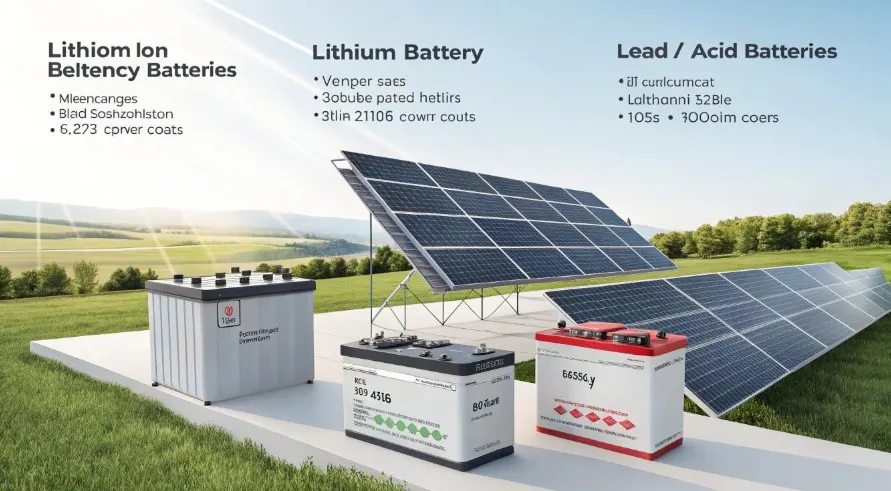
Different battery chemistries have significant differences in lifespan. Below are some of the mainstream solar energy storage battery technologies currently available on the market.
Lead-acid Battery
Lifespan: approximately 3–5 years
Cycle life: around 300–500 cycles
This is one of the oldest energy storage technologies, and its only major advantage is its low cost. However, it has a short calendar life, low charging efficiency, and requires regular water maintenance. As a result, it has become increasingly outdated in the solar storage market.
For new installations, lead-acid batteries are generally not recommended unless the budget is extremely limited or the system is only needed for temporary use.
Gel Battery
Lifespan: approximately 4–7 years
Cycle life: around 500–800 cycles
Gel batteries are an improvement over traditional flooded lead-acid batteries because their electrolyte is converted into a gel form.
However, they are particularly sensitive to overcharging. If the charging voltage is incorrect, the gel structure can be permanently damaged, significantly reducing the battery’s lifespan.
In solar energy systems, gel batteries are slightly better than traditional lead-acid batteries but still fall behind modern lithium technologies.
Lithium NMC Battery (Nickel Manganese Cobalt)
Lifespan: approximately 8–12 years
Cycle life: around 1,000–3,000 cycles
In the home energy storage market, NMC batteries are gradually losing market share to lithium iron phosphate (LFP) batteries.
This is because NMC batteries have lower thermal stability than LFP batteries, fewer charge cycles, and higher costs. Today, only a limited number of residential energy storage products still use NMC chemistry, and some regions have begun restricting its use in residential storage applications.
Lithium Iron Phosphate (LFP) Battery
Lifespan: approximately 10–15 years
Cycle life: around 4,000–8,000 cycles
LFP batteries are currently the dominant choice for home energy storage systems. For example, Piforz’s energy storage series can achieve around 10,000 cycles before battery capacity declines to approximately 80% of its original capacity.
Compared with NMC batteries, LFP batteries offer better thermal stability, making them less likely to experience thermal runaway even under conditions such as overcharging or physical damage. They also provide a longer cycle life and do not contain cobalt, reducing environmental concerns and supply chain risks.
Lithium Titanate (LTO) Battery
Lifespan: approximately 15–20 years
Cycle life: around 10,000–20,000 cycles
LTO batteries currently offer the longest lifespan among lithium battery technologies. They feature extremely high charge and discharge rates and can operate reliably even in sub-zero temperatures.
However, they have lower energy density and higher costs. For the same capacity, LTO batteries can cost several times more than LFP batteries, making them rarely used in residential energy storage applications. They are mainly found in industrial and specialized applications.
| Battery Type | Lifespan | Cycle Life | Best Use |
| Lead Acid | 3-5 years | 300-500 cycles | Low-cost backup |
| Gel Battery | 4-7 years | 500-800 cycles | Small solar systems |
| NMC Lithium | 8-12 years | 1,000-3,000 cycles | EV-based storage |
| LiFePO4 | 10-15 years | 4,000-10,000 cycles | Home energy storage |
| Lithium Titanate | 15-20 years | 10,000+ cycles | Industrial applications |
What Factors Affect Solar Battery Lifespan?
A battery with a rated lifespan of 10 years does not mean it will automatically last 10 years regardless of how you use it.
Many factors affect battery lifespan, and most of them are directly related to your usage habits and installation environment. With the exact same battery, one person may see it fail after 8 years, while another may still have good performance after 12 years. The difference comes down to the following factors.
Temperature
Temperature is one of the most hidden yet significant factors affecting battery lifespan.
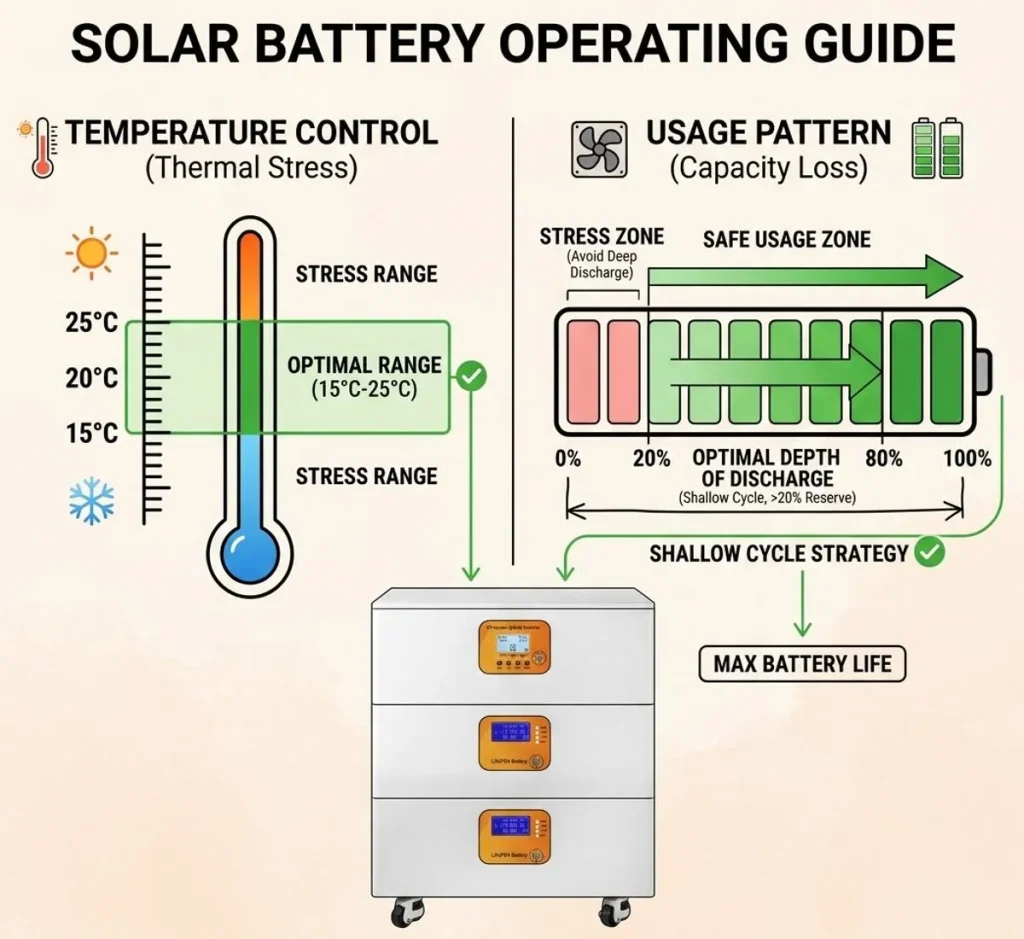
For lithium iron phosphate (LFP) batteries, the ideal operating temperature range is around 15°C to 25°C. Long-term operation in environments above 30°C can accelerate battery aging.
In hot regions such as Arizona, Texas, and California, outdoor battery installations require extra attention because summer temperatures can exceed 40°C. A joint research study found that LFP batteries stored at 55°C experienced significantly faster capacity degradation and greater interface deterioration compared with batteries stored at lower temperatures. The damage accumulated during calendar aging continued to affect their performance during later cycling.
At the same time, charging below 0°C can cause irreversible lithium plating, permanently damaging the battery.
Therefore, battery installation location is extremely important. Avoid placing batteries on walls exposed to direct summer sunlight, and do not install them in garages where temperatures can drop below freezing in winter.
Depth of Discharge (DoD)
How much energy you use before recharging directly affects how many cycles the battery can complete.
Although LFP batteries can support 100% discharge, repeatedly draining the battery completely before charging will reduce the actual cycle life compared with the rated value.
Keeping the depth of discharge below 80% can significantly extend battery lifespan.
It is similar to driving a car — running the fuel tank completely empty every time before refueling puts unnecessary stress on the fuel system and engine. Leaving some reserve capacity allows the equipment to operate more comfortably.
Charge and Discharge Rate
This refers to how quickly a battery is charged and how much power it delivers at once.
High-power fast charging and discharging generate more heat, which accelerates battery aging. If you frequently operate the battery at maximum output power — for example, running multiple high-power appliances at the same time, such as air conditioners, ovens, or water heaters — heat generation and degradation will increase.
Occasional high-power use is not a problem. The key is avoiding this kind of heavy load every day.
Usage Frequency
Battery lifespan is determined by whichever comes first: calendar life or cycle life.
If you charge and discharge the battery once every day, cycle life may be reached first. If you only use the battery a few times a year, calendar aging will likely become the limiting factor.
Interestingly, a battery that sits unused for a long time may actually age faster than one that is used normally. This is because batteries experience self-discharge, and remaining at a low state of charge for extended periods can accelerate internal side reactions.
Not using a battery does not mean it stops aging. Even when sitting idle, it continues to gradually age.
Storage State of Charge
The charge level during long-term storage has a significant impact on battery lifespan.
For LFP batteries, the ideal long-term storage state of charge is around 50%–60%.
Storing a battery fully charged for long periods (such as at 100%) puts additional stress on the cathode material structure and accelerates capacity degradation.
On the other hand, storing a battery in a deeply discharged state for a long time (below 20%) may cause irreversible copper dissolution on the anode, potentially permanently damaging the battery.
Installation and Maintenance
This may sound simple, but many battery failures are caused by improper installation.
Loose terminals, blocked cooling paths, or placing the battery system inside an enclosed cabinet without proper ventilation may not cause immediate problems. However, these issues can accumulate over several years and eventually lead to premature battery failure.
Proper installation and basic maintenance are essential for getting the full expected lifespan from a battery system.
How to Extend Your Home Battery Lifespan?
The factors that affect battery lifespan mentioned above can also be viewed as ways to extend battery life. By following these practical steps, your battery will have a much better chance of reaching the upper end of its rated lifespan.
1. Install the battery in a location with a suitable temperature
Whenever possible, install the battery in a basement, garage, or another cool and well-ventilated area. Avoid direct sunlight or placing it near heat sources.
During the hottest days of summer, you can check the battery enclosure by touch. If the exterior feels hot, the battery may already be experiencing accelerated aging.
If the battery comes with built-in heating or cooling functions, make sure they are working properly. Do not disable temperature control features just to save a small amount of energy.
In winter, if temperatures drop below 0°C and the battery does not have a heating function, avoid charging it in extremely cold conditions. Wait until the temperature rises before charging.
2. Avoid fully draining the battery before every recharge
Although lithium iron phosphate (LFP) batteries are often described as capable of 100% discharge, repeatedly draining the battery completely before charging is not beneficial for lifespan.
For daily use, keeping the depth of discharge around 80% is usually a better approach. For example, with a 10kWh battery, allow it to stop after using about 8kWh and avoid repeatedly running it until it shuts down.
3. Avoid keeping the battery at maximum output for long periods
Spread out the use of high-power appliances instead of making the battery handle multiple heavy loads at the same time.
In most everyday charging and discharging situations, shallow cycling (for example, operating within a 30%–70% state-of-charge range) is more favorable for battery lifespan. This allows the battery management system (BMS) to reduce internal stress during charging and discharging.
4. Don’t leave the battery completely full or completely empty during storage
If you are going away for an extended period or only use the system seasonally, avoid storing the battery at either 100% charge or a fully depleted state.
For LFP batteries, the ideal long-term storage state of charge is around 50%–60%.
Long-term storage at full charge can increase structural stress on the cathode material, while storing the battery at a very low charge level may cause irreversible copper dissolution on the anode.
5. Ensure proper installation and regularly check wiring and ventilation
Choose a qualified installer and perform a basic inspection once a year after installation.
Check whether battery terminals are loose or oxidized, whether ventilation openings are blocked, and whether the software shows any error codes.
Spending ten minutes checking the system is much better than discovering after five years that the battery can no longer operate properly.
Control the temperature, control the depth of discharge, control the storage charge level, control charging power, and control installation quality.
If you manage these five areas properly, it is not unusual for a battery to reach — or even exceed — the upper limit of its rated lifespan.
How Long Can a Solar Battery Power a Home During an Outage?
Battery lifespan and battery runtime are two completely different concepts.
Battery lifespan refers to how many years the battery can continue to be used, while backup runtime refers to how long the battery can keep your devices powered during a single outage.
These two concepts should not be confused.
How long a battery can provide backup power mainly depends on three key factors. For more detailed information, you can click here to learn more.
Battery Capacity
This is the most straightforward factor. How much electricity a battery can store determines how much “fuel” you have available.
A 10kWh battery can theoretically provide 10kWh of energy. However, the actual usable amount will be slightly lower because the inverter conversion process has losses, and most battery systems reserve a small amount of capacity to prevent the battery from being completely discharged.
The larger the capacity, the longer the backup time. This principle is simple and easy to understand.
Electricity Usage
With the same 10kWh battery, one household may only power a refrigerator, router, and a few lights, allowing the battery to last an entire day. Another household may run an air conditioner, electric water heater, and induction cooker at the same time, draining the battery within just two hours.
Therefore, backup time does not depend only on how large the battery is. It depends on how much electricity you plan to use during an outage.
The fewer devices you power, the longer the battery will last. The more devices you run, the shorter the backup time will be.
Inverter Efficiency
The electricity stored in a battery is DC power, while household appliances use AC power. The inverter is responsible for converting DC electricity into AC electricity.
This conversion process causes some energy loss. Inverter efficiency is typically between 85% and 95%.
In other words, a 10kWh battery may provide approximately 8.5kWh to 9.5kWh of usable energy after passing through the inverter.
Although the loss may not seem significant, it adds up over time. When calculating backup runtime, inverter efficiency is an important factor that cannot be ignored.
Estimated Backup Time (hours) = (Usable Battery Capacity (kWh) × Inverter Efficiency) ÷ Household Load Power (kW)
For example:
A 10kWh home battery has a usable capacity of 90%, which means the available energy is 9kWh. It powers a 200W refrigerator and a 30W router, with a total load of 0.23kW. Assuming the inverter efficiency is 90%:
The runtime in this example would be:
(10 × 0.9 × 0.9) ÷ 0.23 ≈ 35.2 hours
When choosing a battery system, first figure out which appliances you want to keep running during a power outage, how much power they consume in total, and how long you need backup power.
Then work backward to determine the required battery capacity.
Don’t buy a system that is unnecessarily oversized and waste money, but don’t choose one that is too small and runs out of power before the electricity comes back.