
If you are researching a 5kW off-grid solar system, you’ve likely seen it praised as the most mainstream and beginner-friendly setup on the market. But a lingering question remains: can a 5kW solar system actually power an entire house without constant power trips?
Many buyers discover too late that nameplate capacity is very different from real-world output. In this comprehensive 2026 guide, we cut through the marketing hype to uncover true hardware energy losses, realistic monthly power generation across global climates, and exact battery sizing rules. Whether you are building an off-grid cabin, converting an RV, or looking for reliable energy storage solutions, this guide will help you design a bulletproof off-grid power plan.
📑 Table of Contents
- What Is a 5kW Off Grid Solar System?
- How Does an Off-Grid Solar System Work?
- How Many Solar Panels Does a 5kW Off-Grid System Need?
- How Much Electricity Can a 5kW Solar System Generate Per Month?
- How Much Battery Storage Do You Need for a 5kW Off Grid Solar System?
- What Can a 5kW Solar System Run?
- What Kind of Homes Is a 5kW Solar System Suitable For?
- 5kW Off Grid Solar System Cost in 2026
- Important Considerations When Using a 5kW Solar System
What Is a 5kW Off Grid Solar System?
An off-grid solar system is essentially a self-contained mini power plant.
A reliable 5kW off-grid solar setup that meets industrial-grade safety standards is typically made up of the following core components:
1. Monocrystalline Solar Panels
Polycrystalline panels used to be very common, but more and more households now prefer monocrystalline panels first.
The reason is simple: under cloudy weather, during early mornings and evenings, or whenever sunlight conditions are unstable, monocrystalline panels usually perform noticeably better. This advantage becomes even more obvious in regions with unstable weather, such as Europe and the UK.
2. Pure Sine Wave Inverter
You must make sure the inverter is a pure sine wave model. Do not accidentally buy a modified sine wave inverter.
A modified sine wave inverter can cause severe noise in refrigerator inverter compressors and microwaves, and may even damage them. It also cannot provide stable power for sensitive electronics such as laptops.
3. 48V LiFePO4 Battery Bank
The higher the voltage, the smaller the current will be under the same power load. Lower current means thinner cables can be used, less heat generation, and lower energy loss.
For a medium-power system like a 5kW setup, a 48V LiFePO4 battery bank is the most suitable and efficient choice.
How Does an Off-Grid Solar System Work?
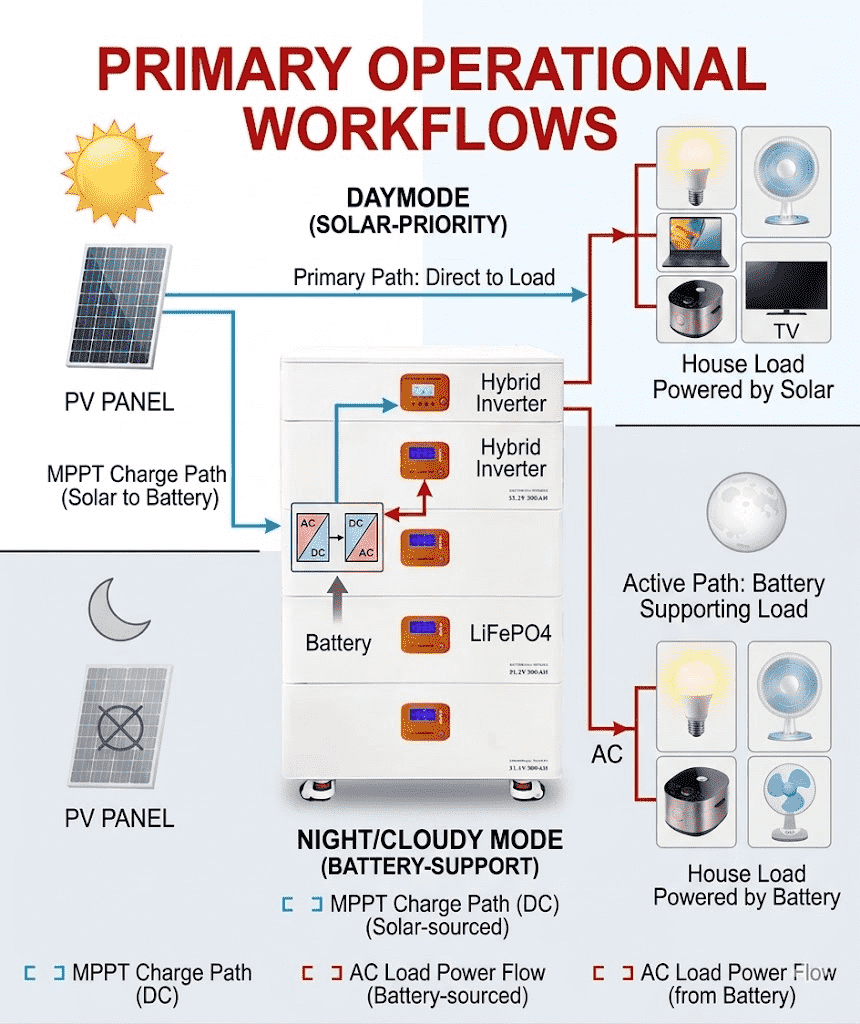
During the daytime, when sunlight is available, the system will prioritize supplying power directly to household appliances. If not all the electricity is used immediately, the remaining energy will then be used to charge the battery bank.
At night, when there is no sunlight and the solar panels stop generating electricity, the energy storage battery will take over and continue powering the home.
How Many Solar Panels Does a 5kW Off-Grid System Need?
It mainly depends on the wattage of the individual solar panels you choose. Here are two common installation scenarios in real life:
1. Fixed Detached Homes / Off-Grid Cabins
Installed on rooftops or on the ground, where space is usually relatively sufficient. The goal is to make the total solar panel power reach 5000W.
- If using 400W solar panels, the actual installation will require 12–13 panels.
- If using 450W solar panels, it will require 11–12 panels.
Reminder: Installing 12 mainstream residential solar panels requires approximately 240–260 square feet (about 23–25 square meters) of unobstructed space in total.
2. Heavy Off-Road RVs / Mobile Trailers
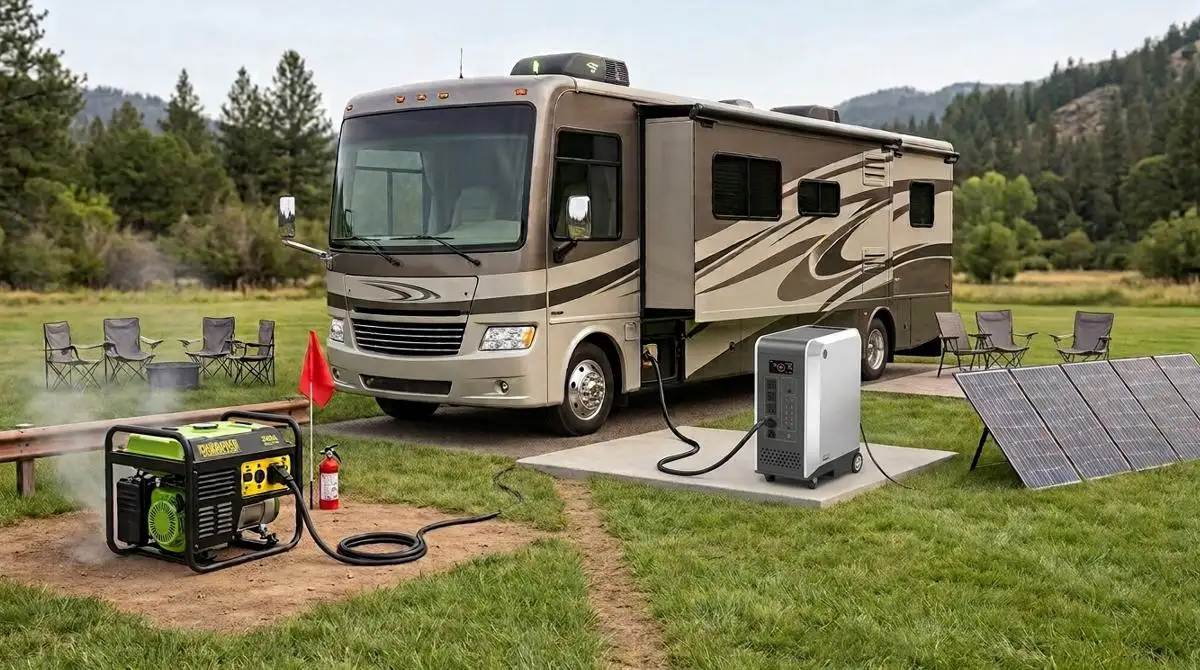
The roof area of an RV is very limited, and it is generally impossible to lay out 12 large residential solar panels flat on the roof. Therefore, a “5kW off-grid system” in an RV usually refers to equipping the vehicle with a 5000W high-power inverter and an ultra-large lithium battery bank to power appliances such as the RV air conditioner, microwave, or induction cooktop.
How Much Electricity Can a 5kW Solar System Generate Per Month?
First, we need to understand that a 5kw off grid solar power system refers to the system’s rated output power being 5kw.
Many people mistakenly assume that “a 5kw system = consistently generates 5 kWh of electricity per hour.” In reality, that is not the case at all.
The actual electricity generation is primarily determined by how many hours of usable sunlight your location receives each day.
| Country | Climate & Solar Conditions | Average Peak Sun Hours | Real Daily Output (kWh) | Real Monthly Output (kWh) | Real Annual Output (kWh) |
| UK | Typical temperate maritime climate with frequent cloudy and rainy weather | 3–4 hrs | 11–17 kWh | 330–510 kWh | 3960-6120 kWh |
| Spain | Southern European Mediterranean climate with abundant sunshine | 5–6 hrs | 22–28 kWh | 660–840 kWh | 8,030–10,220 kWh |
| Philippines | Tropical island climate with strong sunlight and high temperatures year-round | 5–5.5+ hrs | 22–27 kWh | 660–810 kWh | 8,030–9,855 kWh |
| Vietnam | Tropical monsoon climate, especially strong solar conditions in central and southern regions | 4.5–5.5 hrs | 20–26 kWh | 600–780 kWh | 7,300–9,500 kWh |
Note: Even though Southeast Asia is much hotter, its total yearly solar generation does not always significantly outperform southern European countries like Spain.
This is because solar panels have what’s called a “negative temperature coefficient.” Once panel temperatures rise above 25°C (77°F), efficiency typically drops by around 0.4% for every additional 1°C increase.
Spain’s dry Mediterranean climate offers cleaner sunlight, better airflow, and lower panel operating temperatures, which can actually result in higher real-world solar output.
As a result, many people run into a common issue: even though they purchased a “5kW system,” the actual amount of electricity that can be stored in the battery is far lower than expected.
This is because, during the process of converting solar energy into usable electricity, energy is lost at multiple stages through different hardware components.
Below is a table that shows where these energy losses occur:
| Hardware Stage | Source of Loss | Energy Conversion Efficiency | Remaining Usable Energy |
| Solar Panels | Ideal nameplate output under laboratory test conditions | 100% | 25.00 kWh |
| Heat Loss | High summer temperatures reduce panel efficiency | 92%–95% | 23.00–23.75 kWh |
| MPPT Controller | Internal heat and conversion losses inside the controller | 97%–98% | 22.31–23.28 kWh |
| Inverter | Energy loss when converting DC power into household AC power | 92%–97% | 19.50–21.90 kWh |
| Cable & Connections | Small resistance losses converted into heat | 97%–99% | 18.92–21.68 kWh |
| Final Output | — | 75%–87% | 18–22 kWh |
How Much Battery Storage Do You Need for a 5kW Off Grid Solar System?
For a typical 5kW off-grid solar system, the battery capacity mainly depends on daily energy consumption and how many days of backup power are required. A 5kW rating refers to the output power of the solar system’s inverter, which determines how many devices the system can run simultaneously; while battery capacity (kWh) determines how long those devices can continue operating. Therefore, they are not the same concept. Generally, for most households using a 5kW solar system, it is recommended to pair it with a 10kWh-15kWh LiFePO4 energy storage battery. This configuration can meet daily nighttime electricity needs and provide a certain amount of backup power during power outages or extended periods of cloudy and rainy weather.
How to Calculate Battery Capacity for a 5kW Solar System?
Calculation formula:
Battery capacity = (Daily energy consumption × Backup days) ÷ (Battery depth of discharge × Inverter efficiency)
Usable depth of discharge: LiFePO4 batteries are approximately 80%-90%, while lead-acid batteries are around 50%.
Inverter efficiency: Use 90% for calculation.
Daily energy consumption: This can be estimated by checking your electricity bill or by adding up the power ratings of all devices you plan to use and multiplying them by their operating time.
For example, if a household consumes 5kWh of electricity per day and wants two days of backup power, the required LiFePO4 battery capacity would be:
5kWh × 2 ÷ 90% ÷ 90% ≈ 12.3kWh
Therefore, this household would actually need a battery capacity of around 12-13kWh.
Recommended Battery Size for a 5kW Off Grid Solar System
For easier selection, you can refer to the following capacity recommendations:
| Usage Scenario | Daily Energy Consumption | 1-Day Backup | 2-Day Backup | 3-Day Backup | Recommended Battery Capacity |
| Small cabin, vacation home, low-power appliances | 5 kWh/day | 5.6-6.3 kWh | 11.1-12.5 kWh | 16.7-18.8 kWh | 5-12 kWh |
| Average home backup | 10 kWh/day | 11.1-12.5 kWh | 22.2-25 kWh | 33.3-37.5 kWh | 10-15 kWh |
| Full off-grid living | 15 kWh/day | 16.7-18.8 kWh | 33.3-37.5 kWh | 50-56.3 kWh | 15-30 kWh+ |
For most 5kW off-grid solar systems, a 10-15kWh LiFePO4 battery is a relatively balanced choice. If you want longer backup time, it is recommended to choose a battery configuration of 20kWh or more.

LiFePO4 vs Lead-Acid Battery Capacity
If using lead-acid batteries, a larger capacity configuration is required because lead-acid batteries are not suitable for deep discharge. To avoid over-discharging and reducing battery lifespan, they are generally recommended to use only around 50% of their capacity. In comparison, LiFePO4 batteries typically support 80%-90% depth of discharge.
For example, if a household requires 10kWh of usable energy, a LiFePO4 battery would need approximately 11-12kWh of capacity. However, with lead-acid batteries, the required capacity could be around 20kWh. Therefore, most off-grid solar systems today tend to use LiFePO4 batteries because they offer higher usable capacity, longer cycle life, and more stable performance.
What Can a 5kW Solar System Run?
A 5kW solar system can power most essential household appliances, including refrigerators, lights, WiFi routers, TVs, computers, and small kitchen appliances. When paired with enough battery storage, a 5kW off-grid solar system can also support higher-power devices such as washing machines, water pumps, and some air conditioners.
However, the actual appliances you can run depend on your inverter output power, battery capacity, solar generation, and daily energy consumption. A 5kW inverter determines how many devices can run at the same time, while the battery capacity determines how long they can continue operating.
| Appliance | Typical Power | 5kW Solar System |
| Refrigerator | 100-300W | ✅ Easily |
| Lights & WiFi | 10-50W | ✅ Easily |
| TV & Computers | 50-200W | ✅ Easily |
| Microwave / Rice Cooker | 800-1200W | ✅ Short periods |
| Washing Machine | 500-1500W | ✅ Usually |
| Air Conditioner | 1000-3000W | ⚠️ Depends on inverter size and battery capacity |
What Kind of Homes Is a 5kw Off Grid Solar Power System Suitable For?
We’ve also seen many people on online forums asking whether a 5kW solar system is suitable for their home.
In reality, every household faces different living conditions and energy needs, so the answer is not always the same.
| If Your Situation Looks Like This | Suitable? | Analysis |
| Energy-efficient cabins / RV living / emergency backup during outages | Suitable | After accounting for system losses, a 5kW system typically generates around 18–22kWh per day. When paired with a 10–15kWh battery bank, it can support basic daily living needs. |
| Cooking and hot water use gas, while heating relies on diesel or firewood instead of electric heating | Suitable | If you avoid high-power electric appliances such as electric water heaters and electric space heating, a 5kW solar system can usually handle normal daily electricity usage. |
| You understand appliance wattage and are comfortable shifting power usage throughout the day | Suitable | Off-grid living requires planning appliance usage carefully. It’s recommended to keep the total running load within 80% of the inverter’s rated capacity — around 4000W for a 5kW system. |
| Heating, hot water, drying, and cooking all rely on high-power electric appliances | Not Suitable | Electric water heaters alone often consume 4–5kW. Once multiple appliances run simultaneously, the system can quickly overload and trip protection. |
| Your home uses a large central air conditioning system that must maintain constant temperature 24/7 | Not Suitable | The startup surge of central AC systems often exceeds 10kW, which is beyond what a 5kW inverter system can safely handle. A higher-capacity system is recommended. |
| Your region may experience two weeks of little sunlight, with winter temperatures consistently below 0°C (32°F) | Not Suitable | During long rainy periods, solar generation may drop to only 2–3kWh per day, and LiFePO4 batteries generally cannot charge below freezing temperatures. A fuel generator backup becomes necessary. |
To put it simply, a 5kW system is more suitable for households that are conscious about managing their electricity usage.
If your home relies entirely on electricity for cooking, hot water, and heating, and you also need to run central air conditioning 24/7, then a 5kW system is generally not realistic. In such cases, you would likely need either grid support or a higher-capacity system to meet the household’s overall energy demand.
5kW Off Grid Solar System Cost in 2026
Installing a 5kW off-grid solar system mainly depends on the number of solar panels, inverter, battery capacity, installation method, and labor costs. Generally, in 2026, the price of a complete 5kW off-grid solar system typically ranges from $8,000 to $20,000.
Among all components, the battery is usually the most expensive part of the entire system:
- Basic system (5-10kWh battery): Approximately $8,000-$12,000, suitable for small homes, vacation cabins, or backup power use.
- Home backup system (10-15kWh battery): Approximately $12,000-$18,000, capable of meeting the daily electricity needs of most households.
- High-capacity off-grid system (20kWh+ battery): May exceed $20,000, suitable for long-term off-grid living or users who need to run more high-power appliances.
| Component | Estimated Cost |
| Solar panels (5kW) | $2,000-$4,000 |
| All-in-one energy storage system (battery + inverter + BMS+MPPT) | $5,000-$12,000+ |
| Installation & accessories | $2,000-$5,000 |
The cost of a 5kW off-grid solar system also depends on the type of energy storage solution. Traditional modular systems usually require separate batteries and inverters, while all-in-one energy storage systems like Piforz integrate the battery, inverter, and BMS into a single unit, making installation much simpler.
Important Considerations When Using a 5kW Off Grid Solar Power System
Many people, when they first come into contact with off-grid solar systems, naturally assume: “If I have a 5kW system, does that mean I can run 5kW worth of appliances at the same time without any problem?”
In reality, those who actually try this often end up experiencing a sudden overload trip. This is especially common in households with water pumps, air conditioners, or refrigerator compressors.
Below are some key precautions we’ve summarized based on years of factory testing and hands-on installation experience:
1. Don’t actually run the system at a full 5kW all the time
This is also where we often see people asking: “What is the 20% rule for solar panels?” It basically means the total household load should ideally be kept at around 80% of system capacity, leaving at least 20% as a safety buffer.
One of the most common beginner mistakes is seeing “5kW” and assuming the system can continuously and safely run at a full 5000W load. In reality, off-grid systems are best operated at around 70%–80% of capacity for long-term stability. This is because many household appliances draw a much higher surge power at startup.
For example, a water pump rated at 1500W may briefly spike to 4–5kW when it starts. If a microwave, air conditioner, or kettle happens to be running at the same time, the inverter can easily trigger an overload protection shutdown.
Even the first time I encountered this, I was confused: “The math says I’m not over the limit, so why did it trip?”
The answer is simple: startup surge power.
2. Battery capacity is often more important than solar panels
For off-grid systems, storage is often even more critical than PV panels. A common mistake is spending most of the budget on solar panels while underinvesting in batteries. This usually works fine in summer, but becomes a serious problem in winter.
In off-grid households, this situation is very common: once there are consecutive cloudy or rainy days, daytime generation drops while nighttime loads remain—refrigerator, router, lighting, phone charging, and sometimes fans still need power.
If the battery capacity is too small, it often cannot even last through one night. In particular, small systems with around 5kWh of storage can easily hit low-voltage protection by early morning during extended cloudy periods.
So instead of simply adding more solar panels, it is often more important to increase battery storage capacity.
For a 5kW system, we generally recommend a 10–15kWh battery bank.
Here’s a simple breakdown:
A 5kW solar array can theoretically generate up to 5 kWh per hour under strong sunlight. But at night or during continuous cloudy weather, solar production drops to zero.
A typical off-grid household (refrigerator, night LED lighting, Starlink router, phone charging, and a fan) usually consumes about 5–7 kWh per night.
If you only have a 5.12kWh battery, even a single cloudy day can push the system into low-voltage protection and shut it down.
With a 10.24–15.36kWh battery system (such as Piforz modular ESS stack), and reserving around 10% for protection, you still have roughly 9–13kWh usable capacity. This is enough to cover 1–2 consecutive cloudy or snowy days.
3. The most overlooked winter issue: low-temperature charging
Many first-time off-grid users focus only on how much energy the system can produce, while ignoring the battery’s limitations in winter—especially with LiFePO4 batteries.
Although LiFePO4 is safe and long-lasting, it has a very real limitation: it generally cannot be charged properly below 0°C.
Many users in colder regions are surprised the first time they experience this: “The sun is out, so why isn’t the battery charging?” The reason is that charging at low temperatures can cause lithium plating inside the battery. In severe cases, it can permanently damage the cells.
So if your cabin, RV, or off-grid home is located in a cold climate, battery thermal management or insulation is absolutely not something you can skip.