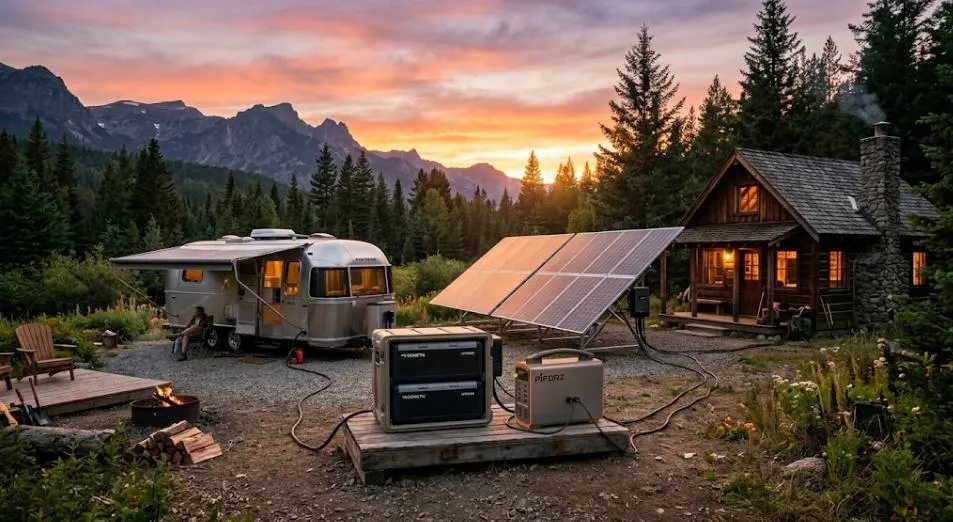
We mentioned the classification of solar systems in our previous article, but the most common way to classify them is still based on whether they are connected to the grid.
So this time, we’ll take a closer look at this classification and see which option best matches your home’s actual situation. Once you’ve considered factors such as how reliable the grid is, how high your electricity bills are, how much a power outage would affect you, and what your budget is, the right answer will naturally become clear.
On-Grid vs Off-Grid vs Hybrid Solar System: Quick Comparison
At the beginning of the article, let’s make a quick comparison of these three types of solar systems. There’s no need to dig into too many technical details—just take a look at the table below.
| Comparison | On-Grid System | Off-Grid System | Hybrid System |
| Grid Connection | Required | Not required | Required |
| Energy Storage Battery | Optional (usually not included) | Required | Required |
| Power During Outages | No | Yes | Yes |
| Upfront Cost | Low | High | Medium to high |
| Energy Independence | Low | High | Medium to high |
| Best For | Stable grid, reducing electricity bills | No grid access, complete energy self-sufficiency | Unstable grid, reducing electricity bills while having backup power |
| Main Purpose | Reduce electricity bills | Complete energy self-sufficiency | Reduce electricity bills + backup power during outages |
The differences in the table are clear, but keep one thing in mind: low upfront cost and high energy independence don’t come together. The lowest-cost option can’t provide backup power, while the options that can provide backup power all come with additional costs. Which one you choose ultimately depends on how much you’re willing to spend to keep your home powered during an outage.
Now, let’s take a closer look at the differences between them.
What’s the Difference Between On-Grid, Off-Grid, and Hybrid Solar System?
In fact, you can already see some of the differences from the equipment names and the table above. The key differences come down to where the electricity comes from, where it goes, and what happens when the grid goes down.
On-Grid System
Its core components include solar panels, an on-grid inverter, and a bidirectional meter. It has the fewest components and the simplest system, but the installation process is the most complicated.
Its operating logic is straightforward: the DC electricity generated by the solar panels is converted into AC electricity through the inverter to power household loads. Any electricity that is not used is sold to the grid, while any shortfall is purchased from the grid. The entire process follows one direction: PV → inverter → loads/grid. A battery is an optional component and may or may not be included. However, one key limitation is that once the grid goes down, the system will automatically shut down.
Therefore, this type of system is suitable for areas with a stable grid and very few power outages, where the primary goal is to reduce electricity bills rather than solve the problem of power outages. In areas with high electricity prices or net metering policies, this type of system can provide relatively straightforward economic returns.
Off-Grid System
Its core components include solar panels, an off-grid inverter, a battery bank, and a charge controller. This type of system has the most complete setup.
It has no connection to the grid at all. Its structure is PV panels → charge controller → battery → inverter → loads. During the day, solar power supplies the loads while also charging the battery, and at night, the battery discharges to provide power. Whether the grid is operating or not is irrelevant because all of its electricity is generated and used independently. But precisely because there is no grid to fall back on, the system must be sized based on the worst-case conditions. Consecutive cloudy or rainy days and shorter daylight hours in winter all need to be factored in ahead of time. A battery is absolutely essential—without one, there is effectively no power available at night or on cloudy days.
This type of system is suitable for remote areas without grid coverage or homes that deliberately choose to live completely off-grid. Users need to have a clear understanding of their electricity consumption, and the system must be designed with sufficient reserve capacity for the least favorable weather conditions.
Hybrid System
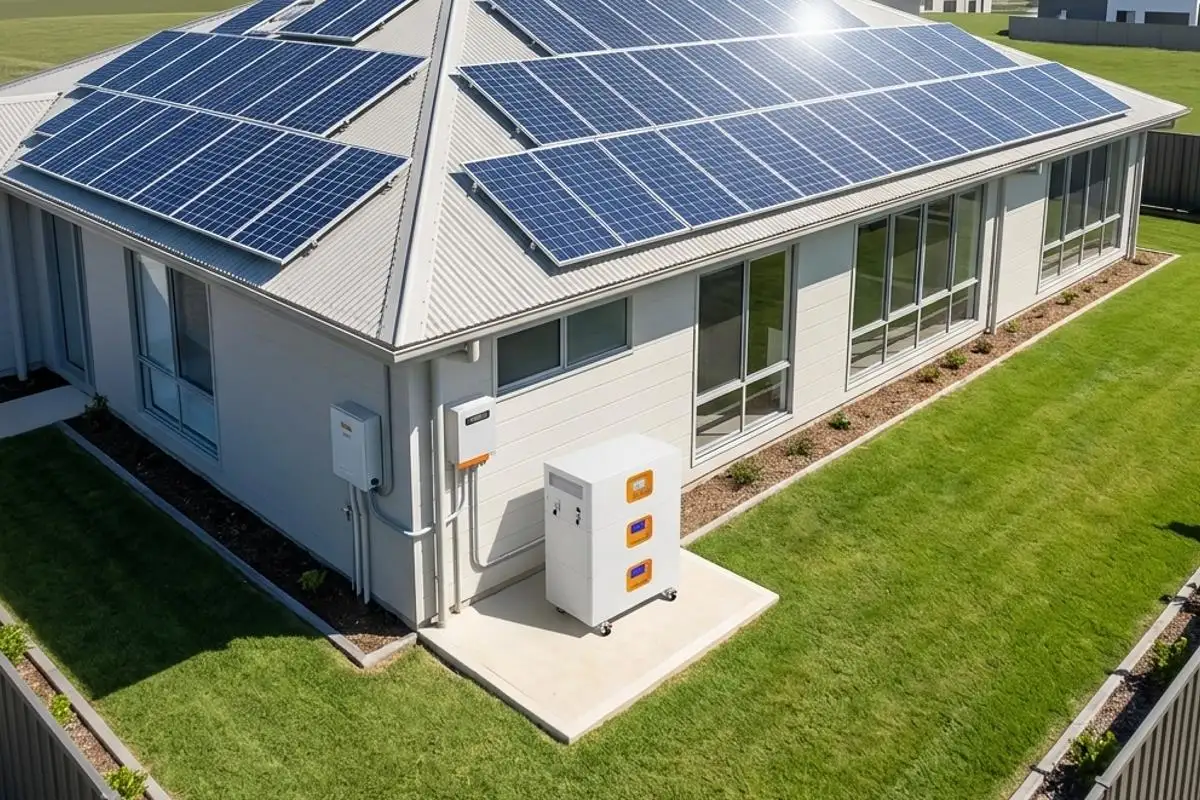
Its core components include solar panels, a hybrid inverter, and a battery bank. Some configurations may also retain the grid as a backup input, but during an outage, the battery and solar panels need to be able to independently support the household loads. Installation is more complicated than with an off-grid system.
It combines the features of the first two types. It is connected to the grid, equipped with batteries, and able to automatically switch between the two modes. When the grid is operating normally, it can work like an on-grid system, using solar power for household loads and sending excess electricity to the grid. When the grid goes down, it automatically switches to off-grid mode and draws power from the battery to continue supplying household loads.
It is suitable for areas where the grid is unstable but the power infrastructure is still adequate, where users want to reduce electricity bills with solar power while also having backup power during outages.
Piforz’s energy storage product line, although its inverters cannot feed electricity back into the grid, can still use grid electricity to charge the batteries.
Which Solar System Is Better for You?
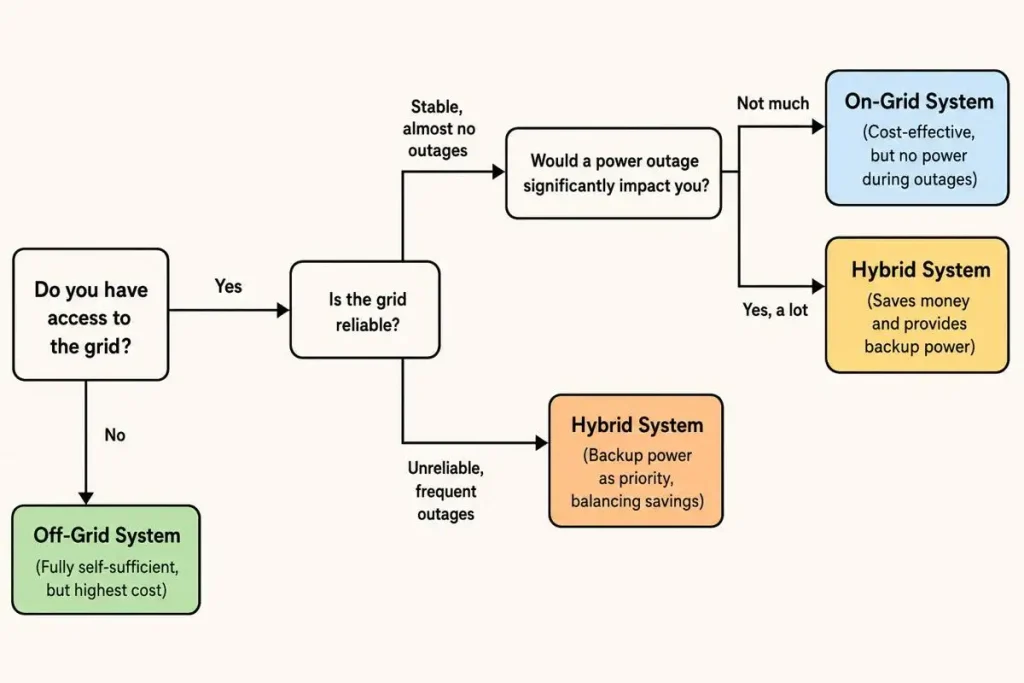
You don’t need to analyze too many parameters to answer this question. Simply answer the following three questions in order, and you’ll have your answer.
1. Is the grid stable where you live?
If you experience almost no power outages throughout the year, an on-grid system is probably all you need, and there’s no reason to spend extra money on a battery. If you experience several outages a year, sometimes lasting a few hours, both a hybrid system and an off-grid system can work. You can use solar power to reduce your electricity bills during normal operation and rely on the battery during outages.
If you don’t have access to the grid at all, or you are determined to completely disconnect from the grid and live independently, then choose an off-grid system. It is designed specifically for situations where there is no grid access.
2. How much would a power outage affect you?
This question directly determines whether you need to spend money on a battery. If you can live with a power outage—your food in the refrigerator isn’t a major concern, you don’t have anything in your aquarium that needs continuous heating, and losing your internet connection while working from home isn’t a big deal, then an on-grid system is enough, and there’s no need to spend extra on a battery.
But if you need to keep food in your refrigerator fresh, your aquarium cannot be left without power, someone in your home relies on medical equipment that requires continuous electricity, or you work from home and cannot afford to lose your internet connection, then a hybrid system is the minimum you should consider, and you need to size the battery capacity appropriately. The greater the impact of an outage, the more battery capacity you should keep in reserve.
3. How much are you willing to spend?
On-grid systems have the lowest upfront cost. They only require solar panels and an on-grid inverter, without the major expense of a battery, making them suitable for users with limited budgets or those who prioritize short-term returns.
Hybrid systems have a medium-to-high upfront cost because they require both a hybrid inverter and a battery, but they can cover both electricity bill savings and backup power needs. Off-grid systems have the highest upfront cost.
In addition to solar panels and batteries, they require larger energy storage capacity and a backup generator. From an upfront investment perspective, this is the most expensive option and is best suited to people who are willing to pay a premium for complete energy independence.
On-Grid vs Off-Grid Solar vs Hybrid: Cost Difference
On-grid and off-grid systems use different components, which naturally leads to differences in cost. Actual prices will vary depending on system capacity, installation conditions, equipment brands, and local labor costs. The price data in the table below is for reference only.
| Cost Item | On-Grid System | Off-Grid System | Hybrid System |
| Solar Panels | Required | Required (usually more) | Required |
| On-Grid Inverter | Required | Not required | Not required (replaced by a hybrid inverter) |
| Off-Grid Inverter | Not required | Required | Not required (replaced by a hybrid inverter) |
| Hybrid Inverter | Not required | Not required | Required |
| Charge Controller | Not required (integrated into the inverter) | Required (MPPT) | Not required (integrated into the inverter) |
| Battery Bank | Not required | Required (large capacity) | Required (capacity depends on backup power needs) |
| Bidirectional Meter | Required | Not required | Required |
| Backup Generator | Not required | Recommended | Optional (depending on backup power requirements) |
| Installation Complexity | Medium (complicated permitting process) | Medium to high (larger system size and longer installation time) | High (permitting + multi-device commissioning) |
| Total Upfront Cost | Low | Highest | Medium to high |
| Payback Period | Short (typically 5–8 years) | Longest (10+ years) | Medium to long (8–12 years) |
| Price Range | Approximately $10,000–$25,000 | Approximately $20,000–$50,000+ | Approximately $15,000–$40,000+ |
Why Does a Hybrid System Have a Shorter Payback Period Than an Off-Grid System?
For an off-grid system, both the solar PV and battery capacity need to be designed around the worst-case weather conditions. This results in the highest upfront investment. However, because there is no grid connection, there is no revenue from selling excess electricity. The entire investment is recovered through avoiding electricity bills, so the payback period is naturally the longest.
Although a hybrid system also includes batteries, its solar capacity can be designed based on average annual generation rather than the worst-case weather conditions. Fewer panels are needed, and the battery only needs to provide the required backup duration rather than support complete energy independence. As a result, the overall investment is significantly lower than that of an off-grid system. In addition, a hybrid system retains the ability to sell excess electricity to the grid, creating an additional revenue stream and allowing the investment to be recovered faster than with an off-grid system.
What Are the Drawbacks of On-Grid,Off-Grid Hybrid Solar System?
Each of the three systems has its own drawbacks, and there is no perfect solution. Understanding their disadvantages is often more important than knowing their advantages, because the drawbacks are what ultimately determine whether a system is right for you.
On-Grid System
The biggest problem is that it cannot provide power when the grid goes down. This is a limitation built into the design of an on-grid system. For safety reasons, the system automatically shuts down when the grid goes down. Even if the solar panels are still generating electricity, you cannot use that power because the inverter must prevent electricity from being fed back into the grid. So, even if the sun is shining and your solar panels are generating power during a daytime outage, you still cannot use it and have to wait for the grid to be restored.
In addition, without a battery, you cannot maximize self-consumption. Electricity generated by the solar panels either has to be used immediately or sold to the grid, while you still need to buy electricity from the grid at higher rates during peak hours at night. Finally, you are also dependent on the utility company’s grid-connection policies. If your local area eliminates net metering or reduces its compensation rate for electricity fed into the grid, you will need to recalculate the economics of the system.
Installation also requires connecting to the grid, installing a bidirectional meter, passing utility inspections, and obtaining grid interconnection approval, making the process considerably more complicated than with an off-grid system.
Off-Grid System
The drawbacks of an off-grid system are also obvious. The upfront investment is too high. Batteries and larger solar arrays make the cost significantly higher than that of an on-grid system. The system design is also more complex, requiring precise calculations of annual electricity consumption, solar generation, and battery capacity. If you size the system too small, you may not have enough power in winter; if you size it too large, you end up wasting money on unnecessary upfront investment.
Energy management also requires greater user involvement. Unlike an on-grid system, you cannot use electricity without limits. You need to develop the habit of monitoring your battery level and the weather. On cloudy days, you may need to conserve power, and during several consecutive days of rain, you may need to start the generator.
Hybrid System
A hybrid system may look like a compromise, but it has its own drawbacks. The first is cost. Compared with a pure on-grid system, it requires an additional investment in batteries, putting its overall cost in the medium-to-high range. It is considerably more expensive than an on-grid system, but the additional functionality can justify the price difference.
The system is also more complex than both on-grid and off-grid systems. A hybrid inverter integrates three functions—grid connection, off-grid operation, and battery management—so there are more components and more complicated wiring. Installation and commissioning take more time than with an on-grid system, and troubleshooting can also be more difficult when something goes wrong.
Another thing to keep in mind is that although a battery-based hybrid system can provide power during an outage, it cannot supply electricity indefinitely. The battery capacity determines how long it can keep your home running. If you want to power high-wattage appliances such as air conditioners or water pumps, you also need to make sure the inverter’s peak output is sufficient. If the system is not sized correctly, you may run out of power after only a few hours during an outage.
Conclusion
There is no absolute best option among on-grid, off-grid, and hybrid systems—only the option with the fewest compromises. Each system has its own limits and ideal use cases: on-grid systems are economical but cannot help during a power outage; off-grid systems offer energy independence but require the highest upfront investment and more day-to-day energy management; hybrid systems offer the most functionality but are also more complex to install and relatively expensive.
Ultimately, choosing a solar system is not a technical question—it’s a matter of trade-offs. No system can be cheap, independent, and hassle-free all at the same time. You can only choose the option you’re least likely to regret based on your grid conditions, electricity usage habits, and budget.