
Introduction:
Over the past four years in the energy storage industry, I have often heard many customers ask: Should I install more solar panels or add more energy storage batteries?
What I want to say is that for residential solar systems, it is not simply about adding more solar panels or adding more batteries. The right choice depends on how many solar panels you already have installed, how much electricity your household uses during the day, and the actual conditions of where you live.
Before you start reading, you can first check out the quick guide below:
| Your Situation | What You Need |
| No one is usually at home during the day, and electricity is mainly used at night | Add more batteries |
| Your household also requires a lot of electricity during the daytime | Add more solar panels |
| You live in an area with frequent power outages or expensive nighttime electricity rates | Add more batteries |
| Your current system is too small and does not generate enough power | Add more solar panels |
| Your existing system is large enough, but the battery storage is not enough for nighttime use | Add more batteries |
| Your household electricity demand increases | Consider both |
How Solar Panels and Batteries Work Together
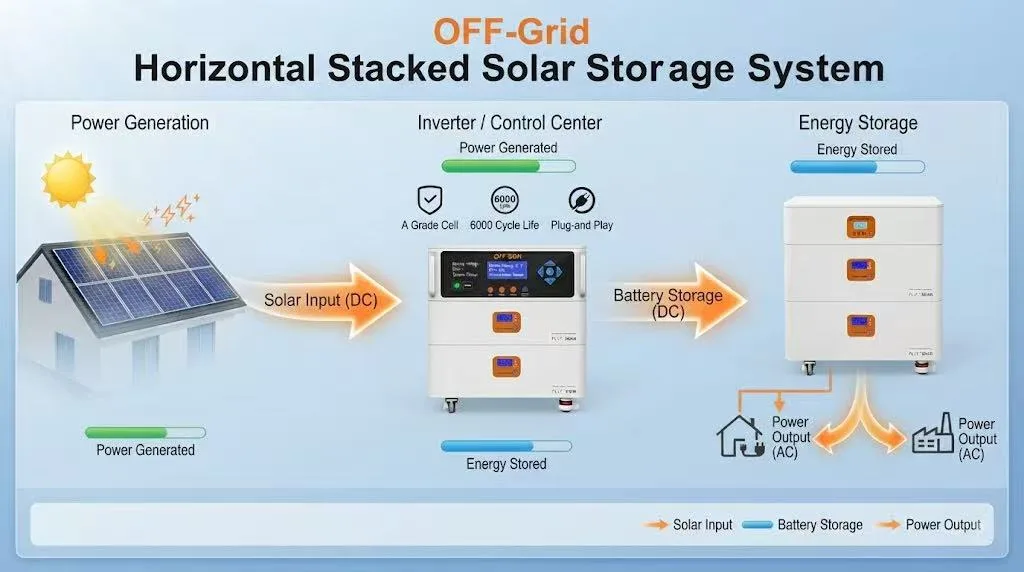
Solar panels are responsible for generating electricity. This electricity can be directly used by household appliances, but there is usually excess power that cannot be used immediately. In this case, the battery stores the surplus electricity and releases it at night or during cloudy and rainy days when the solar panels cannot generate enough power.
This relationship is actually similar to the relationship between a farm and a warehouse. The larger the farm, the more crops it can produce. Besides supplying people’s immediate needs, the extra crops need to be stored somewhere, which is the role of the warehouse. The larger the warehouse, the more crops it can store. This allows people to store food during harvest seasons and use it during periods when crops are not being produced.
However, if the farm is not large enough and cannot produce enough crops, even a huge warehouse will not be very useful. Similarly, if the warehouse capacity is too small, expanding the farm and increasing production will be wasted because there is nowhere to store the extra output.
So, between solar panels and batteries, which one should have a higher priority?
More Solar Panels vs More Batteries: Which Should You Add First?
A research team from the University of Adelaide analyzed two years of real household electricity consumption data from South Australia and found that the trade-off between adding more solar panels and installing more batteries depends on how much solar PV capacity you already have. In other words, if your battery is usually almost fully depleted before sunrise, adding more battery capacity may be your higher priority. However, if your battery cannot be fully charged because your solar panels do not generate enough electricity, then adding more solar panels should be your higher priority.
Let’s compare the differences between adding more solar panels and adding more batteries:
· More Solar Panels: Increase the power generation capability of the solar system, allowing it to capture more solar energy during the daytime and generate more electricity.
· More Batteries: Increase energy storage capacity, allowing you to use more stored electricity at night, during cloudy weather, or during power outages.
| Add More Solar Panels | Add More Batteries | |
| Main Purpose: | Generate more electricity | Store more electricity |
| Problem Solved: | Insufficient daytime power generation | Insufficient stored energy |
| Best For: | High daytime electricity demand | High nighttime or backup power demand |
| During cloudy weather: | Improves charging capability | Relies on existing stored energy |
| Role at night: | Limited | Provides continuous power supply |
| Power outage backup capability: | Limited improvement | Significant improvement |
Simply put: solar panels solve the problem of generating electricity, while batteries solve the problem of when that electricity can be used.
If your system does not generate enough electricity, adding more batteries will not solve the fundamental problem. If your system already generates enough electricity but cannot store and use it flexibly, then increasing battery capacity becomes the main priority.
When Should You Choose More Solar Panels?
1. The battery capacity is sufficient but it is frequently not fully charged
For example, your home originally had a 5kWh battery, and later you expanded it to 10kWh. However, your solar system can only generate an average of 8kWh per day. After the household appliances consume electricity during the daytime, only around 4-5kWh may actually be stored into the battery. As a result, the new battery you paid for may have very few opportunities to be fully utilized over the long term. Expanding the battery may actually reduce the overall battery utilization rate.
In this situation, adding more solar panels is needed to solve the root problem.
There is one point that is easy to confuse: you need to consider which season the battery cannot be fully charged. During winter, a battery not reaching full charge does not necessarily mean there are not enough solar panels. It could also be caused by shorter daylight hours or lower solar angles. However, if the battery frequently fails to reach full charge during spring, summer, and autumn as well, it means the solar system is not generating enough electricity, and adding more solar panels would be the better solution.
2. Solar generation is not enough to cover household electricity demand
This situation is different from the first one. For example, your home has a 5kW solar system that generates 25kWh of electricity per day, but your household consumes 30kWh per day. In this case, even adding a much larger battery will not solve the problem because there are only 25kWh of electricity available to store at most. Therefore, increasing solar panel capacity should be the priority.
3. High daytime electricity demand
If you and your family are frequently at home during the day for activities or work, and you also have high-power loads such as an electric vehicle charger, air conditioning, or heat pump running, your daytime electricity demand can be very high. In this case, using solar energy directly to power these appliances is more efficient and cost-effective.
However, when more loads directly consume solar power during the day, the solar panels have greater pressure because they need to both supply daytime electricity demand and provide additional energy to charge the battery for nighttime use or emergencies.
Therefore, increasing solar panel capacity becomes very important. The goal is to ensure that the system can cover daytime electricity consumption while still generating enough excess power to store for nighttime or other periods.
4. There is available space on a west-facing roof
When installing solar panels, many homeowners prioritize south-facing roofs, which makes sense because south-facing roofs usually receive the most sunlight and provide better energy production from morning to afternoon.
However, west-facing roofs can also receive strong sunlight during the afternoon and evening. Since electricity prices during the evening peak period are often not cheap, adding solar panels on a west-facing roof can generate electricity at the time when it is most needed. Although the total energy production may be slightly lower, it can improve solar energy utilization efficiency.
If your household electricity consumption is especially high between 5:00 PM and 9:00 PM, adding west-facing solar panels can be a good choice.
Why More Solar Panels Are Not Always Better
More solar panels are not always better. Installing too many panels may not only waste money but also fail to generate additional usable electricity if the system exceeds the equipment limits. The most cost-effective solution is to install enough solar capacity to match your household’s actual electricity needs.
Inverter has a solar input limit:
Every inverter has a maximum solar input power limit. When the total power rating of the solar panels significantly exceeds the inverter’s capacity, the excess electricity cannot be converted and used.
Battery already fills early in the day:
If the solar system is oversized, the battery may become fully charged very quickly during the daytime. Once the battery is full, any excess electricity must either be sold back to the grid at a low rate or simply be wasted if the grid does not allow energy export.
Household daytime consumption is low:
The best way to use solar energy is to consume it directly. However, if household electricity demand is low during the daytime, most of the electricity generated by the solar panels cannot be used immediately. It may only be sold back to the grid at a lower price, or wasted entirely if grid export is not available.
Should I store excess solar or sell it to the grid?
In most cases, storing solar energy and using it yourself is more valuable than selling it back to the grid. This is because the compensation rates for exported electricity have dropped significantly over the past few years.
Take California as an example. During the NEM 2.0 era, homeowners could sell electricity back to the grid at around $0.25-$0.35/kWh. If you exported 20kWh per day, you could earn around $5-$7 per day.
After NEM 3.0, the export compensation rate dropped to only around $0.05-$0.08/kWh. The same 20kWh of exported electricity would only earn around $1-$1.60 per day—a reduction of approximately 75%.
Today, instead of selling electricity generated during the day for only $0.05-$0.08/kWh, you can store it in a battery and use it at night when electricity prices may reach $0.40-$0.70/kWh. Assuming the same 20kWh of electricity, selling it back to the grid would earn only $1-$1.60, while storing and using it yourself could save around $8-$14 in electricity costs.
Based on this comparison, which option do you think provides more value?
If we ask when selling electricity back to the grid is still worthwhile, there is only one situation: when your area still has 1:1 net metering, meaning the price you receive for exported electricity is equal to the price you pay for electricity from the grid. In this case, you do not necessarily need to purchase an additional battery to store solar energy for nighttime use.
When Should You Choose More Batteries?
1. High nighttime electricity consumption and the battery is frequently depleted
If your solar panels fully charge the battery during the day, but the stored energy is completely used up at night and still cannot meet your needs—for example, you run the air conditioner while sleeping and find that the battery runs out of power before morning—this indicates that the battery capacity is insufficient. The stored energy is not enough to support your household until the next day. In this situation, increasing battery capacity is the most direct solution.
2. Excess solar power generation during the daytime
If your solar panels generate a large amount of electricity, after powering your household appliances during the day, you should check whether the battery becomes fully charged. If there is still a significant amount of excess electricity after the battery is full, you need to consider how to use this extra energy.
You may wonder: Can excess electricity be sold back to the grid? The answer depends on your local grid export policy and compensation rate.
If your local grid allows your system to export electricity and the compensation rate is attractive, you can choose to sell the excess power back to the grid.
However, if the grid buyback rate is low or exporting electricity is not supported at all, adding more batteries to store this excess energy and use it yourself at night may provide more value than simply adding more solar panels.
3. You need long-duration backup power during extended outages
A solar-only system will automatically shut down during a power outage. This is a safety requirement designed to prevent electricity from being sent back into the grid and potentially endangering utility workers performing repairs.
Therefore, if you want your refrigerator to keep running, your WiFi to remain connected, or medical devices such as ventilators to continue operating during a power outage, you need batteries to provide long-term backup power. In this situation, preparing a larger-capacity battery system at home is necessary.
Why Is a Bigger Battery Not Always Better?
Some people may think that a larger battery capacity is always better. The larger the capacity, the more electricity it can store and the longer it can provide backup power. This is true, but only if your solar panels generate enough electricity to fully charge the larger battery. If solar generation is insufficient and a large-capacity battery remains mostly unused for long periods, that capacity is essentially being wasted.
The investment and return do not match: Energy storage batteries are not cheap and are often the most expensive component of the entire system. If you spend a large amount of money on a battery but can only make limited use of its capacity, the payback period will become much longer. In that case, choosing a smaller battery may be a better option.
The battery remains undercharged for long periods: If the battery system continuously operates in a partially charged state and undergoes repeated shallow charge and discharge cycles, the BMS may gradually have difficulty accurately estimating the remaining battery capacity.
Can You Expand Solar Panels and Batteries at the Same Time?
Yes, you can add both solar panels and batteries at the same time, but the prerequisite is that your home’s solar generation and energy storage capacity are both clearly insufficient. For example, your solar panels cannot generate enough electricity to meet daytime consumption, and even when the battery is fully charged, it still cannot provide power until the next morning.
In this situation, it is necessary to increase both solar panel capacity and battery capacity.
What Conditions Are Required to Expand Both Solar Panels and Batteries at the Same Time?
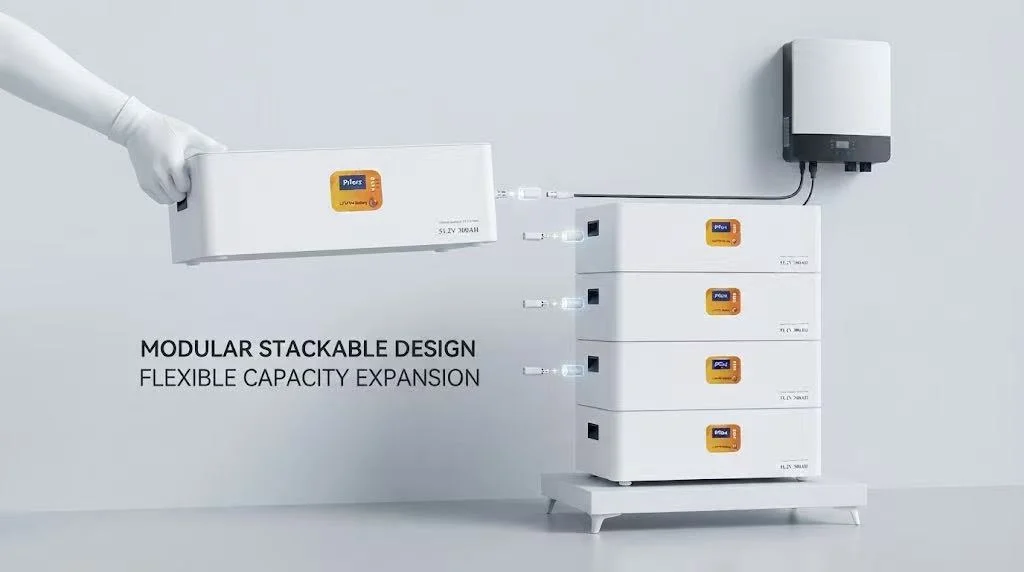
① The energy storage battery must support modular expansion
When expanding the capacity of an energy storage battery, the existing inverter must support battery parallel connection. If your original energy storage system was designed with expansion capability, you can simply purchase additional batteries of the same brand and model for capacity expansion.
However, if the inverter does not support parallel battery expansion, you may need to replace the main unit.
② The inverter’s input power must be greater than the total solar panel power
When considering expanding both solar panels and batteries at the same time, the inverter’s maximum input power is one of the most commonly overlooked factors.
Inverters have a maximum DC input power limit. For example, with Piforz’s 15kWh all-in-one energy storage system, after expanding the battery capacity by another 15kWh, the original inverter has a maximum PV input power of 10kW. This means that after adding new solar panels, the total solar panel power cannot exceed 10kW. If it exceeds this limit, the inverter must be upgraded first.
③ The electrical panel must comply with the 120% rule
Every home has an electrical panel, which works like the main power distribution point. All electricity flows through this panel. Adding more solar generation capacity and energy storage batteries means connecting more current to the electrical system.
The 120% rule in the National Electrical Code (NEC) states that the combined input current from solar and battery systems cannot exceed 120% of the electrical panel’s rated capacity.
In other words, your home electrical panel has a limit on how much additional current it can handle. For example, if your electrical panel is rated for 100A, the total current from all additional power sources cannot exceed 120A. If the limit is exceeded, you may need to upgrade your main electrical panel, which can be a significant additional cost.
How Much Battery Storage Do You Need?
The choice of battery storage capacity mainly depends on which appliances you need to keep running during a power outage and how long you want them to operate.
For example, suppose you need to power the following devices during an outage: a refrigerator (about 150W), WiFi (about 15W), lighting (about 40W), and phone charging (about 20W). The combined power consumption of these essential devices is about 225W. If you want them to run for 10 hours, the theoretical energy requirement would be 225W × 10h = 2.25kWh. Assuming an 80% usable depth of discharge for a LiFePO4 battery and adding around 10% for inverter losses, the actual required battery capacity would be around 3-4kWh. Therefore, a 5kWh battery would be sufficient for this household.
However, if your home also needs to power a water pump, electric heater, medical equipment, or you need to cover a prolonged outage lasting 2-3 days, then a 15-20kWh or larger battery may be necessary. For more details on how long a battery can power household appliances, see our other article, “How Long Does a Battery Backup Last When the Power Goes Out?“
However, there is one important prerequisite: the battery capacity must be properly matched to your solar system’s power generation. If your solar panels do not generate enough electricity each day to fully charge the battery, then even a larger battery will simply sit underutilized.
Next, let’s take a look at how large a solar system you need to meet your household’s energy needs!
How Much Solar Capacity Do You Need?
The logic for choosing solar capacity is different from that for choosing battery capacity. What you need is a system that can generate enough electricity each day. This mainly depends on how much electricity your household uses per day, how many hours of effective sunlight your location receives each day, and system losses.
For more details about the sources of energy losses during solar power generation, see our other article: “Will a 5kw Off Grid Solar Power System Run a House? Everything You Need to Know Before Going Off-Grid“
Suppose your household uses 30kWh of electricity per day, your location receives an average of 5 hours of peak sunlight per day, and the overall system efficiency is estimated at 80%. The required solar capacity would be 30 ÷ 5 ÷ 0.8 ≈ 7.5kW. In other words, a 7.5-8kW solar system could theoretically cover your household’s daily electricity consumption. After the electricity generated by the solar panels is used directly by household appliances during the day, the remaining excess electricity needs to be stored in an appropriately sized battery.
In addition to household electricity consumption, there are several other factors to consider when deciding how many solar panels to install:
As mentioned earlier, if you can sell excess electricity back to the grid at a good rate (such as with 1:1 net metering), you may choose to install more solar panels and sell the excess electricity to the grid. If the compensation for exported electricity is so low that it is almost negligible (such as in areas under NEM 3.0), storing the excess electricity in a battery and using it yourself can be more cost-effective.
In addition, when choosing your solar system capacity, you should also follow the 20% rule for solar panels.
What Is the 20% Rule for Solar Panels?
The 20% solar panel rule means that when designing a solar system, it is recommended to configure the system’s electricity generation capacity to be around 20% higher than the household’s average electricity consumption.
Why? Because this additional 20% provides a buffer to deal with the following factors:
Handling weather and seasonal changes:
Solar panel output decreases during cloudy or rainy days, as well as in winter when daylight hours are shorter. A 20% energy margin helps ensure that your home still has enough electricity available when sunlight conditions are not ideal. This is especially important during periods of high energy demand, such as running air conditioning in summer or heating systems in winter.
Compensating for system losses:
From solar generation to actual electricity usage in your home, energy is lost through components such as cables and inverters. Reserving an additional 20% capacity helps compensate for these hidden energy losses.
Preparing for future energy needs:
Your household may add an electric vehicle, heat pump, or new appliances in the future. This 20% extra capacity allows the solar system to remain sufficient for the next several years, avoiding the need for costly upgrades in the short term.
More Panels vs More Batteries: Which Is Better in 2026?
If your home does not generate enough solar electricity to cover your daytime appliance usage, then you should add more solar panels.
If your solar system generates enough electricity to cover your daily consumption, but the battery is frequently depleted before morning and you still need to rely on grid power at night, then increasing your battery capacity should be the priority.
If both your solar generation and battery capacity are insufficient, then you should expand both at the same time.
In 2026, selling excess electricity back to the grid is becoming less valuable, electricity prices are rising, and natural disasters are causing more frequent power outages. If your solar system can already cover your household’s daytime electricity consumption, I think you should further consider whether buying electricity at night or selling electricity during the day is actually worthwhile. If the economics do not make sense, a battery may provide greater value for your home.
A battery allows you to store excess solar energy generated during the day and use it at night or during a power outage. It can help you avoid expensive peak-hour electricity rates while also providing backup power when the grid goes down.