
If you’re looking to find out how long it takes to charge a battery with solar, and you see those answers that give you a specific time right off the bat with no prerequisites – like “6–8 hours” or “2–8 hours” – with such a big gap, do you really believe them?
Actually, the reason they give a direct answer isn’t because they can calculate your specific situation, but because they assume a most common typical scenario as a reference case. And that “6–8 hours” or “2–8 hours” is just a theoretical estimate under a specific combination, not a universal conclusion that applies to everyone. So how many hours do you need? Please read on.
How Long Does It Take to Charge a Lithium Battery with Solar?
Using solar to charge a lithium battery might take just a few hours, or it might take two or three days. That may sound exaggerated, but it’s the reality, and it’s actually very common in solar charging scenarios. If the battery capacity is small and the solar panel power is ample, it only takes a few hours. But if the panel power is too low, the weather is too poor, or the final stretch of charging is slow – if any one of these hits, the day’s generation won’t be enough, and you’ll have to drag it into the next day or even the third day to finish charging.
Take a common 12.8V 100Ah LiFePO₄ battery as an example. If charging from empty to full, paired with a 400W solar array, it can usually be completed within one day under clear weather; with a 200W solar array, it typically takes about 1–2 sunny days; with only a 100W solar panel, it really may take about 3 sunny days.
Typical Charging Times
The reason there’s no fixed answer is that there are many factors affecting solar charging, mainly these three basics: battery capacity, solar power, and actual sunlight conditions.
Battery capacity is usually expressed in Ah, while solar panel power is in W, and they can’t be directly divided. Before calculating charging time, you need to convert battery capacity into Wh: Battery energy (Wh) = Battery voltage (V) × Battery capacity (Ah)
Generally, when calculating solar charging time, we use this more theoretical formula:
Ideal charging time = Energy to be replenished (Wh) ÷ Solar array power (W)
But in reality, we all know there will be some margin of error. Panel temperature, installation angle, shading, wiring losses, and the charge controller all reduce actual input. So there’s also a more practical estimation method: Actual peak sun hours ≈ Energy to be replenished ÷ (Solar array power × combined efficiency)
The following table selects some common lithium batteries in our daily life – 12.8V 50Ah, 100Ah, and 200Ah – and compares them with 100W, 200W, and 400W solar arrays. You can use this as a reference:
| Battery Spec | Battery Energy | Solar Array | Ideal Peak Sun Hours | Estimate at 80% Efficiency | Estimate at 5 Peak Sun Hours per Day |
| 12.8V 50Ah | 640Wh | 100W | 6.4 hours | about 8 hours | about 1.6 sunny days |
| 12.8V 100Ah | 1,280Wh | 100W | 12.8 hours | about 16 hours | about 3.2 sunny days |
| 12.8V 100Ah | 1,280Wh | 200W | 6.4 hours | about 8 hours | about 1.6 sunny days |
| 12.8V 100Ah | 1,280Wh | 400W | 3.2 hours | about 4 hours | can be done on the same sunny day |
| 12.8V 200Ah | 2,560Wh | 200W | 12.8 hours | about 16 hours | about 3.2 sunny days |
| 12.8V 200Ah | 2,560Wh | 400W | 6.4 hours | about 8 hours | about 1.6 sunny days |
Peak Sun Hours vs. Actual Charging Time
Another point that many people easily misunderstand is Peak Sun Hours and Actual Charging Time.
Peak Sun Hours is a theoretical calculated value. It refers to the equivalent number of hours under standard test conditions (1000W/m²) when you “compress” the total solar radiation that varies throughout the day.
Actual Charging Time refers to the number of days that pass on the clock from the moment you put your solar panels outside until the battery is truly fully charged.
Why the Calculated Hours May Take More Than One Day
The reason these two are easily confused is, on one hand, that they are both in hours, and on the other hand, a more main reason is that people subconsciously swap the concepts. Most people see that Peak Sun Hours need 6 hours, and their first thought is that from 10 a.m. to 4 p.m., the sun hangs in the sky for 6 hours. But in reality, those 6 hours are the result of converting the whole day’s fluctuating sunlight into the same standard intensity. In practice, the sun might shine for 10 hours, but the time that actually reaches standard intensity only adds up to 6 hours. When you use those 6 hours to estimate actual charging time, you mistakenly think there will be 6 hours of strong sun today, only to find it’s not fully charged, and you start wondering if your calculation is wrong – but actually, you’ve mixed up total daylight hours with peak equivalent hours. And this is also the main reason why you calculated that it might only take a few hours to charge, but after a whole day in the sun it still isn’t full.
Of course, besides this point, there are other real-world factors that also lengthen charging time:
- Very low output at dawn and dusk: Generally, in the hours just after sunrise and before sunset, the actual output of solar panels may only be 10%–30% of the rated power. These two time periods contribute the least to solar charging.
- Shading from clouds, tree shadows, dust: Shading certainly affects solar panel absorption, and this effect is often not a uniform reduction but a sudden drop. So, when charging, always choose an open, unshaded location.
- High temperature reduces panel efficiency: Many people may think that the hotter and sunnier it is, the better the generation. But actually, solar panels hate heat; they prefer clear, cool weather. Solar panels are most efficient at 25°C. For every 1°C increase in surface temperature, output power drops by about 0.3%–0.5%. In summer under direct sun, panel surface temperatures can exceed 60°C, and the impact is self-evident.
Understanding the Difference Between Estimated and Actual Charging Time
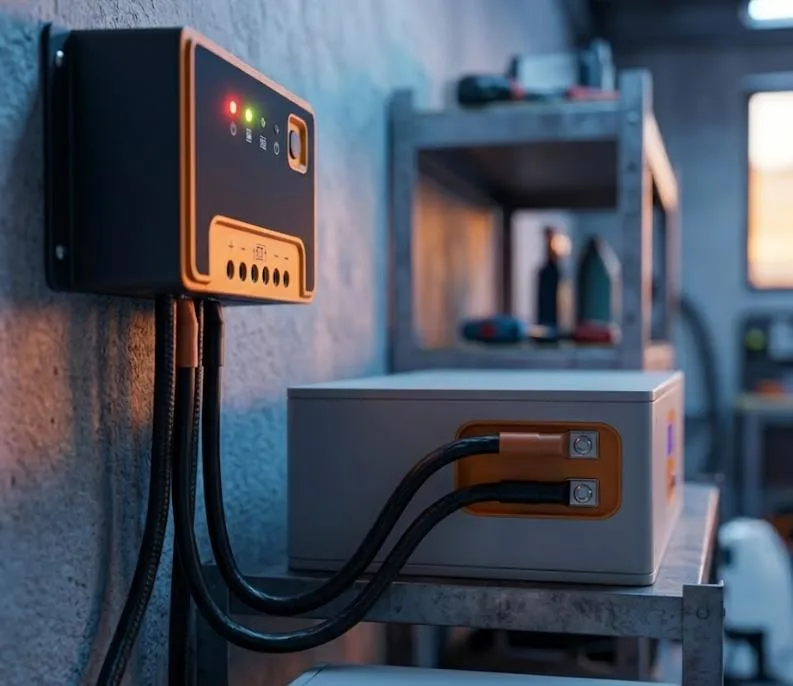
As we said earlier, solar charging time cannot be predicted with complete accuracy by formula because the actual charging process is affected by factors such as weather, temperature, installation angle, system losses, and battery management strategies. So purely theoretical calculations will generally differ from real charging times.
But calculations are still very valuable; otherwise, there wouldn’t be so many related calculators. Through calculation, we can get an estimated range that is close to the actual situation, helping to determine whether the solar panel power is sufficient, whether the battery capacity is matched, and roughly how many sunny days the system needs to complete charging.
In ideal conditions, theoretical results can be close to actual charging times. But in real environments, solar systems usually need extra time reserved:
| Battery Spec | Battery Energy | Solar Array | Ideal Peak Sun Hours | Estimate at 80% Efficiency | Estimate at 5 Peak Sun Hours per Day |
| 12.8V 50Ah | 640Wh | 100W | 6.4 hours | about 8 hours | about 1.6 sunny days |
| 12.8V 100Ah | 1,280Wh | 100W | 12.8 hours | about 16 hours | about 3.2 sunny days |
| 12.8V 100Ah | 1,280Wh | 200W | 6.4 hours | about 8 hours | about 1.6 sunny days |
| 12.8V 100Ah | 1,280Wh | 400W | 3.2 hours | about 4 hours | can be done on the same sunny day |
| 12.8V 200Ah | 2,560Wh | 200W | 12.8 hours | about 16 hours | about 3.2 sunny days |
| 12.8V 200Ah | 2,560Wh | 400W | 6.4 hours | about 8 hours | about 1.6 sunny days |
Why Real Charging Time Is Often Longer
So why is actual charging often slower than expected? This is a common phenomenon almost every solar charging user has encountered, and it’s determined by the battery’s physical characteristics and the complex protection mechanisms of the charging system.
Besides the factors we mentioned earlier – low output at dawn and dusk, shading, and heat-induced derating – there are also controller conversion losses and the forced slowdown near the end of charging.
- Controller conversion losses
We all know that the electricity generated by solar panels is low-voltage DC, which must go through a controller to charge the battery, and there are energy losses in between. There are two types of controllers: PWM and MPPT.
PWM controllers are relatively cheaper, but they work like a straight-through faucet – either fully on or fully off. Their efficiency is usually between 75%–85%, so 15%–25% of the electricity may be wasted.
MPPT is more advanced; it automatically adjusts and tracks. Its efficiency can reach 90%–95%, but there is still 5%–10% loss.
- Forced slowdown in the later stage of charging
When the battery has very little charge left, it charges quickly because there’s not much inside, so the system lets it charge freely. It’s like a sponge that’s completely dry – if you pour a basin of water on it, the water soaks in quickly. That’s high-current fast charging.
But when the charge level reaches above 85%, the Battery Management System (BMS), to protect the battery, actively forces the charging current to reduce and enters constant-voltage absorption/float charging. The last 15% of capacity may fill at only one-third the speed of the earlier stage, and the time is significantly extended.
It’s like the surface of the sponge is already wet, and only a small inner part remains to be filled, so naturally the speed slows down – and it slows down to protect battery safety and extend its lifespan.
What Size Solar Panel Do You Need?
We know that different solar panel powers yield different charging speeds. But bigger isn’t always better; it needs to match the battery capacity you’re charging.
Solar Panel Size for 50Ah, 100Ah, and 200Ah Batteries
These capacities are common on the market, and you can use them as a reference to determine what size solar panel you need.
Of course, this table is based on certain data as reference; real times will vary.
The following data is based on: 12.8V LiFePO₄ battery, charging from 20% to 100% state of charge, 5 peak sun hours per day, system combined efficiency of about 80%, and no additional load consumption during charging.
| Battery Capacity | Stored Energy (approx.) | Solar Panel Needed for ~1 Day Full Charge | Solar Panel Needed for ~2 Days Full Charge |
| 50Ah LiFePO₄ | 640Wh | about 150W | 75–100W |
| 100Ah LiFePO₄ | 1280Wh | about 300W | 150–200W |
| 200Ah LiFePO₄ | 2560Wh | about 500–600W | about 300W |
Include Daily Loads When Sizing the Panel
Of course, besides calculations from formulas, many users also choose solar panels based on common combinations. Here are some typical pairings found in real applications:
- 25W solar panel + 100Ah battery
A 25W panel has low output and is suitable for long-term battery maintenance, such as preventing self-discharge during storage.
But if you need to fully charge a 100Ah battery, a 25W panel will typically take many days, so it may not be suitable as a daily primary charging solution.
- 100W solar panel + 100Ah battery
This is a fairly common small solar system combo. In good weather, a 100W panel usually takes about 2–3 sunny days to fully charge a low 100Ah battery, suitable for camping, small off-grid devices, and other low-power applications.
- 200W solar panel + 100Ah battery
Compared to the 100W option, a 200W panel provides higher charging speed. With sufficient sunlight, it can typically replenish a 100Ah battery in about 1–2 days, making it a more balanced choice.
- 300W solar panel + 200Ah battery
A 200Ah battery stores about twice the energy of a 100Ah battery, so it needs more solar input. A 300W panel can meet some application needs, but if you want to replenish quickly every day, you may need a larger solar array.
- 500W solar panel + 100Ah battery
A larger solar panel doesn’t necessarily mean unlimited charging speed improvement. For example, a 500W panel can theoretically provide a lot of input, but actual charging speed is also limited by the solar charge controller and the battery’s maximum charging current, so you need to confirm the entire system is compatible.
Also, when choosing solar panels, you can’t only consider how much power is needed to charge the battery; you may also need to consider simultaneously powering devices running during the day.
Is It Safe to Charge a Lithium Battery with Solar?
As long as solar panels are used correctly, it is safe to charge lithium batteries. Generally, solar panels cannot be directly connected to a battery because the voltage and current from the panels are unregulated and may exceed the battery’s safe range, causing overcharging, overheating, or permanent damage. You need a solar charge controller to regulate voltage and current to ensure the battery works properly.
The following points must be noted during charging:
1. Use a compatible charge controller
The voltage and current from solar panels vary with light conditions. If directly connected to a lithium battery, it may cause overcharge or damage. So you need to use an MPPT or PWM controller suitable for lithium batteries and set the correct charging parameters.
2. Ensure the battery has a BMS protection system
Most batteries, especially those in home storage systems, have a built-in BMS. It monitors voltage, current, and temperature, and cuts off charging/discharging under abnormal conditions to improve safety.
3. Avoid charging at low temperatures
Lithium batteries are not tolerant of low temperatures. Many LiFePO₄ batteries risk lithium plating when charging below 0°C, which over time can lead to capacity loss or even safety issues. If using in cold regions, choose batteries with low-temperature protection or heating features.
4. System parameters need to match
Before charging with solar, carefully confirm whether the solar panel voltage is within the controller’s input range, whether the controller output voltage matches the battery voltage, and whether the maximum charging current exceeds the battery’s allowable range – these small details matter.
Solar panels, when used correctly, can safely charge lithium batteries, and they are currently a very common charging method in home storage, RVs, camping, and off-grid systems. The key is not whether solar itself is safe, but whether the solar panels, charge controller, battery BMS, and system parameters are correctly matched with each other.