
According to data from the U.S. Energy Information Administration, the average U.S. household uses about 10,300 to 10,500 kWh of electricity per year. Converting that into solar terms, you’d need about a 7–9 kW solar system, which works out to roughly 18 to 23 400‑watt solar panels. Of course, these are just averages—each household’s habits are different, so actual usage varies.
More importantly, the size of a residential solar system can’t be captured by a single number.
What you often hear installers call a “10 kW system” usually refers only to the PV panel power (kWdc) and does not include battery capacity (kWh).
Also, not all residential solar systems must include a battery:
- A standard grid‑tied solar system can consist of just solar panels and a grid‑tied inverter.
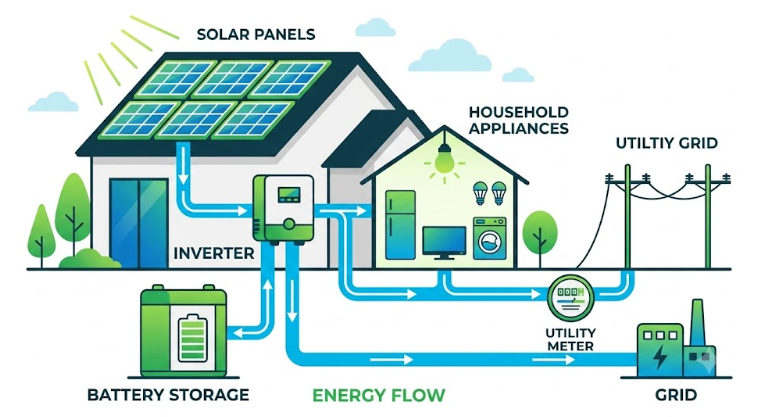
- A hybrid solar system typically connects to solar panels, a battery, and the grid simultaneously.
- An off‑grid solar system relies on PV and batteries, but sometimes also needs a backup generator to operate independently.
Therefore, if you’re installing a standard grid‑tied PV system, you usually only need to determine the specifications of the PV array and the inverter. If you’re planning a hybrid system with storage, you’ll need to additionally calculate battery capacity and battery output power.
For example:
10 kW solar array + 8 kW hybrid inverter + 15 kWh battery
(A solar array, simply put, is a large power‑generating unit made by combining many solar panels together.)
So choosing the size of a solar‑plus‑storage system isn’t as simple as converting monthly household electricity use into a panel count. In essence, it’s a comprehensive trade‑off between usage goals, home energy consumption, PV configuration, and budget.
What Does Residential Solar System Size Include?
Many people ask “How big a solar system do I need?” expecting a single number—like 5 kW, 10 kW, or 15 kWh. But a residential solar‑plus‑storage system can’t be described with just one figure. It consists of three main parts: solar panels, an inverter, and a storage battery.
- Solar panels capture sunlight and generate DC electricity.
- The inverter converts DC power from both the solar panels and the battery into AC power that household appliances can use.
- The storage battery stores excess electricity for use at night or during outages.
| System Component | Unit | Mainly Determined By | What It Represents |
| Solar array | kW | Annual electricity usage, local sunlight, roof conditions | Roughly how much electricity it can produce per year |
| Inverter | kW | Maximum simultaneous load, equipment startup surge | How many appliances it can run at the same time |
| Storage battery | kWh | Nighttime usage, backup load, backup duration | How much electricity it can store and how long it can last |
| Battery output power | kW | Maximum simultaneous load | Whether the battery can start air conditioners, pumps, etc. |
One thing to note: technical specs may label the solar system capacity as kWdc—this refers to the DC rated power of the solar array. That tells you how big the panel system is, not how much electricity the battery can store.
Also, even if two households both use 12,000 kWh per year, the number of panels they need on their roofs can be very different depending on where they live.
- In sunny areas like California or Australia, a 7.6 kW system (about 20 panels) is usually enough.
- But in cloudier, rainier places with weaker sunlight and lower generation efficiency, you’d need a larger system—maybe 11.9 kW, which would require about 30 panels.
Grid‑Tied vs. Hybrid vs. Off‑Grid Sizing
Different types of solar systems have different characteristics. Before calculating system size, you need to confirm whether you’re installing grid‑tied, hybrid, or off‑grid, because the design basis and purpose differ for each.
Grid‑Tied Solar System
A grid‑tied system is connected to the utility grid. When solar generation is insufficient, power can be drawn from the grid. Whether excess power can be sent back to the grid depends on local utility policies and net‑metering rules. So sizing is primarily based on annual household consumption, local annual generation, and the percentage of usage you wish to offset.
Hybrid Solar System
A hybrid system connects to solar panels, batteries, and the grid simultaneously. The solar array can still be sized by annual usage, but the inverter and battery must be selected separately according to your specific goals for nighttime usage, self‑consumption rate, and backup needs. The battery’s role is to store excess solar power generated during the day for use at night or during outages.
Off‑Grid Solar System
Off‑grid requires much more consideration: winter or the lowest‑sun months; consecutive cloudy/rainy days; daily critical loads; battery depth of discharge; inverter startup power; and whether a backup generator is included—all must be accounted for, without exception.
How to Size a Residential Solar System
We can break this down into two steps. Step 1: calculate the solar array capacity based on household electricity usage and local sunlight. Step 2: choose the appropriate inverter and battery based on your needs for simultaneous loads, nighttime usage, and backup objectives.
Step 1—Estimate the Solar Array Size
Installing a solar system is like buying a home appliance—bigger isn’t necessarily better; it depends on how much you use. Don’t worry if kWh seems confusing. Just grab your electricity bills and work backward from the numbers on them, and you’ll get a good idea of where your household stands.
First, look at your electricity bills from the past 12 months and add up the kWh for each month—don’t rely on just one month. Summer air conditioning and winter electric heating can cause significant seasonal variations.
For easy reference, the table below is estimated under typical conditions: annual generation ≈ annual consumption, average daily peak sun hours of 3.5–5.5 hours, overall system efficiency of 80%, and 400W per panel. If your numbers are roughly in line with these, you can confidently use this table as a guide:
| Monthly Usage | Daily Usage | Estimated Solar Array Capacity | Number of 400W Panels | Panel Area |
| 500 kWh/mo | 16.7 kWh/day | 3.8–6.0 kW | 10–15 panels | about 205–307 sq. ft. |
| 750 kWh/mo | 25 kWh/day | 5.7–8.9 kW | 15–23 panels | about 307–470 sq. ft. |
| 1,000 kWh/mo | 33.3 kWh/day | 7.6–11.9 kW | 19–30 panels | about 389–614 sq. ft. |
| 1,500 kWh/mo | 50 kWh/day | 11.4–17.9 kW | 29–45 panels | about 593–920 sq. ft. |
| 2,000 kWh/mo | 66.7 kWh/day | 15.2–23.8 kW | 38–60 panels | about 777–1,227 sq. ft. |
If your usage isn’t in the table, you can calculate it yourself.
- To figure out the solar array capacity you need, use this basic formula commonly used in the PV industry:
Solar array size (kW) = daily electricity usage ÷ local peak sun hours ÷ system efficiency factor (typically 0.8)
For example: if your household uses 1,200 kWh per month, divide by 30 days, giving 40 kWh per day. If you’re in Chicago, where the average annual peak sun hours are about 4 hours, the calculation is: 40 ÷ 4 ÷ 0.8 = 12.5 kW. That’s the total DC power your system needs.
- Once you’ve determined the solar array capacity, use this formula to calculate how many panels you need:
Number of panels = solar array capacity ÷ power rating of one panel
| Solar Array Capacity | 400W Panels | 450W Panels | Area for 400W Panels |
| 5 kW | about 13 | about 12 | about 266 sq. ft. |
| 8 kW | 20 | about 18 | about 409 sq. ft. |
| 10 kW | 25 | about 23 | about 511 sq. ft. |
| 12 kW | 30 | about 27 | about 614 sq. ft. |
| 15 kW | about 38 | about 34 | about 777 sq. ft. |
| 20 kW | 50 | about 45 | about 1,023 sq. ft. |
Of course, in real life, generation is affected by various factors—that’s unavoidable—but this general approach will point you in the right direction.
Step 2—Choose the Inverter and Battery
The calculations above solve the problem of how much electricity you need to generate per year. The inverter and battery, on the other hand, address when that electricity is used, which appliances run at the same time, and how long you need backup during an outage.
Choose the Inverter Size
When sizing an inverter, the main consideration is the household’s maximum simultaneous load—not a direct calculation from monthly usage.
Because the inverter determines output. It has to cover not only continuous loads but also the startup surge (peak power) of large appliances like refrigerators, air conditioners, and pumps.
So when selecting an inverter, check:
- Continuous output power
- Peak or surge power
- Whether it supports both 120V and 240V loads
- Whether it can operate independently during a grid outage (islanding capability)
- Whether it is compatible with the solar array and battery
A standard grid‑tied PV system usually cannot continue powering your home during a grid outage. To have backup capability, you need a storage battery and an inverter with the appropriate functionality. If you’d like to learn more about inverters, check out our related articles.
Choose the Battery Capacity
The battery exists to store power for contingencies, so its capacity is mainly based on nighttime usage or backup load requirements:
Usable energy needed = average load power × target runtime
For example, if your critical loads during an outage average 1.5 kW and you want them to run for 8 hours, that’s 1.5 kW × 8 hours = 12 kWh. But 12 kWh is just the actual energy the loads need. If the battery has 90% usable capacity and the inverter is 90% efficient, the nominal battery capacity would be roughly:
12 ÷ 0.9 ÷ 0.9 ≈ 14.8 kWh
So in this case, you’d start with a battery around 15 kWh.
Monthly usage determines how much electricity you need to generate. Your usage goals determine how that electricity needs to be stored and used. Different needs lead to different choices.
| Usage Goal | How to Size the Solar Array | How to Size the Inverter | How to Size the Battery |
| Reduce part of the electricity bill | Design according to the annual percentage you want to offset | Choose based on everyday loads | Optional; can be small or skipped |
| Increase selfconsumption of solar power | Design based on annual usage and local generation conditions | Choose based on main everyday loads | Size according to nighttime usage |
| Backup for critical loads | Design for normal generation needs | Choose based on simultaneous criticalload power | Size as critical load × backup time |
| Wholehome backup during outages | Consider solar recharging capability during outages | Choose based on wholehome peak load and startup surges | Size based on estimated usage during an outage |
| Fully offgrid | Design for winter or lowsun months | Choose based on wholehome peak load | Size based on daily consumption and number of consecutive cloudy days |
FAQ
Will a 10kW solar system run my house?
It certainly could—but you need to distinguish between producing enough energy over the year and being able to run all your appliances simultaneously. A 10 kW solar array may generate enough electricity over the year to cover your household usage. But whether it can run the whole house during an outage also depends on inverter power, battery capacity, and which appliances are running at the same time. For a household using about 1,000 kWh per month, a 10 kW system is often adequate, but you should still calculate based on your actual sunlight hours.
What is the average residential solar system size?
Berkeley Lab’s 2025 data update shows that in 2024, the median residential PV system capacity in the U.S. was about 7.2 kW, with an average around 9.3 kW. Most systems fall roughly in the 4–11 kW range.
How many panels do I need for a 2,000 sq ft house?
You can’t determine that just from floor area. If that house uses 1,000 kWh per month, as we calculated earlier, it would need about 19–30 400W panels. If it only uses 750 kWh per month, it might need only 15–23 panels. Floor area mainly tells you whether the roof can physically fit the panels; actual electricity usage determines how many you need to install.
Should I oversize my solar system?
Oversizing is a clear option—you can certainly leave a little extra margin—but the array isn’t always better when it’s larger. Adding too many panels can be limited by roof space, inverter capacity, panelboard capacity, and net‑metering or buyback policies.
Is solar system size measured in kW or kWh?
Both units are used, but they represent different things. The solar array is measured in kW; the inverter is measured in kW; battery storage capacity is measured in kWh; and battery output capability is still measured in kW.