
The winter storms of January 2026 left millions of people without power. For many households, the real problem wasn’t the lights going out—it was refrigerators stopping, internet connections dropping, medical equipment becoming unusable, and even remote work being interrupted. These outages created significant disruptions to everyday life.
A reliable home backup battery system isn’t something you choose simply by buying the most expensive model or the one with the largest capacity. When researching different household backup power needs, we found that many homeowners tend to overestimate their actual electricity requirements.
In this article, I’ll do my best to approach the topic from the perspective of someone about to spend their own money. We’ll discuss who truly needs a backup battery system, who probably doesn’t, what appliances it can power, how long it can run them, and what difference solar panels actually make. And when a reality check is needed, I’ll give one.
Are home battery backups worth it?
The answer is actually quite simple: it depends on how often your home loses power and how much those outages affect you.
Who Should Consider a Home Backup Battery System?
The following groups are worth considering:
- People with critical devices that cannot lose power. For example, oxygen concentrators, CPAP machines, or even aquarium heaters. A power outage can quickly become a serious problem.
- People who live in areas with frequent power outages. If your area experiences several outages a year and each one lasts half a day or more, you already know how valuable a backup power source can be.
- People who work from home or create content online. When your computer, router, and monitor all shut down at once, your workday comes to an abrupt halt. In situations like this, a reliable backup power system can be invaluable.
- Homeowners with solar panels but no battery storage. Without a battery, excess solar energy generated during the day is often wasted, and you can still lose power during an outage. Adding battery storage allows you to save that daytime energy for nighttime use and provides backup power when the grid goes down.
- Renters. Installing a permanent battery system typically requires modifications to the electrical panel and connection to the home’s electrical system, making installation and removal complicated. Portable battery solutions are often a more practical option for renters.
When a Battery Backup May Not Be the Best Choice
In the following situations, it may not be necessary:
- Your home rarely loses power. If you only experience one or two outages a year and they last just an hour or two, your refrigerator will likely stay cold enough, and the inconvenience may not justify the cost of a battery system.
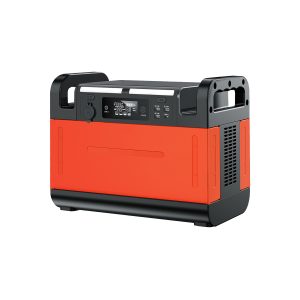
- You’re working with a tight budget. A home battery system is not an absolute necessity. If money is tight, a portable power station and a few extension cords can provide backup power for essential devices at a much lower cost.
- Your only goal is to save on electricity bills. Battery systems can reduce electricity costs to some extent, but fully recovering the purchase price through energy savings alone can be difficult. Lower utility bills are a nice bonus, but backup power—not bill reduction—is the primary reason most people buy these systems.
What Is a Home Backup Battery System?
In simple terms, a home backup power system is basically a large battery paired with an inverter. When the grid is operating normally, it sits quietly in the background and keeps itself charged. If a power outage suddenly occurs, it immediately takes over and continues supplying electricity to your home.
Unlike a generator, it makes no noise, produces no exhaust fumes, and doesn’t require you to go out to the garage and pull a starter cord. Even better, the switchover happens in just a few milliseconds when the power goes out, so quickly that your lights may not even flicker.
Its limitations are just as obvious, though. Battery capacity is finite. Once the stored energy is used up, it’s gone until you recharge it with solar panels or wait for grid power to return.
Key Components of a Home Backup Battery System
The battery pack is where the energy is stored. According to Battery Design, large battery packs are built by connecting multiple battery cells in series to increase voltage and in parallel to increase capacity, forming battery modules that are then assembled into a complete battery pack. Today, the most common cell chemistry on the market is LiFePO₄ because it is safe, long-lasting, and can remain in service for more than ten years. As a result, it has become widely used in residential energy storage, solar energy storage, and backup power systems.
The inverter determines the system’s power output and is responsible for converting electricity from one form to another. Batteries store electricity as direct current (DC), while household appliances such as refrigerators, TVs, and routers run on alternating current (AC). The inverter’s job is to convert DC power from the battery into AC power for your appliances. It can also work in reverse, converting AC power from the grid or a solar system into DC power for battery charging.
The Battery Management System (BMS) acts as the battery pack’s personal bodyguard. According to a research report from NLR, the BMS continuously monitors each cell’s voltage, current, temperature, and state of charge to ensure the battery always operates within a safe range. If it detects overcharging, over-discharging, overheating, or a short circuit, it immediately disconnects the circuit. The BMS also balances voltage differences between cells, helping extend the lifespan of the entire battery pack.
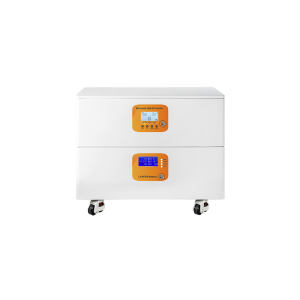
Take the PIFORZ 6KW+16KWh all-in-one home backup energy storage system as an example. The battery pack is responsible for the 16kWh battery capacity, while the inverter is responsible for the 6kW power output.
We also tested its BMS system. During a power outage, a laptop that was playing a video didn’t flicker or interrupt at all. We later checked the user manual and found that the system’s transfer time is between 10 and 20 milliseconds. So what does 10 milliseconds actually mean? A single blink of your eye typically takes about 100–200 milliseconds. In other words, when the power goes out, the switchover happens so quickly that your lights may not even flicker.
As for overcharge protection, we previously tested another off-brand battery. After leaving it plugged in even after it had reached 100% charge, we noticed a significant reduction in runtime just three months later. A properly designed BMS automatically stops charging once the battery is full, helping protect the battery cells. As a result, the battery capacity will not degrade significantly over a short period of time.
What Can a Home Backup Battery System Power?
There’s no one-size-fits-all answer to this question, because what your system can power depends on two things: battery capacity and inverter output power. However, we can break it down into three different levels.
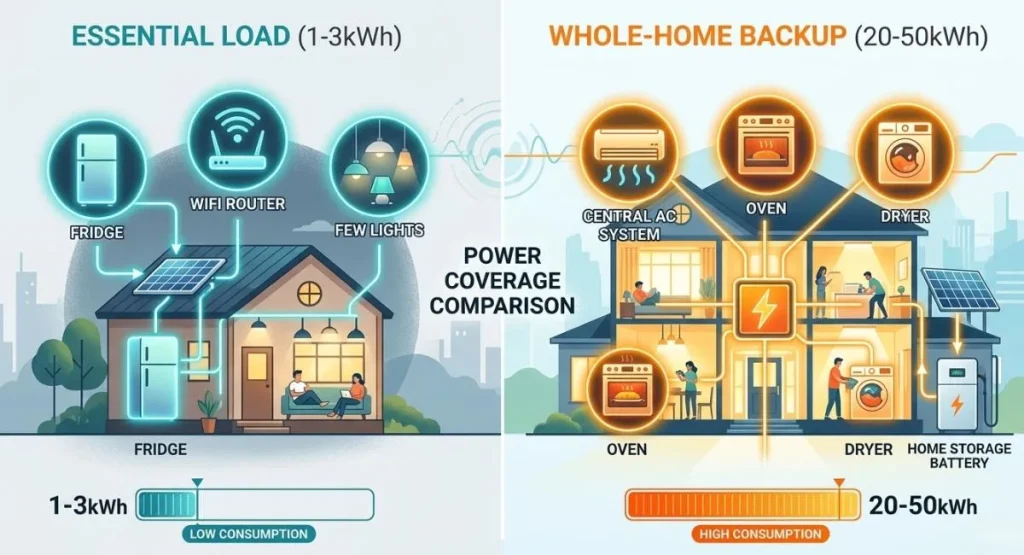
Essential Home Loads
This is the primary reason most households buy a backup battery system—to keep the essentials running during a power outage. Typical critical loads include:
- Refrigerator (150–300W while running, with a startup surge of around 600W): keeps food from spoiling
- Router (20–30W): keeps your internet connection alive
- A few LED lights (5–10W each): so you’re not left in the dark
- Phone/tablet charging (5–20W per device): helps you stay connected with the outside world
Together, these loads typically consume no more than 400W. A 1500Wh battery can usually power them for 4–6 hours without any problem. If these are the only devices you need to keep running, most portable power stations on the market will be more than capable of handling the job.
High-Power Appliances
If you want to maintain a normal quality of life during a power outage, you’ll need to consider higher-power appliances:
- Microwave (800–1500W)
- Electric kettle (1000–1500W)
- Rice cooker (600–800W)
- Hair dryer (1000–1800W)
- Space heater (1000–1500W)
- Air conditioner (1000–3500W, depending on size)
- Electric water heater (1500–3000W)
- Induction cooktop (1200–2000W)
- Water pump (500–1500W)
There are two challenges here. First, the inverter must be powerful enough—typically at least 3000W. Second, the battery capacity must be able to keep up. In most cases, you’ll need at least 10kWh of storage to maintain a normal lifestyle for about a day.
For example, a 1500W electric kettle running for 10 minutes consumes about 250Wh, which is not a big deal for a 10kWh battery. However, a 1500W space heater running continuously for 8 hours will consume 12,000Wh, completely draining a 10kWh system.
So it’s not that high-power appliances can’t be used during a power outage—it’s that occasional use and continuous operation are two very different things.
Can a Battery Backup Power an Entire House?
Technically, yes—but only if you’re willing to spend the money.
A whole-home backup system means powering your central air conditioner, electric water heater, electric stove, washing machine, dryer, lighting, and all the outlets in your house. When these loads operate at the same time, the total power demand can easily exceed 10kW.
To support that level of demand, you’ll need an inverter with a continuous output of at least 10–15kW. You’ll also need a battery capacity of 20–30kWh to keep the house running for roughly half a day to a full day. If the outage lasts longer than a day, you’ll likely need solar panels to recharge the batteries.
At that point, it’s worth considering a 10kW-class modular energy storage system, where additional battery modules can be added whenever you need more capacity.
The downside is cost. A setup like this can easily run into the tens of thousands of dollars, making it far more expensive than a portable power station with just a few kilowatts of output.
Whole-Home Backup vs Essential Load Backup
Which of these two approaches you choose will determine how much you spend, how large a system you need to install, and how much convenience you’ll enjoy during a power outage.
| Dimension | Essential Load Backup | Whole-Home Backup |
| Coverage | 3–6 critical circuits | Entire household circuits |
| Inverter Power | 1–3 kW | 10–20 kW |
| Battery Capacity | 1–3 kWh | 20–50 kWh |
| Can Run Air Conditioner | No | Yes |
| Can Run Electric Stove | No | Yes |
| Can Run Dryer | No | Yes |
| Cost | Low (hundreds to a few thousand USD) | High (tens of thousands USD) |
| Installation Difficulty | Low (plug-and-play) | High (requires professional electrician) |
| Outage Experience | Functional but limited usage | Almost normal life |
In general, a critical-load backup system is best for people who already prepare for outages by keeping food and drinking water on hand. A whole-home backup system is more suitable for households with medical equipment that must run continuously, people living in remote areas that experience frequent or prolonged outages, or those who want to maintain a high quality of life during a power outage.
If your budget is limited right now but you may want to expand in the future, a modular system can be a smart choice. You could start with a 15kWh battery and a 10kW inverter connected only to your essential loads. Then, a few years later, if you find that you need more capacity, you can add another battery module (for example, expanding to 30kWh) and connect additional circuits to the backup system.
This approach allows you to avoid a large upfront investment while gradually working toward full-home backup coverage.
How Long Will a Home Backup Battery Last?
Here we will focus on discussing how many hours a single charge can last.
What Determines Battery Runtime?
Runtime depends on three factors, and the formula is straightforward:
Runtime (hours) = Battery Capacity (Wh) ÷ Average Load Power (W) × 0.85 (Inverter Efficiency)
There are three variables:
- Battery Capacity: Usually rated in Wh or kWh. The larger the capacity, the longer the runtime.
- Load Power: The combined power draw of all the devices running at the same time. For example, a refrigerator at 150W, a router at 20W, and lights at 30W give a total load of 200W. The higher the load, the shorter the runtime.
- Inverter Efficiency: Converting DC power to AC power results in some energy loss. Efficiency is typically between 85% and 92%. Using 85% provides a conservative estimate.
There are also two commonly overlooked factors:
- Depth of Discharge (DoD): LiFePO₄ batteries can typically be discharged to 95% or even 100% of their capacity, while lead-acid batteries are usually limited to around 50%. Since most home energy storage systems use LiFePO₄ batteries, a 95% usable capacity is a reasonable assumption.
- Temperature: At temperatures below 0°C (32°F), the usable capacity of LiFePO₄ batteries can decrease by 10–30%.
How Long Will a 10kWh Battery Power a House?
This depends on what equipment will be used in the house; you can refer to the following examples:
| Usage Scenario | Typical Load | Estimated Runtime |
| Essential loads only | Refrigerator 150W + Router 20W + 3 × 10W LED lights = ~200W | 10,000 × 0.85 ÷ 200 ≈ 42.5 hours |
| Essential loads + occasional microwave use | 200W baseline + microwave 1000W for 10 minutes (≈70W average) = ~270W | 10,000 × 0.85 ÷ 270 ≈ 31.4 hours |
| + Window air conditioner | 200W baseline + 1200W AC = ~1400W | 10,000 × 0.85 ÷ 1400 ≈ 6 hours |
| Whole-home typical usage | Refrigerator, lights, TV, computer, fan, occasional microwave ≈ 1700W | 10,000 × 0.85 ÷ 1700 ≈ 5 hours |
However, the estimates above assume continuous operation. In real life, a refrigerator doesn’t run constantly, and a microwave isn’t on all the time. As a result, actual runtime is usually longer than the calculated estimate.
What Size Home Backup Battery Do You Need?
There’s no universal answer, but you can calculate your own needs in three simple steps.
Step 1: Make a list of the devices you want to power.
Then find the power rating of each device, which is usually listed in the user manual or on the product label.
Step 2: Decide how long you want to stay powered during an outage.
Step 3: Use the formula to estimate your required capacity.
Once you have the basic information above, you can plug the numbers into the formula from the previous section to estimate how much battery capacity you need.
A Few Easy-to-Overlook Details
- Refrigerators use less energy than most people think
A refrigerator doesn’t run continuously. Its compressor typically operates only 30–50% of the time. A 200W refrigerator may actually consume only 60–100Wh per hour on average. However, the inverter still needs to handle the startup surge power. This doesn’t affect the battery capacity calculation, but it does affect the inverter size you choose. - Winter and summer are different
Cold temperatures reduce the usable capacity of lithium batteries (by about 20% at 0°C), while hot temperatures cause refrigerators to run more frequently. If extreme temperatures are common where you live, it’s a good idea to add a 20% safety margin to your estimate. - A real-world example
My own system uses a 10kWh battery and powers a refrigerator, a router, four lights, a laptop, and phone charging, with occasional microwave use. In actual testing, it ran for 28 hours and still had 15% battery remaining.
Home Battery Backup With Solar vs Without Solar
The key difference between the two is simple: with solar panels, you can recharge your system yourself; without solar, once the battery is empty, it’s empty.
Without Solar (Battery-Only Backup)
The battery can only be charged from the grid. You typically charge it during off-peak electricity hours and use the stored energy during a power outage.
Advantages:
- Simple system design
- Lower installation cost
- Not dependent on weather conditions
Disadvantages:
- Limited energy supply
- If an outage lasts more than a day or two, you’re out of power once the battery is depleted
This option is best for households that experience infrequent outages or have a limited budget.
With Solar (Battery + Solar Panels)
The battery is primarily charged by solar panels, with the grid serving as a backup source. During the day, solar panels generate electricity, and any excess energy is stored in the battery. At night or during a power outage, you draw power from the battery.
Advantages:
- Much longer backup duration
- As long as the weather is reasonably good, solar panels can continue generating power
Disadvantages:
- Higher upfront cost due to the solar panels
- Requires suitable roof space and installation conditions
This option is ideal for areas with long-duration outages, remote locations, or homeowners who want to significantly reduce their dependence on the grid.
Home Battery vs Generator
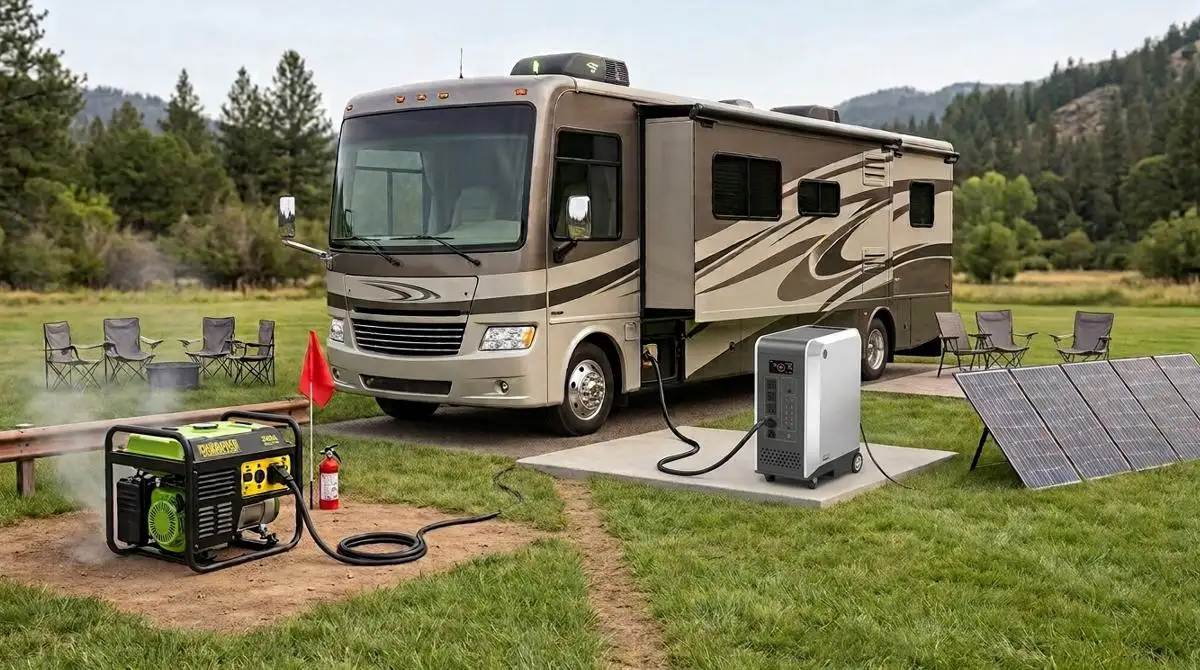
The main energy storage options for powering high-wattage devices are typically home backup battery systems and generators. Here are a few points briefly described. For a detailed comparison, please click here to view the relevant article.
| Comparison | Home Battery Backup System | Generator |
| Operating Noise | Nearly silent | High noise level |
| Indoor Use | Yes | No |
| Fuel Requirement | No fuel required | Requires gasoline, diesel, or natural gas |
| Maintenance | Low maintenance | Regular servicing and oil changes required |
| Runtime | Limited by battery capacity | Depends on fuel availability |
| Emissions | Zero emissions | Produces exhaust emissions |
| User Experience | Clean and quiet operation | High power output but noisy operation |
What Factors Affect the Cost of a Home Backup Battery System?
Backup battery system prices can vary by several times within the industry. The main factors that affect the cost of a system are:
1. Battery Capacity
The larger the capacity, the higher the cost. This is the most direct pricing factor.
- 5kWh: approximately $2,000–$4,000
- 10kWh: approximately $4,000–$7,000
- 15kWh: approximately $7,000–$10,000
- 20kWh+: approximately $10,000–$15,000+
These are the approximate market prices for batteries alone and do not include installation costs.
However, bigger is not always better. You only need enough capacity for your actual needs. Any extra capacity that never gets used is simply wasted money.
2. Battery Cell Chemistry
LiFePO₄ batteries are generally slightly more expensive than NCM batteries, but they offer longer lifespan and better safety. For this reason, LiFePO₄ is typically the preferred choice for home energy storage systems.
3. Inverter
The inverter’s power rating and type play a major role in the overall cost.
Higher-power inverters require more robust power components and more sophisticated cooling systems, which naturally increase the price. In addition, pure sine wave inverters cost more than modified sine wave inverters, but for home use, a pure sine wave inverter is non-negotiable—it is the minimum standard you should accept.
4. Installation Costs
Installation costs can vary significantly.
If you’re only connecting a few critical-load circuits, an electrician may be able to complete the job in half a day. However, if you’re installing whole-home backup, modifying the electrical panel, or adding a transfer switch, the amount of work increases dramatically.
In addition, older homes may require an electrical panel upgrade before a battery system can be connected. This is an expense that many homeowners overlook.
5. Whether Solar Is Included
A battery-only system requires just the battery and inverter.
If you add solar panels, you’ll also need to purchase PV panels, mounting hardware, wiring, and a combiner box, as well as pay for roof installation. While this increases the upfront cost considerably, generating your own electricity can significantly reduce long-term operating costs.
The key difference is that the energy stored in a battery-only system ultimately comes from the grid, whereas adding solar panels allows you to generate and use your own electricity.
How to Choose the Right Home Backup Battery System?
Overall, choosing the right home backup battery system isn’t about buying the one with the highest specifications—it’s about choosing the one that best fits your household’s actual needs.
1. Capacity
Capacity determines how long your system can provide power.
Based on what we’ve discussed earlier, start by making a list of the devices you absolutely need to keep running during an outage, then calculate the total kWh you require. A common mistake is buying more capacity than you need. If your home only experiences a few outages a year and each one lasts just a few hours, there’s little practical difference between a 10kWh and a 20kWh system. The extra money may simply be wasted.
2. Output Power
Power output determines which devices you can run at the same time.
Add up the power ratings of the devices on your list to determine your required output. Be sure to distinguish between continuous power and surge power. For example, the startup surge from a refrigerator requires an inverter with sufficient short-term overload capability. Manufacturers typically list both ratings in their specifications.
3. Battery Chemistry
As mentioned earlier, LiFePO₄ batteries are generally the best choice for home use because of their superior thermal stability and safety.
4. Safety
Safety is not a single feature—it’s an entire system.
Look for battery cells and systems that have passed recognized safety certifications. You should also consider factors such as cooling design, enclosure flame-retardant ratings, and protection features for overheating, overcurrent, and short circuits.
5. Expandability
You may only need 15kWh today, but what happens if your household adds new appliances in three years or power outages become more frequent?
A modular system allows you to add battery modules later, expanding from 15kWh to 30kWh or even 45kWh. With a sealed all-in-one system, your only upgrade option may be replacing the entire unit.
So, when it comes to home backup batteries, more expensive doesn’t necessarily mean better. First, determine your actual needs: which devices you want to protect, how long you need backup power, and whether solar energy is part of your plan. Then use the information in this article to choose the right system.
Hopefully, this guide will help you avoid spending money where you don’t need to—and invest in a backup power solution that truly serves your needs.
FAQ
Q:Can I install a home backup battery myself?
A: If you don’t plan to connect the system to your home’s electrical circuits and simply want a plug-and-play solution, you can install a backup battery yourself with ease. However, if you want the system connected to your home’s electrical system and capable of automatically switching over during a power outage, it must be installed by a licensed electrician, as this involves modifications to the electrical panel and the installation of a transfer switch.
The Piforz 6KW + 16KWh system offers both options—it includes standard outlets for direct plug-and-play use, while also supporting connection to your home’s electrical circuits.
Q:Can solar panels charge a home battery during an outage?
A: Of course. Solar panels can supply power to the battery, and this has nothing to do with whether there is a power outage—it only depends on lighting conditions. As long as there is sunlight, solar panels can charge the battery.