In recent years, as electricity demand has increased and extreme weather events have become more frequent, many homeowners have started looking for reliable home backup power solutions.
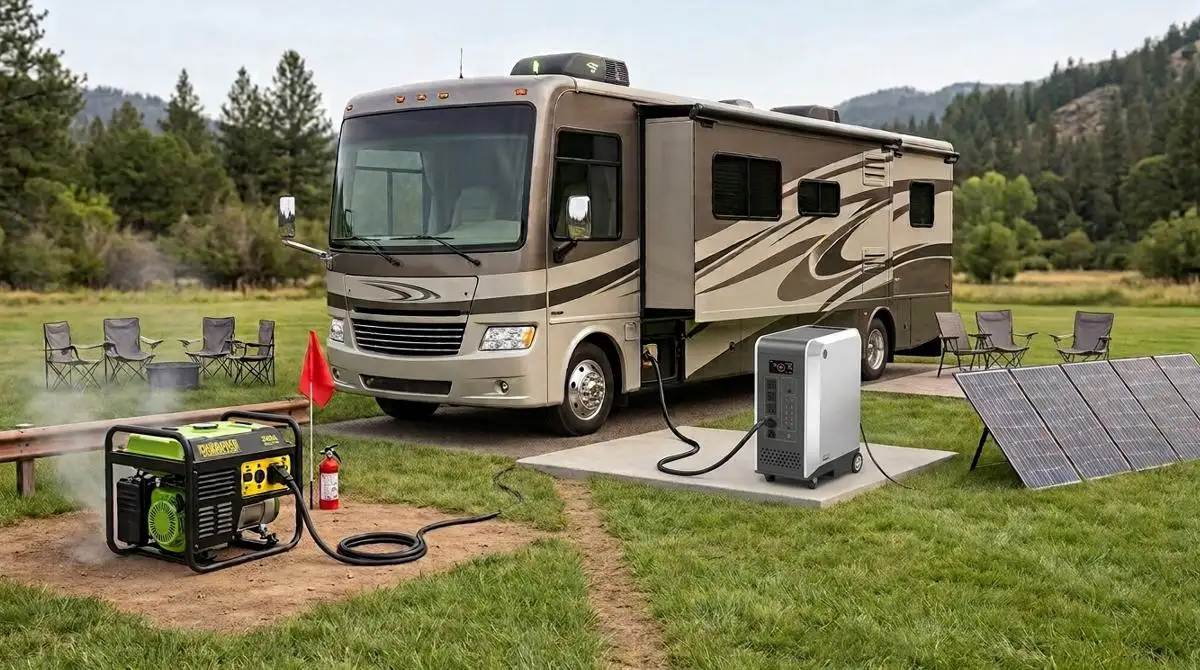
After learning about both generators and solar battery systems, it’s common to hesitate between the two. When we compare generator vs solar battery, what we’re really struggling with are their differences, strengths, and drawbacks—because each option has features that appeal to us.
This article will break down the key differences between generators and solar batteries, analyze their pros and cons, and offer buying suggestions for different user scenarios.
Generator vs Solar Battery: What Each System Is Designed For
When comparing generator vs solar battery, the first step is to clarify your core needs: do you prioritize high power output, or do you want a worry-free, low-maintenance backup solution? Generators and solar battery backups are built on completely different design concepts, so understanding how each one is designed can help you determine which option aligns better with your needs.
What a Generator Is Designed For
A generator is designed for immediate, continuous, and high-power electricity supply. Powered by fuel, it delivers strong output and can run for long periods of time. This is why the typical use cases for generators are very clear: power tools on construction sites, whole-home emergency backup, large outdoor events, or any situation that requires high wattage for several hours—or even several days—of uninterrupted operation. A generator can handle them all.
What a Solar Battery Backup Is Designed For
A solar battery backup is designed to operate quietly, emission-free, and automatically. Its purpose isn’t to generate electricity by burning fuel, but to store energy in lithium batteries. The stored power can come from daytime solar panels or low-cost off-peak grid electricity at night.
This means a solar battery backup is not intended for running air conditioners, washing machines, or welders for long hours during a blackout. Instead, it is built to keep your essential devices running and your daily life uninterrupted when the grid goes down. Over the long term, it can also help reduce your electricity bills.
Generator vs Solar Battery: Core Differences Explained
1. Conversion Method
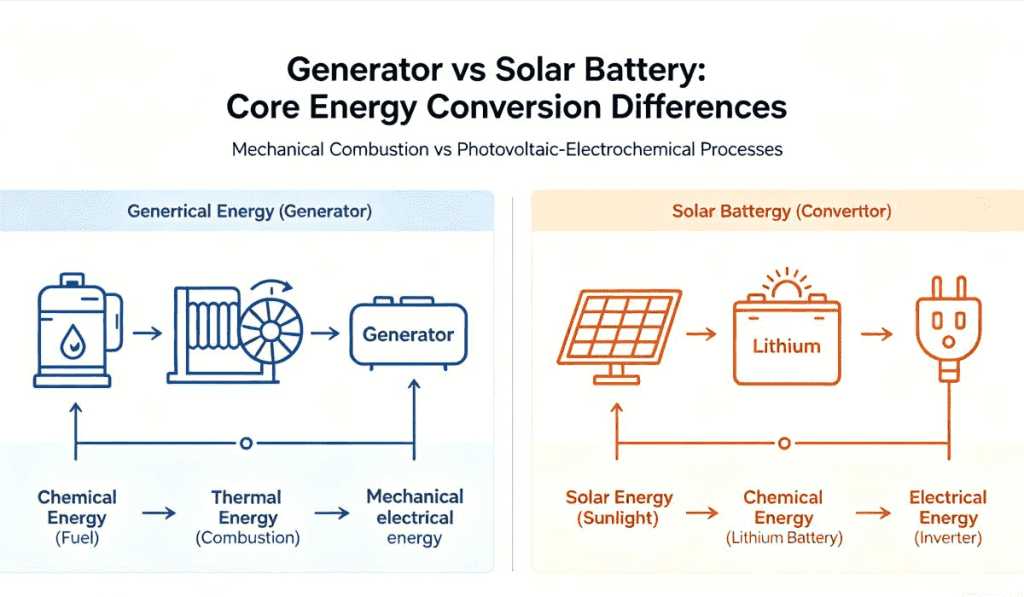
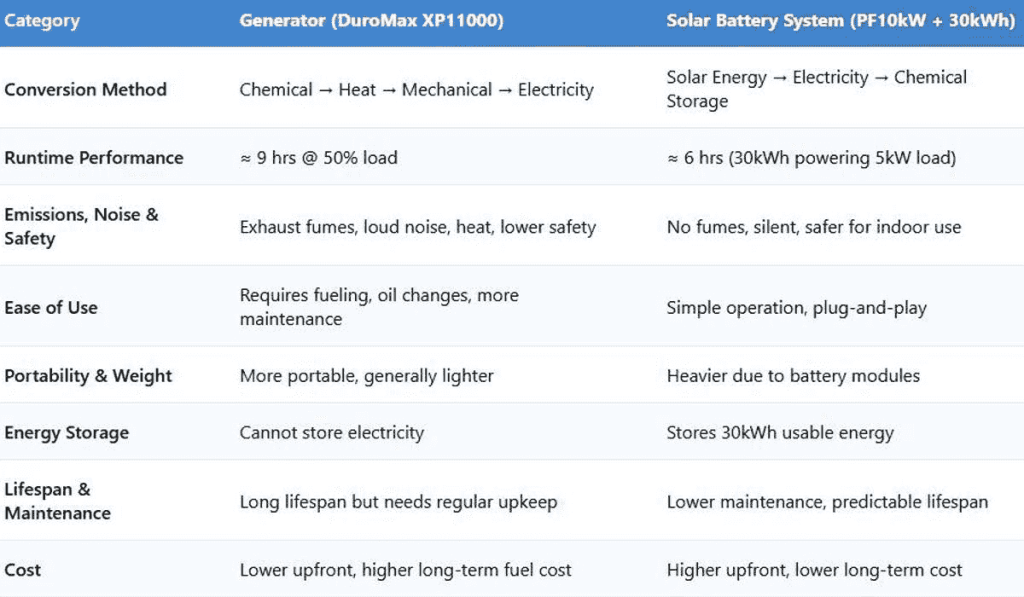
The power generation process of a generator essentially follows this sequence: chemical energy → thermal energy → mechanical energy → electrical energy.
In more detail, the chemical energy in the fuel is converted into thermal energy through combustion. The high-temperature, high-pressure gases produced during combustion drive the pistons to move back and forth. Through the connecting rod, the pistons rotate the crankshaft—this is the process of converting heat into mechanical energy.
The rotating crankshaft is connected to the rotor inside the generator. As explained by the U.S. Energy Information Administration in How electricity is generated , when the rotor spins next to the stator, its magnetic field acts like an invisible comb, “brushing” through the coils and pushing the electrons to move, thereby generating electric current.
In contrast, the energy conversion process of a solar battery follows a different chain: solar energy → electrical energy → chemical energy → electrical energy.
Here’s how it works. When photons from sunlight hit silicon atoms, they “knock” electrons from a lower energy level to a higher one. A photovoltaic cell consists of a P-type silicon layer paired with an N-type silicon layer. This structure forces the excited free electrons to migrate toward the N-type region, while the “holes” (positions lacking electrons) move toward the P-type region, creating a directional voltage. Electrons then flow from the N-side → through the external circuit → back to the P-side, forming an electric circuit.
During charging, an external power source pushes electrons toward the negative electrode, storing energy in chemical form. During discharging, lithium ions flow from the negative electrode back to the positive electrode, and the electron flow produces current that powers devices.
In short, one system is driven by combustion, and the other relies on solar energy conversion. But the solar-battery process is cleaner and far more direct than that of a fuel-powered generator.
2. Runtime Performance
The runtime of a generator depends on how much fuel it can store, while the runtime of a solar battery system depends on its battery capacity and the weather conditions.
To make the comparison fair, let’s look at a nighttime scenario where no solar power is available, and compare the DuroMax XP11000iHT with the Piforz 10kW + 30kWh system.
The DuroMax XP11000iHT holds 7.1 gallons of gasoline and can run for about 9 hours at half load.
The piforz 10kW + 30kWh system stores 30 kWh of battery energy, and at half load, its theoretical runtime is around 6 hours.
Of course, a generator can keep running as long as you refuel it, and a battery system can also be expanded with additional battery capacity if needed.
3. Emissions, Noise & Safety
In terms of emissions:
A generator burns fuel while running, which means it inevitably produces exhaust gases that are harmful to the environment and to human health. In contrast, the energy conversion process of a solar battery system is clean and simple, with no gas emissions during operation.
In terms of noise:
Generators generate mechanical power, which involves large, continuous internal movements — and movement always comes with noise. Some users have shared that when they ran their generator through the night, their family couldn’t sleep for two nights in a row and ended up feeling mentally exhausted.
Solar battery systems, on the other hand, operate mainly through micro-scale electronic movements, so the system is almost silent. The only audible sound typically comes from the inverter’s cooling fan.
In terms of safety:
Generators produce carbon monoxide, so they must not be operated in enclosed spaces to avoid the risk of CO poisoning.
Solar battery systems, however, can be safely installed in a storage room or garage. What needs attention is the nature of lithium batteries — they carry a potential risk of thermal runaway. Therefore, a qualified solar battery system must include a reliable BMS and proper ventilation or heat dissipation.
4. Ease of Use & Operation
A generator is a manually activated system. When a power outage occurs, you still need to pull it out from storage, check the oil level, add gasoline, pull the recoil starter or press a start button, connect extension cords, and then plug in the devices you want to power. This entire process can easily take five to six minutes, and if the unit hasn’t been properly maintained, it may take up to half an hour before it becomes usable.
A solar battery system, on the other hand, is fully automatic. Once installed, it remains online continuously. It charges itself when the grid is normal, and the moment a power outage occurs, it automatically switches over—without any action required from the user.
5. Portability & Weight
Of course, under the same power level, solar battery systems are less portable than generators. Let’s still use the DuroMax XP11000iHT and Piforz 10kW + 30kWh as references for comparison.
The DuroMax XP11000iHT weighs approximately 102.5 kg.
The Piforz 10kW + 30kWh system is made up of multiple modules, so we need to sum their weights. The inverter weighs 25.3 kg, the middle battery module weighs 105.5 kg, and the lower battery module weighs 110 kg, giving a total system weight of 250.8 kg.
From this comparison, we can see that under the same power output, solar battery systems are significantly heavier.
6. Ability to Store Energy
Another key difference between them is whether they can store energy.
A generator cannot store electricity. Once the fuel runs out, it can no longer produce power. If we want to ensure continuous electricity during an outage, we must always keep the fuel tank filled.
A solar battery system, however, can store electricity. Even at night, when solar panels are not working, it can still provide power as long as there is energy stored in the battery from daytime charging.
Therefore, a generator provides only immediate power without storage, while a solar battery system can both deliver immediate power and store energy for backup use.
7. Lifespan & Maintenance
The lifespan of a generator is typically measured in operating hours. High-quality brands can theoretically last 30–40 years. However, the key issue is maintenance: it requires regular oil changes, spark plug replacement, air filter cleaning, and prevention of carburetor clogging. In addition, gasoline can degrade after being stored for more than three months, which means the generator may not even work properly when a real outage occurs.
The lifespan of a solar battery system is measured in charge cycles. LiFePO₄ batteries typically offer around 3,000 to 6,000 charge-discharge cycles. Assuming one full cycle per day, this translates to about 8 to 15 years of service life. Maintenance costs are almost zero—you don’t need oil changes or carburetor cleaning. The only important considerations are to avoid storing it fully discharged, keep the battery at around 50–60% when not in use, and avoid charging it below 0°C.
8. cost
A generator does have one clear advantage: the upfront cost. You can get a whole-home unit for just a few thousand dollars, which is far cheaper than a solar-plus-battery setup.
But the catch comes later. Every time the power goes out, you have to buy fuel again. Spending ten or twenty dollars in fuel per outage is completely normal, and if it happens five or six times a year, you’re easily paying hundreds of dollars just in fuel. On top of that, you need regular oil changes, new spark plugs, and occasional professional maintenance. Those ongoing costs—both money and time—add up more than most people expect.
Solar battery systems, on the other hand, cost more upfront. A full-home setup can easily run several thousand to over ten thousand dollars.
But once it’s installed, the energy source—sunlight—is free. There are no spark plugs to clean, no oil to change, and no technician needed for routine upkeep. You’re essentially paying a larger amount at the beginning in exchange for long-term peace of mind. And because every kilowatt-hour generated from free sunlight offsets your electricity bill, you’re recovering your investment every time the system produces power.
Generator vs Solar Battery: Pros & Cons at a Glance
Key Factors Homeowners Prioritize When Choosing Between a Generator and a Solar Battery
We have now learned the differences between generator vs. solar battery. When it comes to choosing between them, the key priorities also differ. Of course, when selecting a power solution, we usually consider factors such as power output, weight, and size.
What People Care About When Choosing a Generator
When choosing a generator, the key factors to focus on include:
- Starting reliability: whether it can start smoothly when a power outage occurs.
- Fuel type: gasoline can degrade over time, while propane or dual-fuel systems are generally more reliable and convenient.
- Fuel tank capacity: this determines how long the generator can run on a single fill-up.
- Noise level: excessive noise can affect both your sleep and your neighbors.
- Carbon monoxide sensor: it can detect surrounding CO levels and automatically shut down the generator if they become too high, improving safety.
What People Care About When Choosing a Solar Battery Backup
When choosing a solar battery system, the key factors to focus on include:
- Battery capacity: it determines how long the system can run without recharging.
- Transfer speed: whether it can switch instantly during a power outage without interrupting the load.
- Battery type: most high-quality solar battery systems on the market use lithium iron phosphate (LiFePO₄) batteries.
- Expandability: whether the system allows additional batteries to be added when more capacity is needed.
- Installation convenience and aesthetics: whether it can be easily installed, hidden, and operate quietly enough to be barely noticeable.
Which One Is Better for Your Home?
There is no single solution that fits every scenario, so we need to evaluate them based on different use cases.
If you live in an urban area where power outages are frequent but usually short, a solar battery system is the better choice. In cities, houses are close together, so quiet operation and clean energy are especially important.
If you are in a remote area where outages may last for several days, both options can work. Generators are suitable because there is enough outdoor space to operate them safely, and as long as there is fuel, they can run continuously. A solar battery system combined with solar panels can also power most household needs for long periods. In this case, an even better setup is to use the solar battery system as the primary source and the generator as a backup for extreme situations.
For high-power households, a solar battery system with solar panels is generally recommended, as it can handle significant loads while remaining quiet and safe.
If budget is the main constraint, a generator is usually the more affordable option.
Ultimately, the right choice depends on your specific situation. However, the advantages of zero emissions and quiet operation already indicate that energy storage systems are becoming the mainstream solution for backup power.