In this article, I will walk you through what an inverter is, the 7 types of inverters, and how to choose a home power inverter.
What Is an Inverter?
An inverter is an electronic device that converts direct current (DC) from a battery into alternating current (AC) that household appliances can use, meeting the electricity needs of home devices.
The 7 Types of Inverters
Type 1: Output Waveform
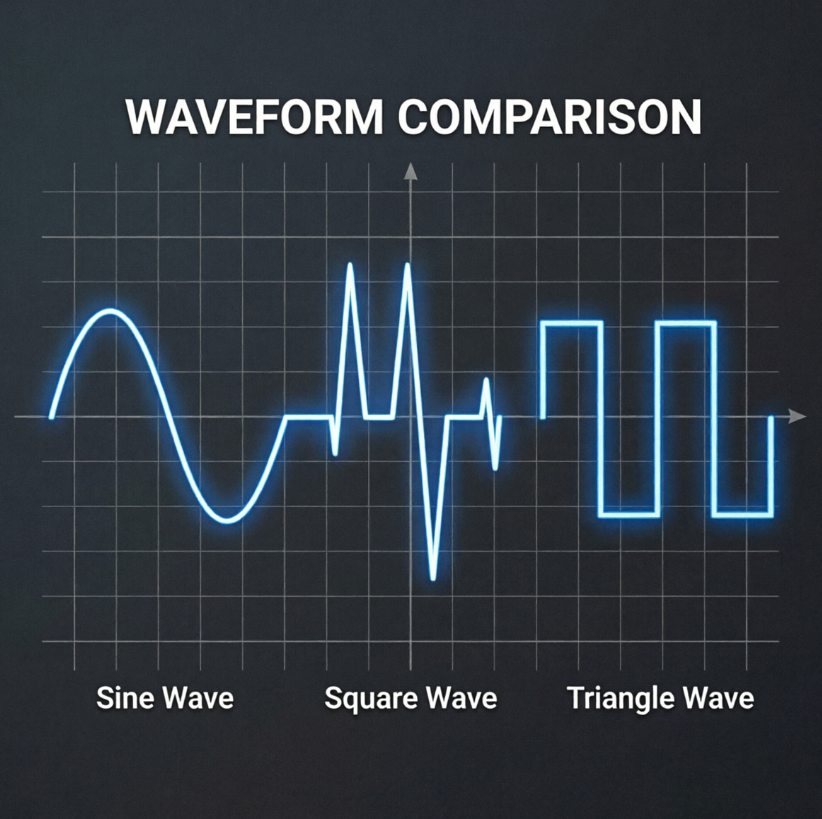
1. Sine Wave Inverter
Produces a smooth sine wave identical to grid power. It can run all household appliances, especially sensitive ones like medical equipment. If you’re considering a backup power inverter for your home, a sine wave inverter is the best choice.
2. Modified Sine Wave Inverter
The output waveform has multiple steps, suitable for resistive electrical appliances, such as light bulbs and water heaters. But if used for equipment with motors, such as compressors and other more precise devices, there may be noise and even the risk of overheating.
3. Square Wave Inverter
Produces a square wave with high harmonic distortion. These are early, simple inverters that are now largely obsolete, used only with a few resistive loads and old tools.
Type 2: Grid Relationship
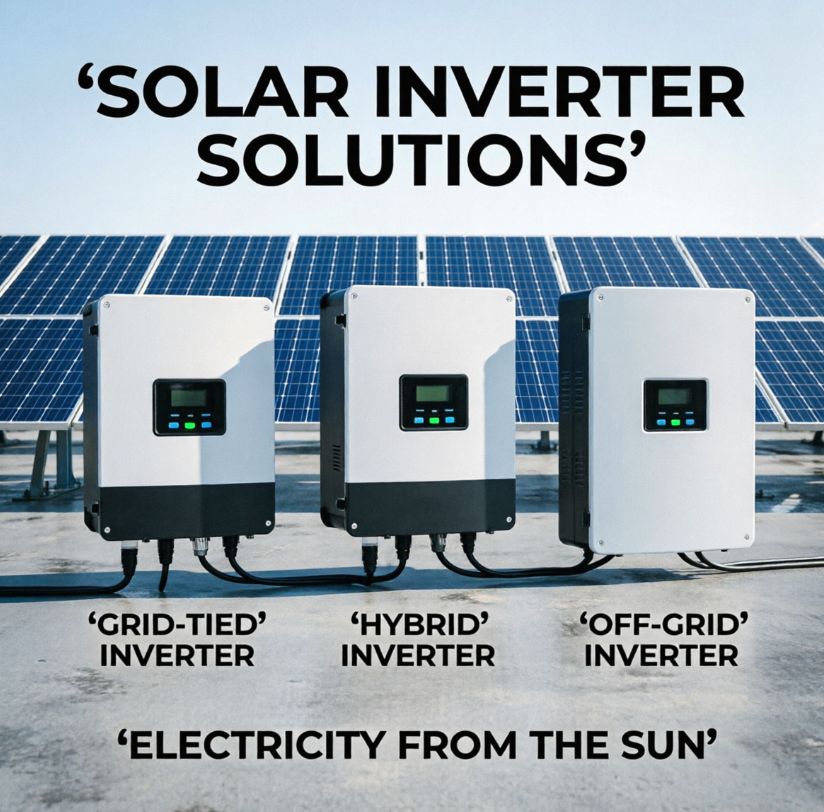
1. Grid-Tied Inverter
Connects to the grid and synchronizes with it. It converts DC from solar panels into AC and can sell excess electricity to the grid. Suitable for PV/wind grid-tied systems. Cannot supply power independently in areas without a grid and shuts down during a blackout.
2. Off-Grid Inverter
Operates independently without relying on the grid. Must be used with batteries. Suitable for power supply in off-grid areas or as home emergency backup. If you’re planning an off-grid lifestyle, you may find the article “How to Power an Off-Grid Cabin” helpful.
3. Hybrid Inverter
Combines grid-tied and off-grid functions. Manages power flow among PV, batteries, grid, and loads. Can switch to off-grid mode during a grid outage. Used in integrated solar-storage systems, supporting “self-consumption, surplus feed-in” and backup power.
Type 3: Application Area
1. PV Inverter (Solar)
– Central Inverter: Power above 500kW. Multiple PV strings are connected in parallel and converted centrally. Suitable only for flat ground-mounted power stations. Low unit cost, high efficiency; disadvantages: few MPPT channels, poor shading tolerance.
– String Inverter: Power range 1kW–300kW. Supports multiple MPPT trackers (each optimizes 1–2 strings independently). Mainstream for commercial/industrial rooftops and distributed stations, balancing cost and efficiency, with a small fault impact range.
– Microinverter: Power range 300W–2000W. Module-level connection, each PV module has its own inverter. Excellent shading tolerance and safety, suitable for residential rooftops with complex shading; however, cost is higher.
2. Energy Storage Inverter (PCS)
Manages battery charging and discharging. DC port connects to batteries, AC port connects to grid or loads. Available in both grid-tied and off-grid models.
3. Car Inverter
Familiar to many drivers. Converts 12V/24V DC from a car to 220V AC for household appliances in the vehicle. Power ranges from hundreds to several thousand watts, available in modified sine wave and pure sine wave.
4. Motor Drive Inverter (VFD)
Used to precisely control the speed and torque of AC motors. In industry, this is a variable frequency drive (VFD). The motor controller in an electric vehicle is also essentially a high-performance inverter.
5. UPS Inverter
Used in uninterruptible power supplies. Normally, the grid charges the battery; during a power outage, the inverter switches to supply power to home appliances within milliseconds.
Type 4: Output Phase and Voltage
– Single-Phase Inverter
Outputs single-phase 220V/230V AC (50Hz/60Hz). Suitable for homes and small commercial equipment.
– Three-Phase Inverter
Outputs 380V/400V three-phase power. Used for industrial equipment and higher-power systems, such as commercial/industrial PV and motor drives.
Type 5: With or Without Isolation Transformer
– Isolated Inverter
The DC and AC sides are isolated by a transformer, offering high safety, suppressing DC injection and common-mode interference.
– Line-Frequency Isolated: Uses a bulky line-frequency transformer; slightly lower efficiency but robust and reliable.
– High-Frequency Isolated: Uses a high-frequency transformer for isolation; compact, lightweight, and higher efficiency.
– Non-Isolated Inverter
Omits the transformer, achieving higher efficiency, lower cost, and smaller size, but requires better circuit design and leakage current suppression. Most modern grid-tied PV inverters are non-isolated.
Type 6: Circuit Topology
– Half-Bridge Inverter: Simple structure with few components, but output voltage amplitude is half of the input. Used for low power.
– Full-Bridge Inverter: Currently the most mainstream; strong output capability, suitable for medium to high power.
– Multilevel Inverter (e.g., NPC, ANPC, cascaded H-bridge): Can output more stepped waveforms, low harmonics, high efficiency. Advantageous in medium/high-voltage high-power applications (e.g., high-voltage energy storage, locomotive traction).
Type 7: Switching Devices
– IGBT Inverter: Suitable for medium-to-high power, frequencies up to tens of kHz.
– MOSFET Inverter: Mostly used in low-voltage, high-frequency low-power applications (e.g., microinverters, DC-DC front ends).
– SiC/GaN Inverter: Wide-bandgap devices, very high switching frequency, extremely low losses. Represents the direction of high-efficiency, high-power-density inverters, gradually being commercialized in high-end PV, EVs, and other applications.
How to Choose a Home Power Inverter
Based on the above, I believe you now have some understanding of inverter types. Many homeowners then ask: how do I choose the right inverter for my home, and what size do I need? Let me explain step by step.
Use Case
Scenario 1: You have solar panels but no battery storage. You generate power during the day for self-consumption and sell excess to the grid.
Recommendation: Buy a PV grid-tied inverter. It does not require batteries and will not work during a grid outage.
Scenario 2: You have solar panels plus battery storage, are connected to the grid, and want automatic switch to off-grid mode during a power outage.
Recommendation: Buy a hybrid inverter. It can connect to batteries, work grid-tied, and go off-grid. This is the most common choice for most households today.
Scenario 3: You are fully off-grid, relying solely on PV and battery power.
Recommendation: Buy an off-grid inverter.
What Size Power Inverter Do I Need?
Reference table for common home power requirements:
| Home Type | Load Combination | Recommended Inverter Power |
| Small (1-2 persons) | Lighting + TV + refrigerator + small kitchen appliances | 3–5 kW |
| Standard (3-4 persons) | Air conditioner + refrigerator + induction cooker + washing machine + water heater | 6–8 kW |
| Large / High demand | 2 AC units + high-power kitchen appliances + tankless water heater | 10–15 kW |
Scenario 1: You need a PV grid-tied inverter
Generally, match the inverter to the total power of your solar panels. For example, if your total PV power is 10 kW, choose an 8–10 kW inverter.
Note: Also check the inverter’s maximum DC input power and the voltage/current range per MPPT to ensure the string voltage and current stay within limits.
Scenario 2: You need a hybrid inverter
Your home load determines the inverter size. List all the appliances you need to run simultaneously during an outage, including their running power and starting surge.
Example:
Starting surge power: 1.5 hp AC (3300W) + refrigerator (600W) + induction cooker (2000W) + rice cooker (800W) = 6700W.
Final power: 6700W × safety factor (1.2–1.5) = 8040–10050W. Therefore, you would need a 9–11 kW inverter.
Many energy storage systems now integrate the battery and inverter. If you’re considering adding an energy storage system to your home, it may be worth looking at storage products from Chinese manufacturers—you might find exactly what you need.
Frequently Asked Questions
How many batteries are needed to run a 3000W or 5000W inverter?
For a 3000W inverter running for 2 hours:
Assume you need to power appliances with a total running power of about 2000W (remember, devices like refrigerators and ACs have starting surges 3–7 times higher—factor this in to avoid tripping) for 2 hours.
System choice: 48V battery bank (most recommended). Inverter efficiency: assume 90% (0.9).
– Lead-acid (50% DoD): (2000W / 0.9) / 48V × 2h / 0.5 ≈ 185 Ah. Buy 2 sets of 48V 100Ah lead-acid batteries in parallel.
– Lithium (80% DoD): (2000W / 0.9) / 48V × 2h / 0.8 ≈ 115 Ah. Consider one 48V 120Ah lithium battery.
For a 5000W inverter running for 1 hour:
Assume you need to run 4000W of appliances for 1 hour.
System choice: Must be 48V battery bank. Inverter efficiency: assume 90% (0.9).
– Lead-acid (50% DoD): (4000W / 0.9) / 48V × 1h / 0.5 ≈ 185 Ah. Buy 2 sets of 48V 100Ah lead-acid batteries in parallel.
– Lithium (80% DoD): (4000W / 0.9) / 48V × 1h / 0.8 ≈ 115 Ah. Suggest one 48V 120Ah lithium battery.
The exact configuration depends on your actual situation.
Can I power my house with a 12V home inverter?
It is suitable for short-term emergency powering of low-power appliances (a few hundred watts), not for continuous power supply to an entire home.
Can a 10,000-watt inverter power a house?
A 10,000W (10 kW) inverter has enough power capacity for the vast majority of ordinary homes. Only appliances like tankless electric water heaters (10–20 kW), large central AC units, or high-power electric floor heating may exceed 10 kW and need separate calculation.