
Over the past five years in the energy storage industry, I’ve seen the question “How many batteries do I need to run a 3000W inverter?” or similar variations of it on numerous forums and posts. But the truly accurate answer is never just a single number.
The question asks about the number of batteries, but what actually determines that number are three variables: the system voltage, the capacity of each battery, and how long you want the inverter to run at full load.
A 12V, 24V, and 48V system powering the same 3000W load can require several times the number of batteries. Without first determining the voltage and capacity, any number is just an assumption. Below, I’ll break down these three variables and calculate them for you.
How Many Batteries Do You Need for a 3000W Inverter?
As mentioned in the introduction, the battery capacity required for a 3000W inverter depends on three factors: system voltage (12V/24V/48V), battery type (lead-acid/lithium), and how long you want it to run.
According to UL Solutions, there are two important factors to consider when determining whether an inverter is suitable for use with a battery power source: first, whether the inverter is certified for use with a battery source; and second, whether the inverter’s input short-circuit current rating is greater than or equal to the available short-circuit current output by the battery and its battery management system.
The table below provides recommended configurations directly. Assuming you want to run the inverter at 50% load (approximately 1500W) for 4 hours, this represents one of the most typical use cases.
| System Voltage | Battery Type | Recommended Capacity (Ah) | Configuration | Estimated Runtime |
| 12V | LiFePO4 | 200Ah | 1 × 12V 200Ah | ~4 hours (1500W load) |
| 12V | Lead-acid/AGM | 300Ah | 2 × 12V 150Ah in parallel, or 3 × 12V 100Ah in parallel | ~4 hours (1500W load) |
| 24V (Recommended) | LiFePO4 | 100Ah | 2 × 12V 100Ah in series | ~4 hours (1500W load) |
| 24V (Recommended) | Lead-acid/AGM | 200Ah | 2 × 12V 200Ah in series | ~4 hours (1500W load) |
| 48V (Optimal) | LiFePO4 | 50Ah | 4 × 12V 50Ah in series, or 1 × 48V 50Ah battery pack | ~4 hours (1500W load) |
| 48V (Optimal) | Lead-acid/AGM | 100Ah | 4 × 12V 100Ah in series, or 1 × 48V 100Ah battery pack | ~4 hours (1500W load) |
How Does Battery Voltage Affect the Number of Batteries?
The higher the voltage, the lower the current. This is one of the most basic relationships in electrical engineering: when the power remains constant, doubling the voltage cuts the current in half. A 3000W load draws approximately 250A in a 12V system, 125A in a 24V system, and 62.5A in a 48V system.
Power (W) = Voltage (V) × Current (A). To maintain the same 3000W output:
This difference has a major impact on actual installation. A 250A current requires a 4/0 AWG cable (approximately 11.7mm in diameter), which is expensive, difficult to route, and requires more costly connectors. A 125A current only requires a 2 AWG cable (approximately 6.5mm in diameter), which significantly reduces costs. At 62.5A, you can use 6 AWG or even thinner cables.
Every time the current is reduced by half, the required cable cross-sectional area can be reduced by approximately half. A 48V system uses much thinner and cheaper cables than a 12V system and is also much easier to install.
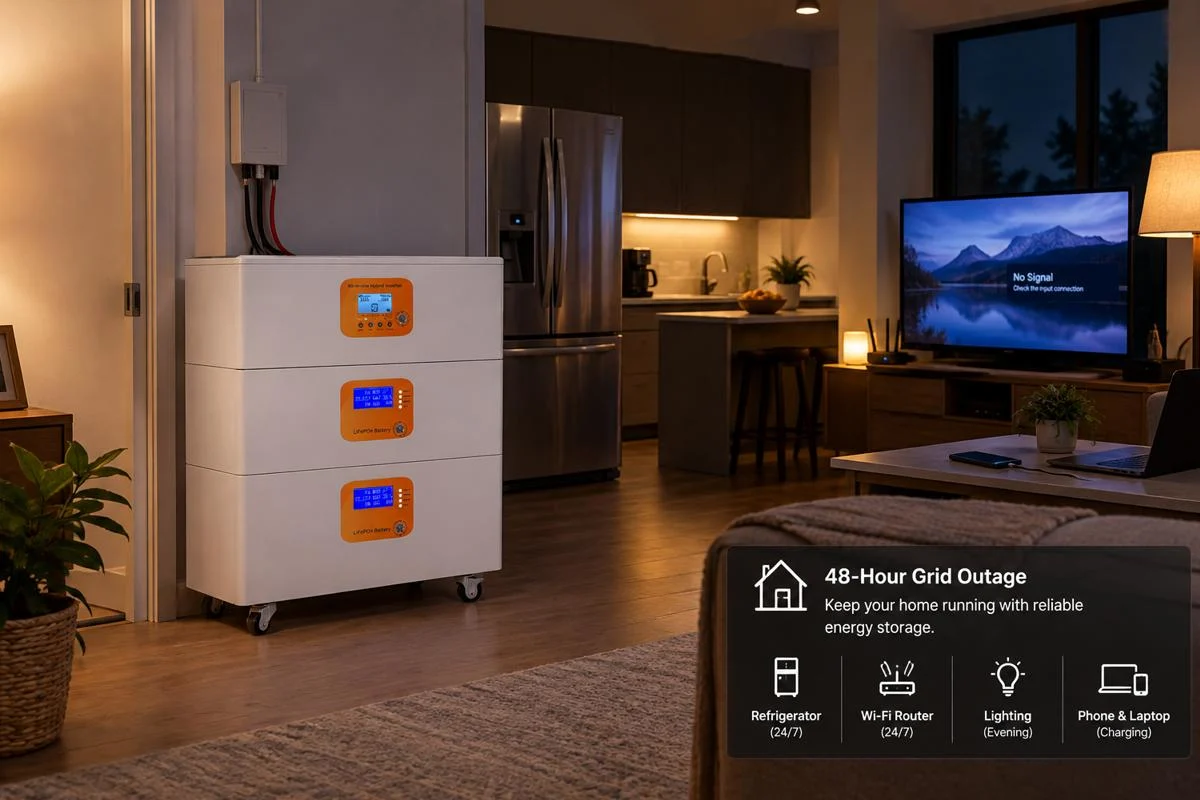
So, the Piforz ST2000 also uses a 48V system, and if you choose an all-in-one unit, you can avoid the hassle of installing everything yourself. But if you’ve decided to go the DIY route, let’s keep going.
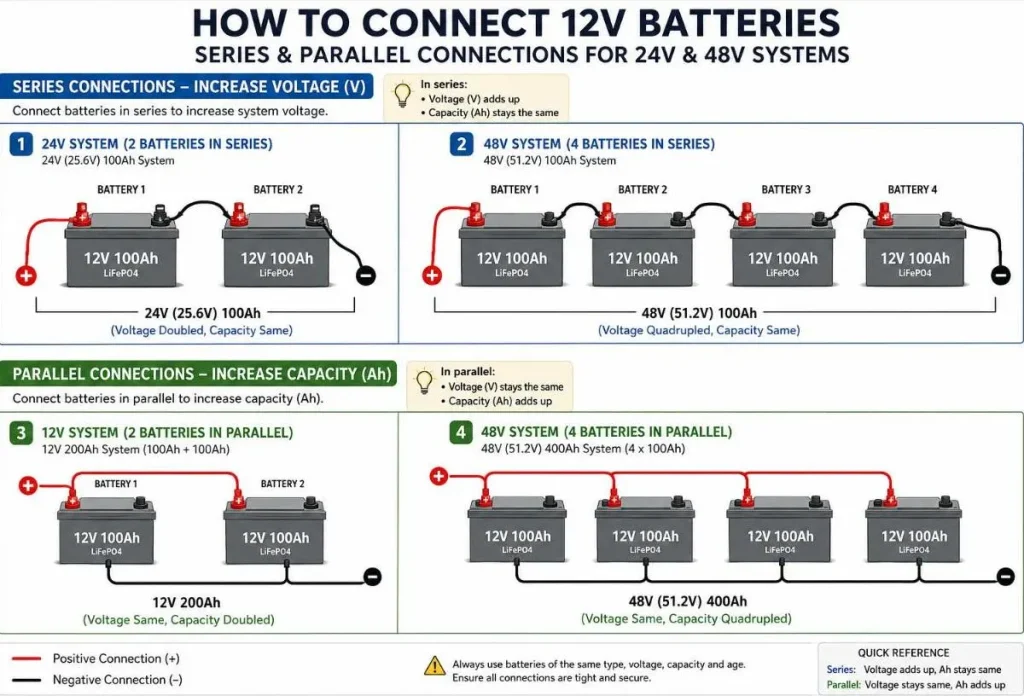
Voltage determines the series-parallel configuration of the battery bank:
The voltage of a single battery is fixed (2V/12V for lead-acid batteries, 3.2V/12.8V for LiFePO4 batteries). To reach the DC input voltage required by the inverter (such as 12V, 24V, or 48V), batteries need to be connected in series to increase the voltage.
- 12V system: 1 × 12V battery, or 2 × 6V batteries in series; the simplest configuration
- 24V system: 2 × 12V batteries in series; the number of batteries doubles, but the current is cut in half
- 48V system: 4 × 12V batteries in series; the most batteries, but the lowest current
The higher the voltage, the fewer batteries you need, provided that the total energy (Wh) remains the same.
Regardless of the battery voltage you use, the general formula for calculating the total number of batteries required is:
Required number of batteries ≈ Total energy demand (Wh) ÷ (Battery voltage × Battery capacity)
Based on the energy requirement, here is an estimate of how many batteries you need. Taking a 5000Wh energy requirement as an example:
| Single Battery Specification | Energy per Battery | Required Number of Batteries | Typical Configuration |
| 12V 50Ah | 600Wh | 9 batteries | 4 in series × 2 in parallel, then add to the configuration |
| 12V 100Ah | 1,200Wh | 5 batteries | Reconfigure based on the system voltage |
| 12V 200Ah | 2,400Wh | 3 batteries | Reconfigure based on the system voltage |
| 24V 100Ah | 2,400Wh | 3 batteries | 24V system |
| 24V 200Ah | 4,800Wh | 2 batteries | 24V system |
| 48V 100Ah | 4,800Wh | 2 batteries | 48V system |
Note: In an actual configuration, the number of batteries must also match the inverter’s input voltage range. For example, a 24V inverter requires two 12V batteries to be connected in series before additional parallel connections are made, while a 48V inverter requires four batteries in series. The number of cells increases, but the total stored energy remains unchanged.
If you configure 10 × 3.2V 100Ah cells into a 48V system, you would need 16 cells (48V ≈ 15 × 3.2V + margin; 16 cells are commonly used in practice), resulting in a total capacity of approximately 5120Wh (16 × 320Wh). Therefore, the actual total stored energy is not fixed at 5000Wh but naturally increases based on the system voltage and the number of cells.
For a 3000W inverter, the voltage you choose directly determines your battery configuration and installation costs. Although a 12V system requires the fewest batteries (1 battery), the cable costs and installation challenges caused by the high current often outweigh the advantage of buying one fewer battery. A 24V system is the sweet spot for 3000W-class applications, with a moderate number of batteries (2 in series), manageable current, and reasonable cable costs. A 48V system requires the most batteries (4 in series), but has the lowest current, highest efficiency, and thinnest cables, making it suitable for high-power applications or scenarios involving long cable runs.
How Does Battery Capacity Affect the Number of Batteries?
Battery capacity directly determines how many batteries you need to meet your total energy requirement. The larger the capacity, the fewer batteries you need; the smaller the capacity, the more batteries you need to connect in parallel. Based on the formula mentioned earlier, when the system voltage is fixed (for example, all at 12V), the larger the capacity (Ah) of each individual battery, the more energy (Wh) each battery can store, and the fewer batteries you need to meet the total requirement.
Take a look at the comparison below (all based on a 24V system with a total energy requirement of 4800Wh):
| Single Battery Specification | Energy per Battery | Number Required to Meet 4800Wh | Configuration | Notes |
| 12V 50Ah | 600Wh | 8 batteries | Connect 2 in series to form 24V, then connect 4 groups in parallel | More batteries and more complex parallel connections |
| 12V 100Ah | 1,200Wh | 4 batteries | Connect 2 in series to form 24V, then connect 2 groups in parallel | Common configuration with good balance |
| 12V 200Ah | 2,400Wh | 2 batteries | Connect 2 batteries directly in series to form 24V | Fewest batteries and simplest wiring |
| 24V integrated battery (100Ah) | 2,400Wh | 2 batteries (directly in parallel) | Connect 2 × 24V batteries in parallel | No series connection required; simplest configuration |
As you can see, when the capacity of each individual battery doubles, the number of batteries required is cut in half. Two 200Ah batteries are enough to reach 4800Wh, while 50Ah batteries require eight units, resulting in four times as much wiring work.
Battery capacity (Ah) and system voltage together determine the final number of batteries. However, it is important to note that battery capacity is not simply determined by the number of batteries. The higher the system voltage, the smaller the capacity of each battery can be for the same total energy, but the number of batteries connected in series will increase. In other words, if you already have four 12V 100Ah batteries, you can either connect them in series to form a 48V system (no parallel connection required, resulting in higher voltage and lower current), or configure them as two parallel strings of two batteries in series to form a 24V system (doubling the capacity while keeping the total energy the same). This depends on the inverter’s voltage platform and your actual requirements.
If you only look at capacity (Ah) without considering voltage (V), you can end up with the following situation: a 12V 100Ah battery (1200Wh) and a 24V 100Ah battery (2400Wh) have the same rated capacity (both are 100Ah), but their actual stored energy differs by a full two times. Therefore, when calculating the number of batteries, always calculate the energy of each battery first (voltage × capacity), then divide the total energy requirement by that value.
How Many 12V Batteries Do I Need for a 3000W Inverter?
A 3000W inverter is not suitable for direct connection to a 12V battery. At 12V, a 3000W load draws approximately 250A. Such a high current requires extremely thick cables (4/0 AWG or larger), and the inverter’s input terminals typically do not support such high current. In fact, most 3000W inverters recommend a minimum battery voltage of 24V.
So, how many 12V batteries do you need for a 24V system?
| Battery Capacity (per 12V Battery) | Energy per Battery (Wh) | 24V System Configuration | Number Required for 3000W Full Load for 1 Hour (approximately 3300Wh) | Number Required for 3000W Full Load for 2 Hours (approximately 6600Wh) |
| 50Ah | 600Wh | 2 batteries in series to form 1 string, then connected in parallel | 6 batteries (3 parallel strings, total energy ~3600Wh) | 12 batteries (6 parallel strings, total energy ~7200Wh) |
| 100Ah | 1,200Wh | 2 batteries in series to form 1 string, then connected in parallel | 4 batteries (2 parallel strings, total energy ~4800Wh) | 8 batteries (4 parallel strings, total energy ~9600Wh) |
| 200Ah | 2,400Wh | 2 batteries in series to form 1 string | 2 batteries (connected in series to form 24V 200Ah, total energy 4800Wh) | 4 batteries (two series strings connected in parallel, total energy 9600Wh) |
The calculations above use approximate total energy values, but the actual usable capacity is not equal to the rated capacity. For lithium batteries, it is recommended to leave a 10%–20% reserve, while lead-acid batteries should only be discharged to a maximum of 50% (otherwise, their lifespan will be significantly reduced). If you are using lead-acid batteries, the number of batteries required above should be doubled because the total energy should be calculated based on half of the rated capacity. For lithium batteries, you can calculate usable capacity based on 80%–90% of the rated capacity.
For systems with other voltages, you can refer to the following:
24V system: Typically requires four 12V 100Ah batteries (2 in series and 2 in parallel, with a total energy of approximately 4800Wh), which can support a 3000W full load for approximately 1.5 hours.
48V system: Typically requires four 12V 100Ah batteries (4 in series, with a total energy of approximately 4800Wh), which can support a 3000W full load for approximately 1.5 hours.
12V system (not recommended): Requires 3–6 × 12V 100Ah batteries connected in parallel (total energy of approximately 3600–7200Wh), but requires extremely thick cables, has lower efficiency, and presents greater safety challenges.
How Many 200Ah Batteries Do I Need for a 3000W Inverter?
There is no single answer to this question. The answer depends on the system voltage (12V, 24V, or 48V), battery type (lithium or lead-acid), and how long you want the 3000W inverter to run.
If you are using the most common 12V 200Ah lithium battery, one battery has an energy capacity of 2400Wh (12V × 200Ah).
However, the key point is that a single 12V 200Ah lithium battery can only run for about 45 minutes to 1 hour at a full 3000W load, and continuous 3000W output may already be near the limit of a single battery’s BMS, potentially triggering protection.
Therefore, in most cases, you need multiple 12V 200Ah batteries connected together to meet the actual requirements of a 3000W inverter. You also need to consider the system voltage. The higher the voltage, the lower the current at the same power level, and the fewer batteries you may need.
The following table shows specific configurations based on 200Ah batteries (using a 1500W load for 4 hours as the standard, which represents a typical half-load operating condition for a 3000W inverter):
| System Voltage | Battery Connection Method | Required Lithium Batteries | Required Lead-Acid Batteries | Description |
| 12V | Multiple batteries connected in parallel | 3 batteries (600Ah total capacity) | 6 batteries (1200Ah total capacity) | Extremely high current (250A+), requiring very thick cables. Not recommended for use with a 3000W inverter in a 12V system |
| 24V (Recommended) | Connect batteries in series to form a 24V group, then connect multiple groups in parallel | 2 batteries (2S1P, 200Ah total capacity) | 4 batteries (2S2P, 400Ah total capacity) | Cuts the current in half, allowing thinner cables with higher efficiency and better safety. Recommended for 3000W inverters |
| 48V (Optimal) | Connect batteries in series to form a 48V group, then connect multiple groups in parallel | 4 batteries (4S1P, 200Ah total capacity) | 8 batteries (4S2P, 400Ah total capacity) | Lowest current and thinnest cables, suitable for high-power and long-duration operation |
Note: The calculations above are based on the industry-standard estimates of 80% depth of discharge for lithium batteries and 50% depth of discharge for lead-acid batteries, and take into account approximately 90% inverter efficiency to maintain battery health and an adequate safety margin.
How Does Battery Type Affect the Number of Batteries?
In the previous sections, we mentioned that battery type affects the number of batteries required. In this section, we’ll take a closer look, using lithium iron phosphate (LiFePO4) and lead-acid batteries, which are commonly used in the residential energy storage industry, as examples.
Battery type determines how much usable energy you can get from the battery, which directly affects the number of batteries required. For the same 3000W inverter, the number of lithium batteries and lead-acid batteries required can differ by as much as two times.
The key difference is depth of discharge (DoD). Lithium batteries can safely be discharged to 80%–100%, while lead-acid batteries should generally only be discharged to a maximum of 50% to preserve their lifespan. This means that to store the same amount of usable energy, lead-acid batteries require nearly twice the total capacity.
Suppose your 3000W inverter requires at least 5000Wh of usable energy to get through the expected power outage. The calculation is based on 12V 100Ah batteries (1200Wh per battery), while the actual number required depends on the total energy demand and battery voltage configuration.
| Battery Type | Depth of Discharge | Total Capacity Required | Energy per Battery (12V 100Ah) | Number of Batteries Required (12V System) |
| LiFePO4 | 80% | 5000Wh ÷ 0.8 = 6250Wh | 1200Wh | 6 batteries (parallel) |
| Lead-acid | 50% | 5000Wh ÷ 0.5 = 10000Wh | 1200Wh | 9 batteries (parallel) |
Other factors that affect the number of batteries:
Energy density difference: At the same capacity (Ah), lithium batteries are approximately 50%–70% lighter than lead-acid batteries. Therefore, under the same weight limitations, lithium batteries can accommodate more battery capacity.
Charging efficiency difference: Lithium batteries have a charging efficiency of approximately 95%–98%, while lead-acid batteries are around 80%–85%. If you need solar panels to fully charge the batteries within a single day, lithium batteries require less solar panel power, which indirectly affects the overall system balance and battery capacity planning.
BMS management: Lithium batteries come with a built-in BMS that can coordinate charging and discharging when multiple batteries are connected in parallel, helping prevent imbalances caused by differences in battery performance. Lead-acid batteries do not have a BMS, so multiple batteries connected in parallel require stricter matching (same brand, same model, and same production batch). Otherwise, if one battery degrades, it can drag down the performance of the entire battery bank.
Therefore, if your budget allows, LiFePO4 batteries should be the preferred choice. Although each battery costs more upfront, they offer a longer lifespan (more charge-discharge cycles) and greater usable capacity, meaning you may actually need fewer batteries overall.
FAQ:
1. how many solar panels do i need for a 3000 watt inverter
A 3000W inverter typically requires 8 to 10 high-efficiency solar panels (such as 400W panels each). Because solar panels rarely generate at their rated power under real-world conditions, it is common in the industry to size the solar array’s DC power 20% to 30% higher than the inverter’s AC output power. This can actually help the system generate more electricity under low-light conditions, such as on cloudy days. For specific requirements, please consult a professional installer.
2.how big of an inverter do i need to run a microwave
It is generally recommended to choose an inverter rated at least 1500W to 2000W. This is mainly because microwaves have two key power ratings to consider: running power and peak power. The power draw when a microwave starts can be 2 to 3 times its running power, or even higher. Although this only lasts for a second or two, the inverter must have enough capacity to handle the surge. Overall, the inverter’s power rating should be higher than the microwave’s power rating.