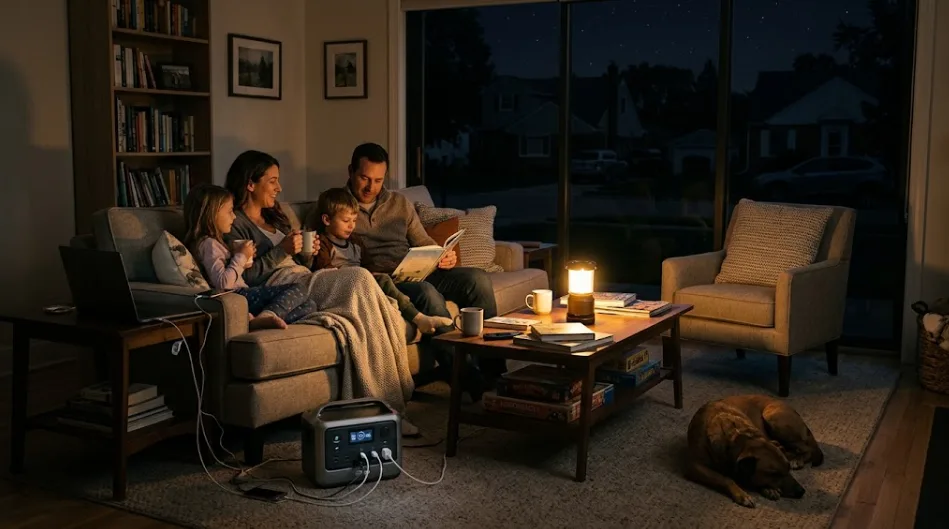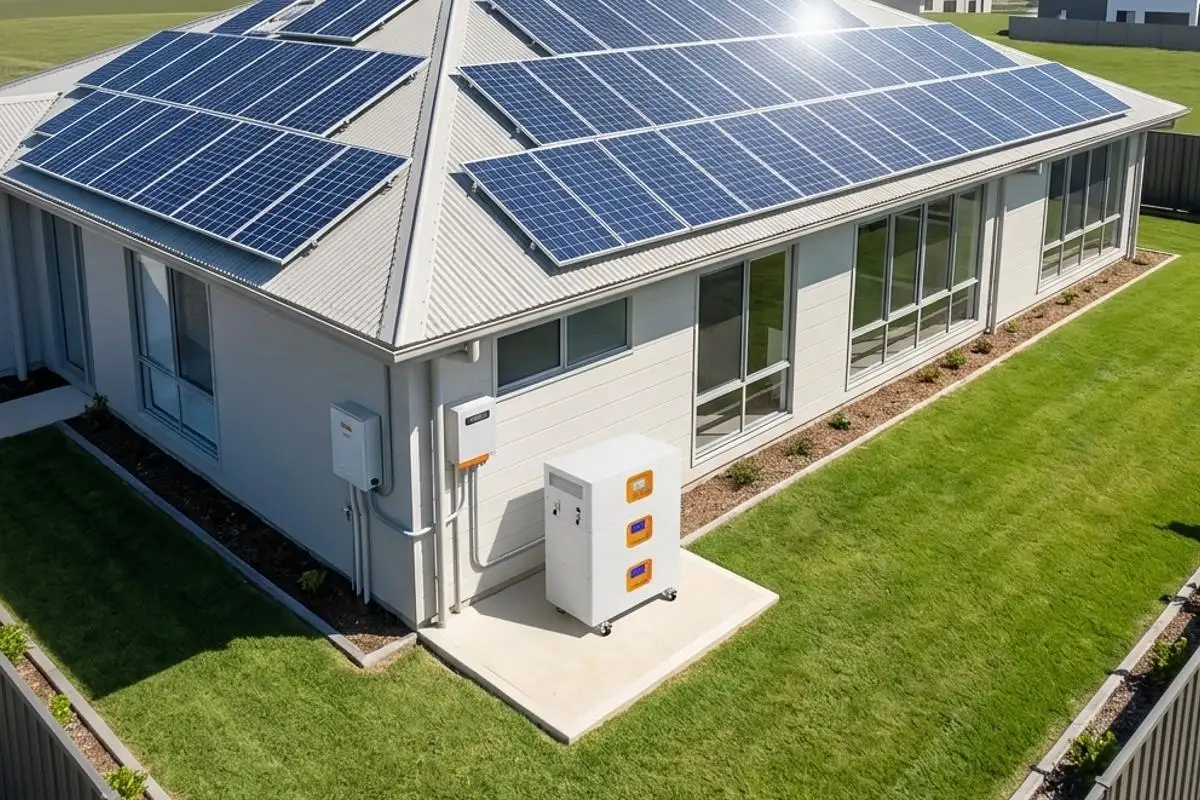

I once had a customer in Northern California who regularly received Public Safety Power Shutoff (PSPS) notices from his utility company, with outages lasting at least 48 hours. At first, he wanted to buy a 10kWh battery, thinking it would be enough to get him through a power outage. But before making the purchase, I asked him to do one thing: list the things he absolutely needed to keep running during an outage. The equipment he needed to power included a refrigerator, a router, a few lights, phone chargers, and an outlet for his water pump. Once we added everything up, these devices would need around 8–10kWh over 48 hours. In theory, a 10kWh battery could cover that demand, but only under ideal conditions. In reality, there would also be inverter losses and power consumption from other devices he hadn’t accounted for. So, following my advice, he ultimately chose a 15kWh battery paired with solar panels, allowing him to recharge some of the battery during the day and get through the 48 hours with a more comfortable margin.
So, the answer to how large a battery you need for 48 hours isn’t a fixed number, but rather a calculation process. It depends on which devices you need to keep running during an outage, how much electricity they consume per hour, and how much usable capacity the battery actually provides. Today, I’ll walk you through the calculations to help you determine the right backup battery capacity to power your home for 48 hours.
What Determines How Long a Home Battery Can Last?
How long a home battery lasts isn’t determined by capacity alone. Several factors work together to determine its runtime. Here’s a breakdown of the main ones:
Battery capacity is the foundation. The larger the battery capacity, the more energy it can store and the longer it can theoretically last. However, rated capacity isn’t the same as usable capacity. Lithium batteries typically retain a 10%–20% reserve, and inverter losses further reduce the available energy, leaving around 80%–85% of the rated capacity actually usable.
Household load is another key variable. The same battery might power a refrigerator and router for several days, but run out of power in just a few hours when supplying a central air conditioning system. How many devices you run simultaneously during an outage and how long you use them directly determine how quickly the battery drains.
Inverter efficiency affects the actual power output. Converting DC to AC typically results in around 10%–15% energy loss. These losses won’t show up in the power ratings of your appliances, but they still consume battery energy.
Depth of discharge (DoD) determines how much of the battery’s energy you can use. Lithium batteries typically support an 80%–100% depth of discharge, while lead-acid batteries are generally limited to around 50%. With the same rated capacity, a lithium battery can provide nearly twice as much usable energy as a lead-acid battery.
Temperature and battery aging also affect real-world performance. At low temperatures, the usable capacity of a lithium battery may temporarily decrease. After several years of use, the battery’s capacity may also degrade to 80%–90% of its original rated value.
How Much Electricity Does a Home Need Over 48 Hours?
To calculate how much electricity you’ll need over 48 hours, you first need to answer one question: Will you use electricity as you normally would during a power outage? Will you turn off appliances such as air conditioners, washing machines, and dishwashers, or will you only keep essential devices running? This means you can’t simply multiply your usual daily electricity consumption by two. Instead, you need to calculate your actual load during an outage.
Let’s look at two sets of figures: a reference value for normal whole-home electricity use and a practical estimate for essential loads during a power outage.
Normal Whole-Home Electricity Use
According to official data from the U.S. Energy Information Administration, the average American household consumes 10,791 kWh of electricity per year. Based on this figure, average daily consumption is approximately 30 kWh (10,500 kWh per year ÷ 365 days). Over 48 hours, that’s 60 kWh. This represents the total energy consumption of all your household devices operating normally, including air conditioners, water heaters, washing machines, dryers, dishwashers, lighting, and plug-in devices.
However, you shouldn’t use this figure to size your battery because you won’t—and often can’t—run all these appliances simultaneously during a power outage.
Essential Loads During a Power Outage
During an outage, the devices you’ll typically want to keep running include a refrigerator, router, a few LED lights, phone and laptop chargers, and possibly an aquarium air pump or medical equipment. Their approximate power ratings and energy consumption are as follows:
| Device | Operating Power | Energy Consumption Over 48 Hours |
| Refrigerator (cycling on and off, running about one-third of the time) | 150 W | About 2.4 kWh |
| Router | 20 W | About 1 kWh |
| LED lights (3 bulbs, 6 hours per day) | 30 W | About 0.36 kWh |
| Phone charging (2 phones, occasional charging) | 20 W | About 0.1 kWh |
| Laptop (occasional charging) | 65 W | About 0.5 kWh |
| Aquarium air pump | 15 W | About 0.72 kWh |
| Total | About 5 kWh |
If you also want to heat food in a microwave, run a small fan, or keep a CPAP machine running during an outage, your total electricity needs over 48 hours will increase significantly:
| Additional Appliance | Power | Additional Energy Consumption Over 48 Hours |
| Microwave (reheating food twice a day, 5 minutes each time) | 1,000 W | About 0.17 kWh |
| CPAP machine (8 hours per night) | 40 W | About 0.64 kWh |
| Small fan (8 hours per day) | 40 W | About 0.64 kWh |
| Electric blanket (4 hours per night) | 60 W | About 0.48 kWh |
With these additional appliances, total energy demand over 48 hours would be around 7–8 kWh. If you also need to run a small air conditioner or electric heater, calculate its consumption separately based on its actual power rating. Each additional hour of operation could use roughly 1 kWh.
How to Calculate the Battery Capacity Needed for 48 Hours?
The previous section calculated the actual electricity consumption over 48 hours. This section explains how to convert that figure into the battery capacity you need to buy. Two adjustment factors come into play: inverter losses and depth of discharge.
Step 1: Confirm Total Electricity Consumption Over 48 Hours
Use the figures from the previous section:
- Essential loads (refrigerator, router, lighting, and phone charging): about 5 kWh
- Including a microwave, CPAP machine, small fan, and electric blanket: about 7–8 kWh
- If you also need to power a small air conditioner or heater: add its consumption separately based on its actual power rating.
Step 2: Determine Inverter Efficiency
Converting DC to AC through an inverter involves energy losses, typically around 10%–15%. For a conservative estimate, use 0.85 (85% efficiency). You can consult the relevant product supplier for specific efficiency figures.
Step 3: Determine Depth of Discharge
Lithium batteries shouldn’t be discharged to 0% every time. It’s generally advisable to retain a 10%–20% reserve. For lithium iron phosphate (LiFePO4) batteries, a depth of discharge of 0.9 is a reasonable assumption, meaning you use 90% of the battery’s capacity before stopping.
Step 4: Apply the Formula
The core formula is: Required Rated Battery Capacity (kWh) = Total Electricity Consumption Over 48 Hours (kWh) ÷ Inverter Efficiency ÷ Depth of Discharge
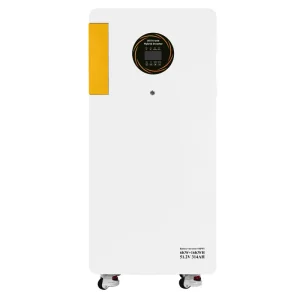
Essential-load scenario (5 kWh consumed over 48 hours): Required rated capacity = 5 ÷ 0.85 ÷ 0.9 ≈ 6.5 kWh. Therefore, a lithium battery with a capacity of around 7 kWh should be able to cover essential loads for 48 hours. Piforz’s 5–10 kWh series falls within this range, allowing you to choose a suitable capacity based on your actual load.
Scenario with additional appliances (8 kWh consumed over 48 hours): Required rated capacity = 8 ÷ 0.85 ÷ 0.9 ≈ 10.5 kWh. In this case, you’ll need a battery with a capacity of 10–11 kWh. Piforz’s 6 kW + 16 kWh energy storage system provides more capacity to spare, although you can also choose a smaller capacity based on your needs.
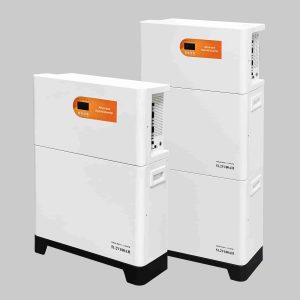
If you also need to power an air conditioner or heater: Suppose a small 800 W air conditioner runs for 10 hours over 48 hours, adding 8 kWh of energy consumption. Combined with the 5 kWh essential load, total consumption reaches 13 kWh. Required rated capacity = 13 ÷ 0.85 ÷ 0.9 ≈ 17 kWh. In this case, a 17–20 kWh battery would be needed to cover the full 48 hours. Piforz’s 10 kW + 30 kWh stackable energy storage system can meet this demand. If you need to power more loads in the future, the system can also be expanded to 45 kWh or even 60 kWh.
However, this calculation assumes the battery only discharges and receives no recharging during the 48-hour period. If you have solar panels, you can recharge the battery during the day, potentially reducing the capacity you need. For example, if you replenish 3 kWh during the day, the battery only needs to cover the remaining energy demand.
Can a 15kWh Battery Power a House for 48 Hours?
The answer doesn’t depend on the battery itself, but on what you’re actually running during a power outage. Let’s work backward using the formula from the previous section:
Usable energy over 48 hours = 15 kWh × 0.85 (inverter efficiency) × 0.9 (depth of discharge) ≈ 11.5 kWh
In other words, a 15kWh battery can provide approximately 11.5kWh of usable energy over 48 hours. This means it can last as long as your home’s total electricity consumption over those 48 hours doesn’t exceed 11.5kWh.
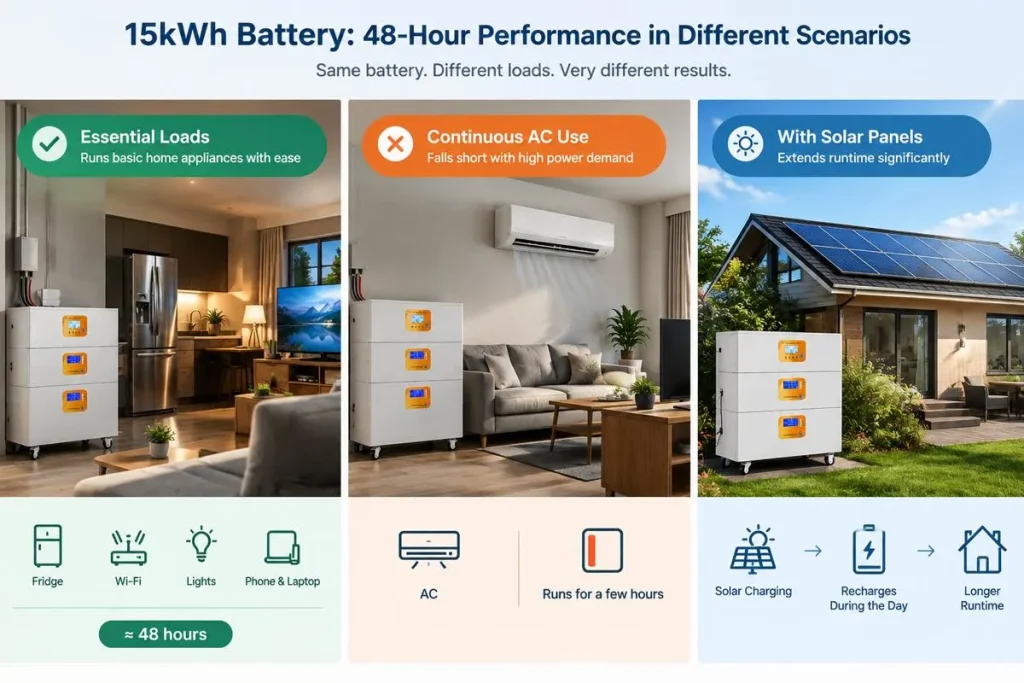
If you only need to keep essential devices running during an outage, such as a refrigerator, internet equipment, lights, and phone chargers, a 15kWh battery will comfortably last 48 hours, with plenty of capacity left for a laptop, fan, or occasional microwave use.
However, if you want to run an air conditioner, electric heater, or other high-power appliances during those 48 hours, a 15kWh battery won’t be enough. A small 800W air conditioner running 10 hours a day will consume 13kWh over 48 hours. Add the 5kWh essential load, and total consumption reaches 18kWh, exceeding the 11.5kWh of usable energy from a 15kWh battery. The shortfall isn’t enormous, but the battery still won’t last the full 48 hours. Alternatively, you can adjust how long you run the air conditioner based on your needs.
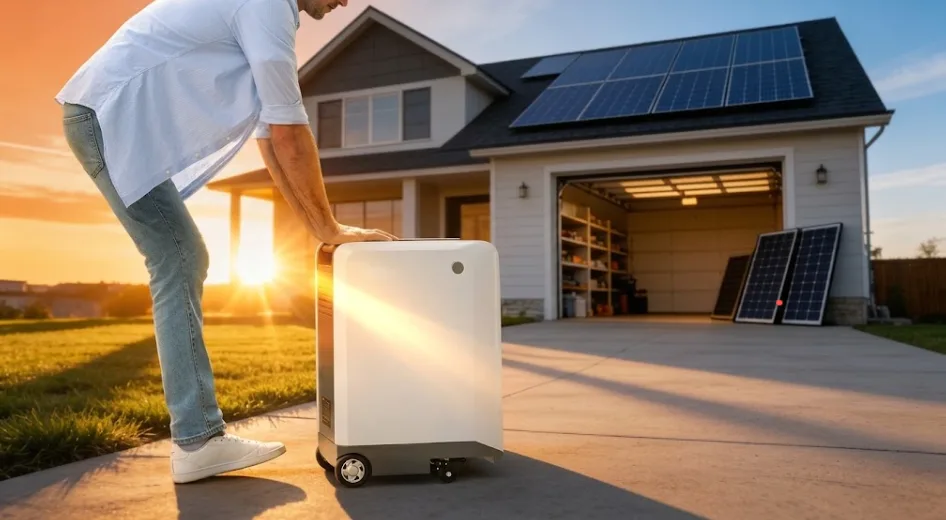
However, the situation changes if the 15kWh system is also equipped with solar panels that can recharge the battery during the day. Suppose you get four hours of effective sunlight per day and have 5kW of solar panels. They could generate around 15kWh per day, or about 12kWh after accounting for efficiency losses, giving you 24kWh over two days. Combined with the battery’s 11.5kWh of usable energy, that’s enough to cover around 35kWh of electricity consumption. In this case, running a small air conditioner for 48 hours—or even running a central air conditioner for short periods—may be possible.
If you only need to power a refrigerator, router, lights, and phone chargers, you’ll need a battery with around 6–7kWh of capacity for 48 hours. Add a microwave, CPAP machine, and small fan, and the requirement rises to 10–11kWh. If you also need to run a small air conditioner or heater, you’ll need a battery capacity of at least 17kWh. If you have solar panels, daytime recharging can reduce the battery capacity you need. If you’re relying entirely on battery power, you should size the system for the worst-case scenario.So, the next time someone asks how large a battery they need for 48 hours, don’t rush to give them a number. First, ask: What do you need to keep running during an outage? How much electricity do those devices consume in total? And how much usable energy does the battery actually provide? Once you have the answers to these three questions, the right capacity becomes clear.