If you’re heading to a campground without an electric hookup, how do you keep things powered? That’s a very real question. Don’t assume every RV site has power—even in North America, powered sites are common but not guaranteed. According to a market analysis by the RV Industry Association , about 63% of private campgrounds have water and electric hookups, while about 59% of public campgrounds offer electricity.
So before you book a campsite, it’s important to check whether your specific site has power—especially if you’re planning on bringing devices that need electricity. If your campsite doesn’t have an outlet, you’ll need to consider other ways to stay powered, such as portable power stations, solar panels, or generators.
This article will walk you through five power solutions for tent camping, along with practical safety tips to help you stay powered during your trip.
Do Tent Camping Sites Have Electricity?
Yes, most campgrounds do have electricity available, including tent sites. But there are also unpowered options, and those tend to be cheaper. Whether a tent site has power depends on the campground type, site configuration, and whether you booked a standard tent site or one with an electric hookup. So before you book, make sure you read the site description carefully. If you see “Electric Hookup,” “Electric Site,” or “Water & Electric,” that usually means the site has power. If it says “Non-Electric,” “Primitive,” or “Basic Tent Site,” chances are there’s no outlet.
Many powered sites only offer a standard 15A/20A household outlet—the same three-prong wall plug you have at home. The 30A and 50A outlets are more common at RV sites for larger rigs. For tent camping, though, that 15A/20A outlet is all you need. It looks just like the outlets in your house and runs at the same 110V voltage. So you can charge your phone, laptop, drone, and other gadgets exactly the way you do at home—no adapter or transformer needed, as long as your charger itself supports 110V.
If you want a deeper dive into 50A RV setups, check out our article about generator for 50 amp rv
But if you’re staying at a primitive site or dispersed camping area—the kind that feels more like old-school traditional camping—you’ll likely only get a picnic table, fire ring, and maybe a pit toilet, with no power outlet in sight. In that case, you’ll need to bring your own power solution, like a portable power station.
So before you head out, make sure you’ve confirmed: Does this tent site have power? What type of outlet is it? Is electricity included in the site fee or an extra charge? And does the campground allow tent campers to use these hookups? That way you’re not showing up empty-handed.
What Do You Actually Need Electricity for While Tent Camping?
Back in the day, a lot of people just threw a tent, a flashlight, and a sleeping bag in the car and headed out. Not anymore. These days, we’re glued to our devices—phones, smartwatches, tablets, laptops, cameras, you name it. If the campground has a dedicated power area, great. If not, it can be a real buzzkill. But then again, there are still folks who prefer to pack light, so the gear you bring and your power needs depend entirely on your style. Below is a reference table based on what members of the Reddit r/camping community typically bring, along with their approximate power draw.
| Category | Common Devices | Reference Power |
| Basic Essentials | Camping lanterns, flashlights, tent lights | Multiple LED lights: ~5–20W |
| Electronics | Phone, GPS, walkie-talkies, camera batteries, laptop, tablet, mobile Wi-Fi | Phone/walkie-talkie/mobile Wi-Fi: 5–30W; Camera battery: 5–15W; Tablet: 15–30W; Laptop: 45–100W |
| Entertainment | Bluetooth speaker, projector, drone | Bluetooth speaker: 5–30W; Portable projector: 40–120W; Drone battery charging: 30–90W |
| High-Power Devices | Microwave, induction cooktop, space heater | Car microwave: 800–1200W; Outdoor induction cooktop/electric skillet: 800–2000W; Camp space heater: 1000–2000W |
| Sleep & Health Devices | CPAP machine, air mattress pump, camp fan | CPAP: 30–60W (with humidifier: 90–120W); Air mattress pump: 50–150W; Camp fan: 10–40W |
| Cooking Gear | Mini fridge, rice cooker | Car mini fridge: 45–65W (~300–500Wh per day); Portable rice cooker: 200–400W (~150–250Wh per batch) |
If you’re just doing a basic overnight, you might need: Phone charging at 15W for 2 hours + LED light at 10W for 4 hours + electric blanket at 60W for 6 hours = 430Wh. That means you’d want at least a 500Wh portable power station. Add a CPAP machine (roughly 100W for 8 hours = 800Wh), and your total need jumps to nearly 1200Wh.
Keep in mind this table is just a rough guide—always check your own devices’ specs for real power and capacity. CPAP machines, in particular, need extra attention because different models, pressure settings, humidifiers, and heated tubes all affect consumption. So read the fine print on capacity, and always leave yourself a little extra buffer so you don’t run out in the middle of the night.
Main Ways to Get Electricity for Tent Camping
Based on real discussions from Reddit r/camping and Good Sam forums, combined with product specs from major brands, here are the five most common power solutions for tent camping:
1. Campground Electric Hook-Up
As we mentioned above, it all depends on the campground type. Having a powered site is super convenient—you don’t need to bring your own power source, and you get the same stable electricity you’d have at home. Better yet, you can run your devices without worrying about capacity or wattage limits.
The downside? Even though you don’t have to bring a power source, you might have to share that outlet with other campers. And powered sites usually cost an extra $10–$20 per night.
If you’re using campground power, you’ll need some extra gear for safety and convenience. The outlet might be 25 to 50 feet away from where you actually set up your tent, so you’ll need a long, heavy-duty extension cord—nothing flimsy, because you don’t want people tripping over it or wearing it out. And once you run that cord into your tent, you’ll want a power strip so you can plug in multiple devices at once.
2. Portable Power Station
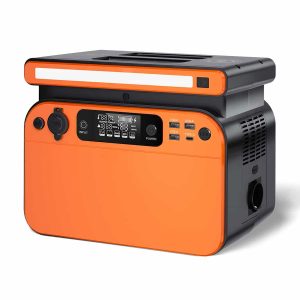
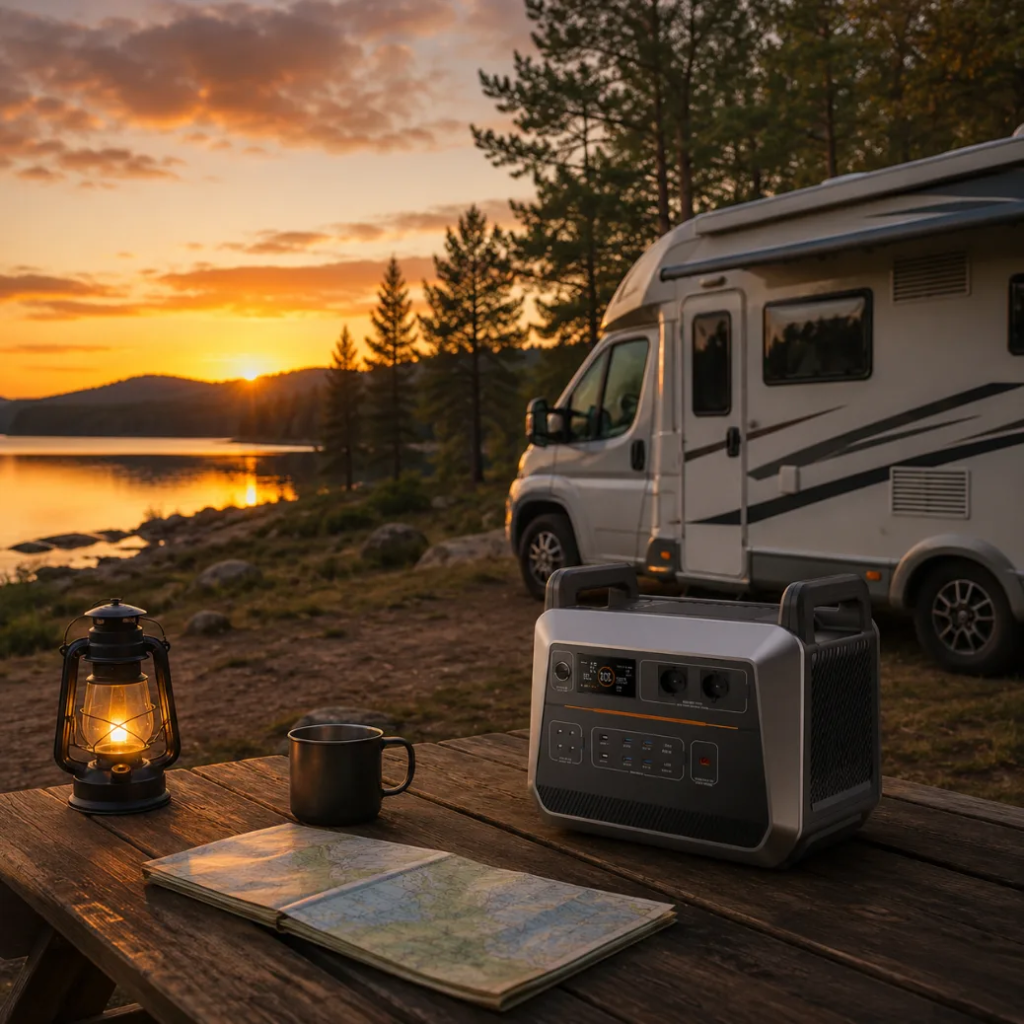
Portable power stations are many campers’ top choice, and for a lot of folks, they offer the best balance of convenience and capability. The biggest advantage is that they’re like a giant power bank with multiple output options—perfect for anyone bringing a variety of devices outdoors. Their strengths are obvious:
Virtually silent operation:Like a power bank, they produce almost no noise during normal use. Only when outputting high wattage and the cooling fan kicks in do you hear a faint hum—barely enough to bother anyone.
Zero emissions:They run on battery power, so no fuel, no exhaust, and zero fumes. You can use them anywhere without worrying about ventilation.
Plenty of ports:They come with AC outlets, USB-A and USB-C fast-charge ports, and 12V DC outputs, so you can charge phones, cameras, laptops, lights, and more simultaneously.
Safe and flexible charging:Most use lithium iron phosphate (LiFePO₄) batteries with excellent thermal stability, so you can keep them right inside your tent or under your canopy without safety concerns. And you can recharge them via wall outlet, solar panel, or car charger.
Major brands include Jackery and EcoFlow, and newer players like PIFORZ are also worth a look. Capacities range from 200Wh to over 2000Wh, with prices roughly: EcoFlow River 2 (256Wh) ~$179, Jackery 300 Plus (288Wh) ~$269, Jackery 1000 Plus (1264Wh) ~$999. According to brand specs, a 300Wh unit can charge a phone 4 times + a laptop once + run an LED light for a night—good for about two nights of basic use. If you need to run a CPAP overnight, better go for a 700Wh+ model.
Of course, they have limits too. The battery is finite—unlike a wall outlet, you have to watch your usage and capacity. They’re not great for running A/C units, space heaters, or high-power induction cooktops for long stretches, since those will drain a station fast. And you’ve got to charge it up before you leave—otherwise, you’re praying for good sun with solar panels, or you’re out of luck.
Over on Good Sam and Reddit, plenty of people ask whether a portable power station is worth the investment. In my view, the real question is: besides tent camping, will you actually use it elsewhere? The answer is yes—about 80% of outdoor scenarios can benefit from a portable power station, and they also work as backup power at home. But if you don’t have much of a power need and won’t use it often, other options might work just fine.
3. Solar Panels
Solar panels are an option, but they work better as a supplemental charging system rather than your sole power source. Using something like a Jackery SolarSaga 100W portable panel, on a clear day with good sun angle and no shade, you can add roughly 300Wh to your power station over a day. With peak sun, you might even get 400–500Wh—enough for phones, lights, fans, and other basics. That works great during the day, but what if it rains, or night falls before your battery is topped up? That’s why solar panels are usually paired with a battery or portable power station for the best results.
4. Battery Bank or Deep-Cycle Battery
Beyond the all-in-one power stations you see everywhere, there’s a more hardcore, old-school approach: building your own power system with deep-cycle batteries. Some experienced campers in the forums talk about stringing together a couple of standard 6V batteries to last for days in the backcountry. It’s doable—but is it for everyone?
Sure, plenty of folks DIY their own setups, especially in the U.S. where RV culture and DIY are huge—there are tons of tutorials on Reddit and YouTube. But honestly? It’s a lot of hassle compared to just buying an all-in-one unit. And there are real safety risks. Reverse the positive and negative terminals, and you’ll get sparks flying, an inverter fried on the spot, or worse, damage to the battery’s internal protection board. Exposed terminals are another hazard—drop a wrench or metal tool across them, and you’ve got a dead short, massive current surge, and a tool that can turn red-hot in seconds. All-in-one units have smart management systems that cut power if you exceed limits. With a DIY system, if you hook a 1000W inverter to a battery that can only handle 300W, or plug in too many devices at once, you’re looking at blown fuses at best, or battery overheating, swelling, or even fire at worst.
Bottom line: unless you’re an experienced pro, don’t try this at home. The risks far outweigh the rewards.
5. Generator
If your power needs are huge and none of the above options cut it, you’re left with the traditional fuel-powered generator. And there’s no denying generators are way more powerful than any battery system.
Energy density is on another level. Pound for pound, gasoline stores dozens of times more energy than lithium batteries, so a generator can sustain high output for hours while a battery drains in no time.
Refueling is instant. Run out of gas? Pour some in from a jug—10 seconds and you’re back to 100%. As long as you have fuel, you can keep going indefinitely. With a portable power station, you have to wait for it to recharge.
They can handle big loads. High-startup-current devices like A/C units, welders, and large pumps—generators can handle them.
But the downsides are equally real:
Noise. The roar of a generator is jarring in the wilderness. It bothers you and your neighbors, and many quiet campgrounds ban them outright.
Exhaust fumes. Gas combustion produces carbon monoxide and other toxic gases. You must use them outdoors in well-ventilated areas—never inside a tent or enclosed space—or risk CO poisoning.
You have to carry fuel. That means a gas can, a trip to the station, careful storage on the road, and fire-safety precautions during use—way more hassle than plug-and-play.
Which Power Option Is Best for Tent Camping?
Still not sure? Take a look at this comparison chart—it should help you decide.
| Power Option | Advantages | Limitations | Best For |
| Campground Hook-Up | Steady power, unlimited use | Not available at all sites | Campers on powered sites |
| Portable Power Station | Quiet, clean, user-friendly | Limited capacity, can’t go all-out | Most tent campers |
| Solar Panels | Recharges during the day | Weather-dependent, slow on cloudy days | Multi-day trips |
| Deep-Cycle Battery Bank | Customizable capacity | Requires electrical know-how, safety risks | Experienced DIYers |
| Fuel Generator | High output, quick refueling | Loud, fumes, need to carry fuel, maintenance | High-power-device users |
Safety Tips for Using Electricity in a Tent
When it comes to electricity, safety is priority number one. The following guidelines are based on CDC recommendations, NEC electrical codes, and industry best practices:
- If you’re using a fuel generator, keep it outside the tent and well away from the entrance. The CDC explicitly recommends positioning generators at least 20 feet away from tents, windows, or vents to eliminate any risk of carbon monoxide poisoning. Don’t be lazy and just move it a couple of feet.
- With portable power stations, protect them from moisture and ensure good ventilation. Place them on a dry surface—ideally elevated on a mat or pad, not directly on damp ground.
- Keep all plugs and power strips clear of water. Tents can have condensation or accidental spills, so elevate your connections on a tabletop or an overturned storage bin rather than leaving them on the ground.
- Use extension cords rated for outdoor use. Standard household cords have insulation that degrades quickly in outdoor conditions. Look for “outdoor-rated” or “water-resistant” labels, and choose a thick enough gauge—don’t use a skinny little cord for high-power devices.
- Don’t overload a single power strip with too many high-wattage devices. Kettles, space heaters, electric blankets, and small A/C units—avoid plugging them all into the same strip. Run multiple high-power items at once and you risk tripping the breaker, overheating the wires, or worse.
- Be extra cautious with space heaters, kettles, coffee makers, and A/C units. These either draw a lot of power or have heating elements. Keep an eye on them while they’re running—don’t leave them on while you sleep or step away.