
As we all know, in new energy fields such as energy storage and portable power, one fixed component is always mentioned—solar panels. We can use solar panels to charge and replenish batteries in various devices. But there is a problem that many people overlook, and it is an extremely important one: can all types of batteries accept charging from solar panels? Of course not. Solar panels can only charge secondary rechargeable batteries (storage batteries). It is strictly forbidden to directly connect non-rechargeable primary batteries (such as alkaline batteries or single-use lithium manganese batteries), otherwise reverse forced charging will cause the electrolyte to vaporize, internal pressure to surge, and the safety valve to rupture or even explode. However, in actual off-grid and energy storage systems, being chargeable does not mean it can be connected directly.
How solar panels actually charge a battery
Solar panels cannot directly charge a battery, and doing so will cause very bad consequences. So how exactly do solar panels turn this electricity into electricity that can be charged and used?
In fact, a complete solar charging process is not as simple as panel → battery, but a process of gradual stabilization and matching.
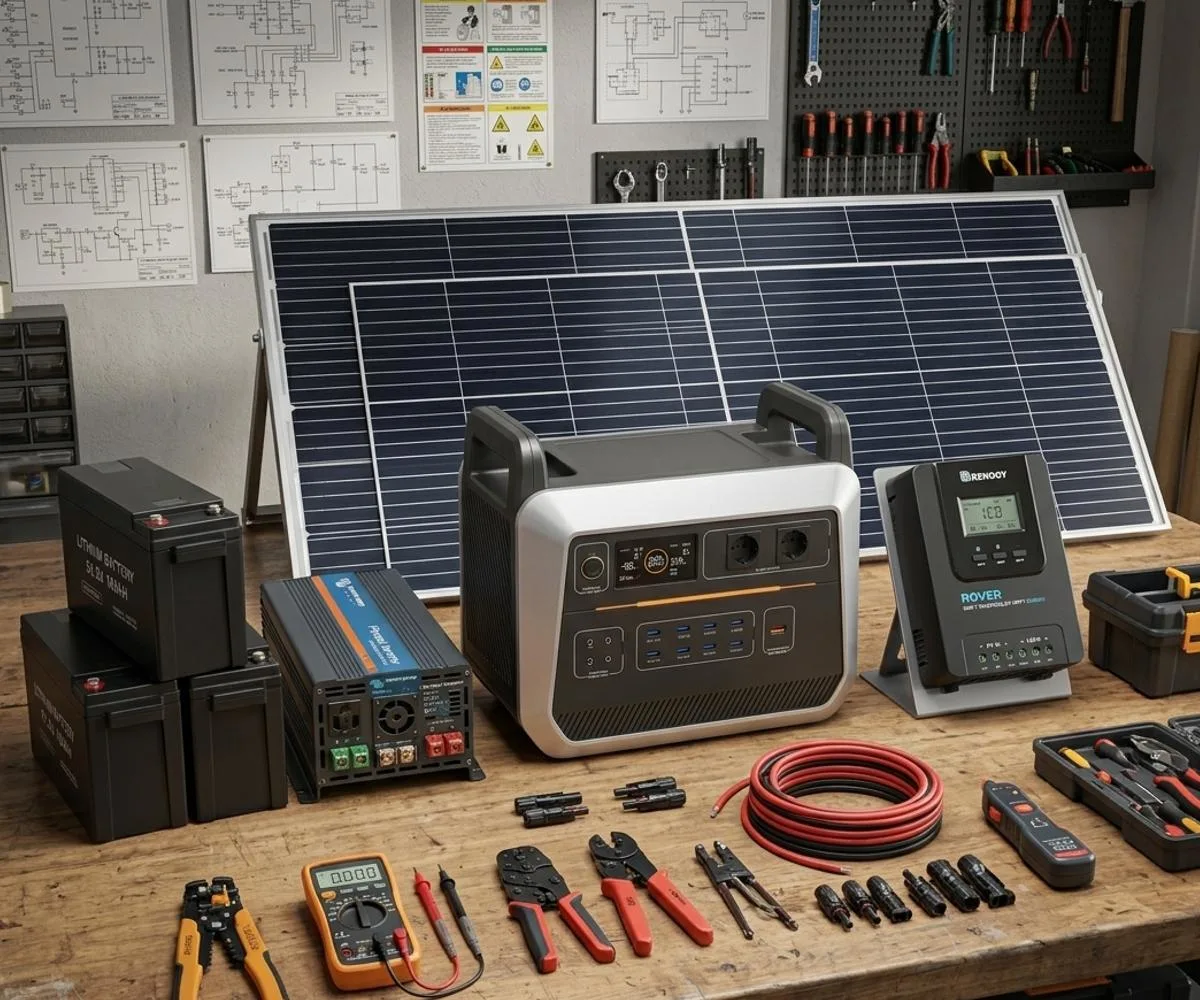
First, after the solar panel absorbs and outputs electricity under the influence of weather changes, it is direct current, and both voltage and current are unstable. This part of the electricity first enters a charge controller such as MPPT or PWM, where it is “organized” into a charging method acceptable to the battery. That is, it converts the originally fluctuating input into a more stable voltage and outputs it according to the charging curve required by the battery.
Then this part of the electricity, which has already been reorganized, enters the battery system. After entering, the BMS inside the battery continues to provide the final layer of control. It not only plays a protective role, but also ensures that each cell works within a safe range, such as limiting charging voltage, controlling temperature, and avoiding overcharging or overdischarging. It is precisely because the charging process is controlled more precisely that the performance differences among different batteries in the same system become more obvious. Each battery has its own suitable charging voltage range and charging method. If the system is not matched to the battery, even if electricity can be charged in, efficiency may be very low, and it may even accelerate battery aging during long-term use.
So, a complete solar system is not simply charging a battery. It is constantly converting unstable natural energy into electrical energy that the battery can use safely over the long term.
What batteries can you use with solar panels?
Battery types
Not all types of batteries can accept charging from solar panels. Only storage batteries can accept charging. Batteries can be divided into two types: primary batteries and secondary batteries. This does not refer to the number of uses, but to whether the energy conversion inside the battery is one-way or two-way.
Primary battery: After this kind of battery is manufactured, the chemical energy stored inside can only be released once in a one-way conversion into electrical energy. If it is forcibly charged afterward, the current cannot restore the chemical bonds along the original path. Instead, it will also cause electrolyte decomposition, a sharp rise in internal heat, and lead to the safety valve bursting open, leakage, or even explosion. Ordinary alkaline batteries, carbon-zinc batteries, and single-use lithium manganese batteries are all primary batteries. The batteries in household remote controls, gas stove igniters, wireless mice, ordinary children’s electric toys, and button cells are basically all primary batteries.
Secondary batteries also refer to cells that, after being manufactured, usually need secondary processing and charging formation before they can be used. More importantly, they can be reinjected with energy many times. That is, after discharging, they can be charged again, and then a second time, a third time… even thousands of cycles. For example, lithium iron phosphate, ternary lithium, lead-acid storage batteries, and so on that we see on the market are all secondary batteries.
Common batteries that can accept solar panel charging
As mentioned earlier, only secondary batteries, that is, storage batteries, can accept charging. For a battery to accept charging from a solar panel, it depends not only on whether the battery itself accepts charging, but also crucially on passing through a solar charge controller to stabilize voltage and prevent overcharging.
You need to know that a solar panel itself is not a device that directly charges a battery. The electricity absorbed by a solar panel is greatly affected by weather, so the voltage and current it directly produces fluctuate sharply. This absolutely cannot be directly charged into a battery. Direct connection can easily cause overvoltage, overheating, bulging, and even fire risks. Therefore, no matter which battery you use, an intermediate link is needed to “regulate” voltage and current. Generally, there must be two lines of defense in between. The first is a charge controller, such as MPPT, which can organize the high-voltage, messy electricity from the solar panel that rises and falls erratically into a constant-current, constant-voltage charging curve acceptable to the battery, and block reverse charging at night. The second is the BMS system, which constantly monitors the state of the cells. Once it detects conditions such as overheating or overcharging, it immediately physically disconnects.
Moreover, “can charge” and “suitable for long-term use in a solar system” are actually two different things. Many batteries can theoretically be charged, but they are not suitable for repeated solar energy storage. Therefore, from the perspective of actual use, the common batteries that can be used in solar systems are roughly these categories:
| Dimension | Lithium Iron Phosphate | Ternary Lithium | Lead-Acid Battery |
| What it is suitable for | Backup during outages, the first choice for home and outdoor energy storage, sturdy and durable | Lightweight outdoor power supplies, short-trip emergency use; for those who want light weight and small size. | Occasional emergency backup on an ultra-low budget; extremely low initial purchase cost, but you must accept the price of bulky size and short replacement cycles |
| Safety and temperature resistance | Extremely high safety. Thermal runaway temperature reaches 500°C–600°C; and decomposition does not release free oxygen, making it very difficult to catch fire | Thermal runaway is about 150°C–200°C; once the circuit fails and overcharging occurs, the risk of spontaneous combustion is relatively high | Relatively safe under normal sealed use; if overcharged, it will cause the casing to swell and release trace acid gas, so open flames must be guarded against |
| Battery storage conversion efficiency | Above 95%. Low internal resistance, almost no waste of the electricity charged in by photovoltaics | Around 90%. Part of the electrical energy is converted into body heat during charging | Only 70%–80%. Nearly 20% of the electrical energy is wasted as heat from internal resistance and electrolytic reactions |
| Usable depth of discharge during outages (DoD) | Can reach above 90%–95%, but it is recommended to use 80%–90% | About 80%–90%. More usable capacity, but frequent complete draining will accelerate lifespan degradation | Discharge depth is only half, and a maximum of 50% DoD is recommended; deeper discharge will cause sulfation |
| Long-term idle standby | After being fully charged and left for half a year without attention, it still has most of its charge when taken out, ready for use | Self-discharge during storage is also relatively slow, but it should not be left for a long time in a high-temperature environment with full charge and direct sunlight | Monthly self-discharge rate reaches 4%–6%; if not recharged for 3 months while idle, irreversible passivation and scrapping are likely |
| Solar charging and discharging in severe cold scenarios | Can discharge but cannot charge; in extremely cold environments, an built-in heating film must be selected | Discharge capacity shrinks noticeably below zero; large-current charging is restricted at low temperatures, and low-temperature tolerance is average | Capacity is halved below zero; supports weak low-temperature slow charging, but it is extremely difficult to fully charge, and severe cold seriously weakens power |
| Service life (cycle count) | 3,500–6,000 cycles. With frequent daily charging and discharging, it can be used for 8–10 years or more, with extremely strong resistance to degradation | 800–1,500 cycles. Under normal use, degradation gradually becomes obvious in 3–5 years, and it is not suitable for high-frequency deep cycling | 300–500 cycles. Under daily high-frequency charging and discharging, it can only last 1–2 years |
| Charging protocol requirements | Two-stage (CC/CV); after constant current switches to constant voltage and reaches full charge, it must be disconnected quickly, and long-term high-voltage float charging is strictly prohibited | Two-stage (CC/CV); strict temperature-control linkage, and speed/current must be immediately reduced if the body overheats | Traditional three-stage (Bulk/Absorption/Float); after full charge, a long-term tiny current float charge is needed to maintain voltage |
Which battery is best for solar panels?
When the question changes from “can it be used” to “which one is more suitable,” the logic of judgment is completely different. It is not just about looking at a single set of data, but also about comprehensively weighing it against specific usage scenarios. Under different usage environments, the system’s requirements for batteries are completely different:
- Outage backup
If the need is only outage backup, that is, it is not used much normally, and you want to protect some important and critical devices when a power outage occurs, then the requirements for the battery are also very simple: it must be safe, stable, and ready for use at any time. As long as the capacity is not particularly small, it can be placed at home and taken out immediately when a power outage occurs.
In this scenario, the core considerations are float-charge life, self-discharge rate, and initial purchase cost. Lithium iron phosphate is indeed very suitable. Its chemical structure is stable, safety is high, and placement stability is also good. No matter how long it is left at home, there is not much to worry about. It also comes with a low-static-power-consumption BMS and is basically maintenance-free. Of course, lead-acid batteries are also often used here, mainly because the initial purchase cost is low. When the budget is especially tight, sealed AGM lead-acid still has a place. But its trouble is: it needs regular water replenishment, cannot be deeply discharged, and also needs regular high-voltage equalization charging. Compared with the maintenance-free nature of LFP, lead-acid is indeed more troublesome.
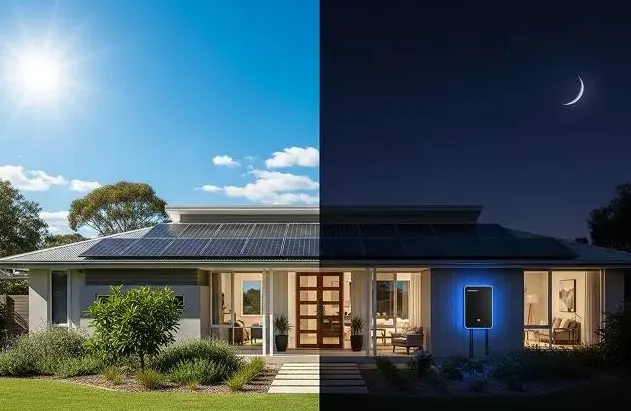
If the scenario in which the battery is to be used is home energy storage, then the requirements for the battery are even higher. Home energy storage not only needs to take over the household electrical equipment’s demand for electricity when the mains power is unavailable; it also needs to store solar energy during the day and release the stored electricity at night. This storing and releasing makes the battery’s usage frequency noticeably higher, and the requirements for cycle life and efficiency are also higher.
Therefore, in this case, the consideration standard becomes the cost spread over each kilowatt-hour, cycle life, and round-trip charging and discharging efficiency. LFP has a high cycle count and a high depth of discharge. For batteries of the same capacity, more of the electricity can actually be used, and it is also more durable. With more than 4,000 cycles and round-trip efficiency above 95%, after careful calculation, the cost per kilowatt-hour is far lower than that of lead-acid batteries. So in this scenario, LFP is basically the first choice, not because it is the only one that can be used, but because the math works out in this scenario.
- Off-grid system
If you want to go directly off-grid and not connect to the power grid, and all the equipment used at home depends on the sun and batteries, then the requirements for the battery rise another level. At this time, the demand for the battery is not just whether it is easy to use, but also whether the battery can operate stably over the long term. In an off-grid environment, the battery experiences a complete charge-discharge cycle almost every day. Once the system is unstable, it may directly affect household electricity use.
Therefore, cycle life, stability, and overall efficiency all become very critical. In this scenario, LFP is still the most recommended solution, especially because it has more advantages from the perspective of long-term usage cost.
However, you should know that lithium iron phosphate batteries are not good at cold resistance. Below 0°C, their usable capacity is greatly reduced, and more importantly, charging is not allowed below 0°C. That is to say, in extremely cold regions, if you do not have very complete measures to protect the battery temperature, it is very difficult for you to use electricity normally.
If the budget is really limited, then lead-acid batteries are also a pretty good choice. Their initial purchase cost and threshold are both low, and the technology is mature and available everywhere. But the premise is that you can accept their short service life and the high replacement cost over the long term.
So, from the analysis above, it is not difficult to see that in most current practical applications, the reason lithium iron phosphate batteries have become mainstream is not because they are the only usable option, but because they achieve a better balance among lifespan, safety, and usage efficiency.