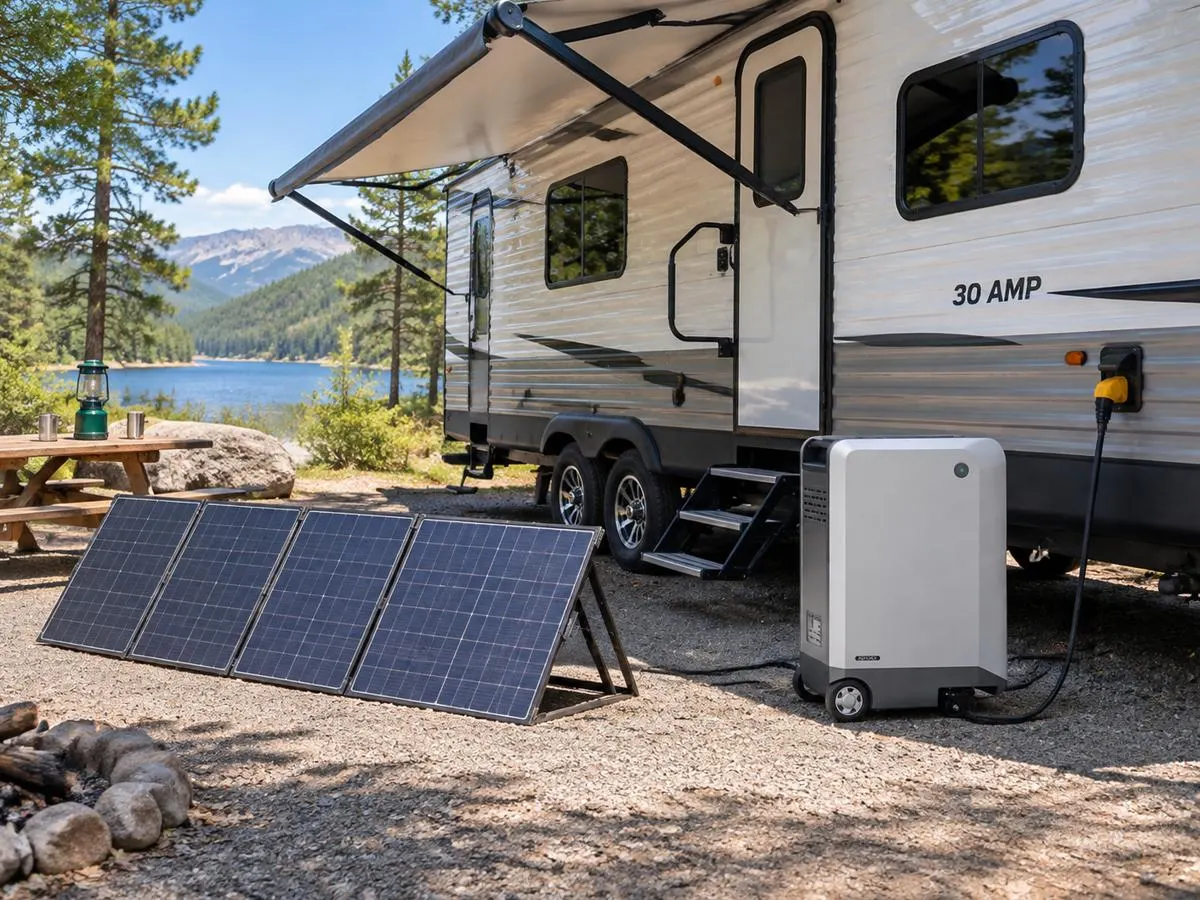

We all know that the rate at which solar charging absorbs energy is determined by the power rating of the solar panel. Many people care more before buying about whether the panel is large and whether it charges fast, but few pay attention to or care about what to do after they get it home and the solar system is fully charged. Do you keep charging? Will it affect or damage the battery? Or do you want to take the solar panel down so it doesn’t keep sitting in the sun? People do a lot of homework before buying, but after buying they are almost completely unfamiliar with use and maintenance or other knowledge areas like this. But that’s okay—this article will introduce you to what the “world” is like after solar charging is full.
Where Does the Solar Energy Go?
A solar panel is essentially a voltage source excited by light, not a water pump that must continuously spit out energy. When the battery in the energy storage system is full or the grid doesn’t need power, the controller adjusts the circuit state so that the PV panel exits the power-generation state, and the excess sunlight directly becomes heat and is dissipated into the air.
So after the solar panel has finished charging the battery, it won’t be like what we imagine—needing to take the solar panel down or something. It has its own set of power supply procedures, and where this excess power goes also varies depending on the system you have installed.
Grid-Tied Systems
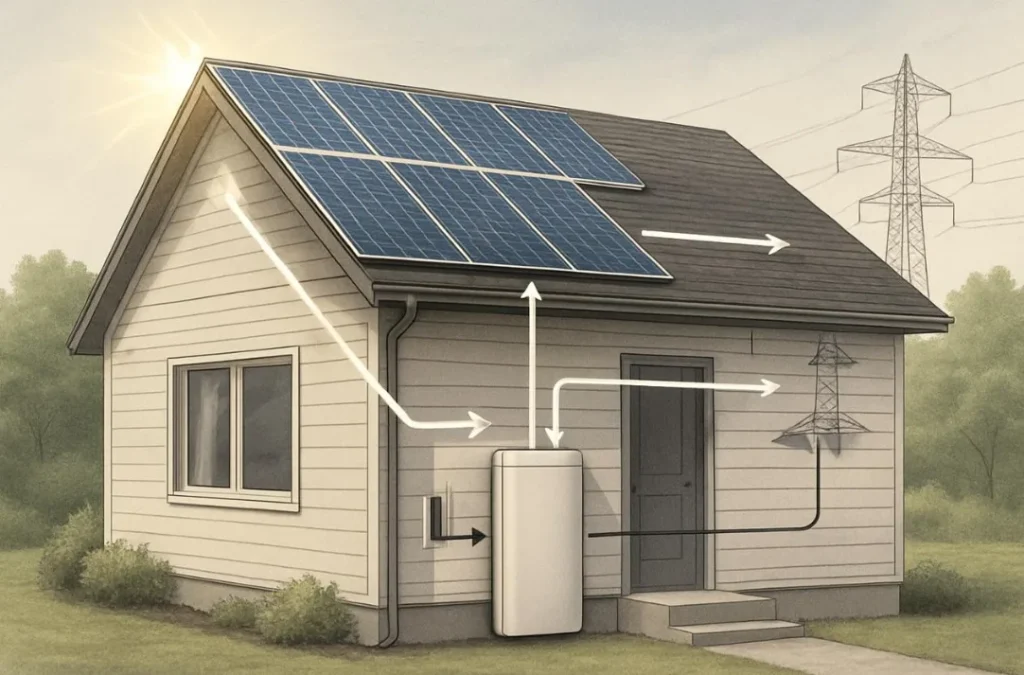
For systems connected to the public grid, the surplus power has clear destinations:
1. Sell to the grid: This is the most common destination. When solar generation has met both the household load and the battery, the surplus power is sent to the grid through the inverter. And depending on local policy, this portion of electricity can be used to offset electricity bills or directly generate income.
2. Limit generation: If the grid does not allow receiving power, or the money from selling power is extremely low or even sending power requires paying out of pocket, the system would rather generate less or not send power out at all, limiting output to just enough for local use.
And the system can detect this itself because grid-tied systems usually come with a reverse-power meter or sensor that can monitor current direction in real time. Once it detects that power wants to “flow backward” into the grid, it notifies the inverter to reduce output power, even down to just enough for local use. The PV panel is still sitting in the sun; the system is just drawing less power from it. At the same time, the charge generated inside the panel does not pile up indefinitely; it quickly recombines and turns into a tiny amount of heat that dissipates.
Although both are functions and both have “anti-,” this is different from anti-islanding. The anti-islanding safety function is basically standard for grid-tied systems; but reverse-power prevention or limiting backfeed is not necessarily available on all grid-tied systems—it depends on local policy and system configuration. In many places, this function is only installed when surplus power is required not to go onto the grid.
Off-Grid Systems
Off-grid systems are not like grid-tied systems, where surplus power has a destination. If an off-grid system has too much power and it is not handled properly, it will cause battery overcharging and damage. So it must absorb power through the following methods:
1. Dump load: The system directs surplus power to a specially designed dump load device. The most common is using the power to heat water, converting electrical energy into thermal energy and storing it for later use, thereby avoiding power waste.
2. System shutdown or standby: But in extreme cases, if there is neither a load nor a dump path, the controller may disconnect the PV array from the system. This disconnection is automatic for the controller’s self-protection; after disconnecting, you don’t need to worry—it will restore power supply by itself next time.
3. Limit generation: This is similar to grid-tied systems. When the battery is full and the dump load cannot consume more, the charge controller limits the PV panel’s output power to prevent continued charging of the battery. If the battery is fully charged, the steps by which the controller makes it slow down or stop are also very simple:
Step 1: The controller actively “pushes back,” making the PV panel output less or even no power.
When the controller (such as an MPPT controller) finds that the battery is full and no appliances in the house are using power, it doesn’t need to forcibly pull a switch. It is smart inside and will actively adjust resistance and operating state, deliberately pushing the PV panel’s operating point toward “idling,” so that the solar panel outputs no power or very little power. In other words, it is directly telling the solar panel: I don’t need you to put out power now; take a rest.
Step 2: The voltage rises, but the current directly becomes 0
If you go look at the controller screen at this time, you will find a very interesting and counterintuitive phenomenon: normally when charging, the voltage may be only thirty-odd volts; now that it is full and not charging, the voltage instead soars all the way to forty or fifty volts! Don’t be scared by this; anyone who has studied junior high physics knows that power equals voltage multiplied by current (P=U×I). Although the voltage looks quite high, because the controller is no longer drawing power, the current in the wires directly drops to zero. Since the current is 0, the resulting power is 0, and it is actually not generating at all. So there is absolutely no need to imagine the terrifying scene of several kilowatts of electricity trapped in the wires melting them—it simply won’t happen.
Step 3: The excess sunlight naturally becomes a tiny amount of heat and dissipates
Since it didn’t become electricity, where did the energy from the blazing sun go? In fact, even when a solar panel is generating at full speed, only about 20% of sunlight can become electricity, and the remaining 80% originally just becomes heat and dissipates. Now that the controller is not drawing power, it is simply that the 20% of energy that would originally have become electricity also turns into heat and dissipates into the air.
Before leaving the factory, solar panels undergo this kind of no-load blazing-sun test every day; they are much tougher than we imagine and are not afraid of sun exposure at all. And because there is not even any current in the wires, the wires and controller at this time actually feel much cooler to the touch than they did during high-current hard charging.

How Controllers Taper Off Power
When solar charging is full, it stops, but this stop is not simply turning off a switch. It is a precise control process based on battery status, from detection and judgment to execution. The goal of the whole process is to prevent battery overcharging and protect its lifespan and safety: real-time sampling of battery voltage and charging current → judging whether the full-charge condition is met according to charge-stage criteria → limiting or cutting off charging current through the power-stage actuator → entering float/maintenance stage → automatically resuming charging after voltage drops.
- Full-Charge Criteria
The controller can usually judge whether the battery is full based on one or more conditions. Because the closer the battery is to full, the more the voltage rises to a high level, while the current it can absorb becomes smaller and smaller.
Voltage: When the battery voltage hits the stop line preset by the controller, the controller stops the bulk charge accordingly. Taking a 12V lead-acid system as an example, when the voltage rises to around 14.4V–14.8V, it indicates that it is close to the full point.
Current: During the constant-voltage stage, the charging current gradually decreases. When it drops below the preset tail current, it means the battery can hardly continue absorbing charge.
Time: Because the constant-voltage stage cannot be dragged out indefinitely, the controller sets an upper time limit. When the time is up, even if the current has not dropped below the tail current, it is considered that the finishing stage is sufficient, and it switches to float charging.
BMS signal: In lithium battery systems, the controller can learn the status from the BMS. It will tell the controller how much charging current is allowed, what the SOC is, whether it is fully charged, etc.
(The constant-voltage stage means that when the battery is nearly full, if the controller keeps charging hard with high voltage, the battery is prone to overcharge damage. So the controller stabilizes the charging voltage and stops raising it, keeping it at a fixed value.)
- Execution Methods for Stopping or Limiting Charging
After confirming that it is full, what the controller needs to do is stop letting the solar panel continue pouring large current into the battery. Although the purpose is the same, different controllers may have different ways of stopping.
Series controller: A switch is connected in series between the solar panel and the battery. When full, the switch is opened, the main circuit is cut off, and electricity cannot pass.
Shunt/parallel controller: It does not cut off the main circuit. Instead, it adds a shunt branch to the solar panel output, directing excess current there to be dumped, so the battery side gets no charging current.
PWM controller: It controls charging by fast switching. The smaller the duty cycle, the smaller the average charging current; when full, the duty cycle is reduced to zero or close to zero, and the charging current is basically gone.
MPPT controller: It does not charge in just one way; it follows “constant current—constant voltage—float charge.” It first charges at high current, then finishes at constant voltage, and when the current drops below the tail current or the constant-voltage time is up, it exits bulk charging and switches to float charging or standby.
- Battery Differences in the Float-Maintenance Stage
Traditional lead-acid batteries, because they easily lose charge themselves, do indeed need long-term small-current float maintenance. But today’s mainstream lithium iron phosphate batteries are different: they basically do not leak much charge themselves, and what they hate most is being kept at high voltage for float charging after being full; charging like that for a long time actually accelerates cell aging. So when today’s smart controllers encounter lithium iron phosphate, they usually just stop charging after it is full and enter an idle standby state. Only when you use power, or after a long time the voltage drops a little (for example, to around 13.2V–13.4V), will it restart and top up by itself.
| Battery Type | Characteristics | 12V System Reference |
| Ordinary lead-acid/AGM | Relatively noticeable self-discharge; requires long-term small-current maintenance | About 13.5V–13.8V |
| Gel battery | More sensitive to excessive maintenance voltage than ordinary lead-acid, so it is usually set lower | About 13.05V–13.65V, according to manufacturer requirements |
| Lithium iron phosphate | Low self-discharge; many systems use only weak float charging, with safety left more to the BMS | Commonly around 13.5V |
| Ternary lithium | More sensitive to overcharging; not suitable for lead-acid-style long-term trickle float charging | For a 12V three-cell series pack, the maintain voltage is often around 12.45V–12.6V, for reference only |
- Temperature Compensation
For old-style lead-acid batteries, when it is hot, the float voltage should be lowered a little to prevent bulging from overcharging; when it is cold, it should be raised a little to ensure a full charge, adjusting by 0.018V for every 1 degree rise in temperature. But if you are using a lithium battery, absolutely do not copy lead-acid and do any kind of temperature fine-tuning. The safety of a lithium battery depends entirely on its built-in BMS system. What it cares about is not adjusting those hundredths-of-a-volt voltages, but whether the temperature is safe. In winter, if it is too cold and charging is forced below 0°C, metal can easily precipitate inside the battery and pierce the separator, so once the BMS detects below zero, it will directly “snap” and forcibly disconnect to stop charging; when it is too hot in summer, it will also limit current by itself to prevent overheating. You don’t need to manually worry about any of this at all; just leave it to the BMS to manage.
- Resuming Charging
After the battery enters float charging or stop-charge standby, it will not stay stopped forever; it will resume. When the battery voltage drops below the set limit due to leakage or connected appliances, the controller will automatically restart high-current charging. As long as too much power is lost, it will make it up by itself, with no human intervention needed.
Running Loads on a Full Battery: Are You Wearing Down the Cells?
This is the question most often asked in DIY solar forums and the one most likely to make people agonize over it.
“At noon the battery is already 100%, and the room is terribly hot. If I want to turn on the air conditioner at this time, is the system directly using solar power, or is it using battery power to supply the air conditioner while receiving solar charging at the same time? Will such frequent shallow charging and discharging wear the battery out?”
I understand that many people ask this because they think: the device is clearly still plugged in and also has to supply power to appliances—isn’t that charging and generating at the same time? Wouldn’t that easily damage the battery?
But actually, as long as the energy storage device has DC bus pass-through and PV-priority power supply functions, it will not consume the cycle life of the cells at all.
Its working mechanism is very clever: inside a solar-plus-storage system or portable energy storage device, the solar charge controller (MPPT), battery, and inverter are connected together. At high noon when solar generation is at its strongest (for example, it can generate 800W) and your air conditioner only needs 500W, the power generated by the solar panel at this time directly goes along the wiring to supply the air conditioner, without passing through the battery cells at all.
At this time, the two ends of the cells are at a full, idle standby level, and the current flowing into and out of the cells is almost 0A—neither charging nor discharging—so there is no charge-discharge cycle wear at all. And based on my years of disassembling, assembling, and reviewing systems, the vast majority of mainstream energy storage devices on the market—including EcoFlow’s RIVER series, Anker SOLIX’s C series, and the emerging brand Piforz’s All-in-One , etc.—all use this solar-priority pass-through architecture in their software and hardware logic. As long as there is plenty of sunlight during the day and the solar power is greater than the load, just use it freely—it won’t hurt the battery at all!
Battery Chemistry Differences: What Actually Happens if Overcharged?
If you have studied batteries yourself, you should know that batteries made of different materials have different densities, service lives, and various tolerances. When a battery is overcharged, different chains of damage occur inside the battery, and the final forms of damage range from heating and leakage, bulging and smoking, to violent fire and explosion.
Lithium iron phosphate batteries are basically the core batteries used in various energy storage devices today. These cells are very delicate and must never be forcibly overcharged. But they have an intelligent BMS to guard and monitor them at all times. Under normal circumstances, the controller is responsible for stopping charging, and even if, just in case, the controller goes crazy and fails someday, the battery’s own BMS will directly trip for self-protection within milliseconds—equivalent to double insurance, so safety is very well guaranteed.
Old-style lead-acid batteries (AGM / gel / flooded lead-acid): There is no intelligent computer board like a BMS inside lead-acid cells; they rely entirely on the external charge controller. Once overcharging occurs, flooded batteries will boil, emit gas, dry out, and be scrapped, while maintenance-free AGM or gel batteries will bulge and get hot.
According to principles of electrochemical materials science and international/national mandatory battery safety testing standards, the reactions that occur after different batteries are overcharged are as follows:
| Battery Chemistry | Microscopic Reaction During Overcharge | Real Macroscopic Consequence | Danger Level |
| Ternary lithium (pure electric vehicles, drones) | The cathode structure is fragile, and overcharging easily releases oxygen rapidly; lithium dendrites grow on the anode and pierce the separator. | A typical case of “self-generated oxygen, self-burning”; chain thermal runaway is very likely, the fire is fierce and extremely hard to extinguish, and the instantaneous temperature can reach over a thousand degrees. | Extremely high |
| Lithium iron phosphate (outdoor power supplies, energy storage cabinets) | The crystal structure is stable; overcharging produces gas, but oxygen is very difficult to release. | In extreme cases, it will bulge severely, and the pressure relief valve will be forced open, emitting white smoke. But as long as there is no external open flame, it is very difficult for it to catch fire or explode on its own, so the safety baseline is relatively high. | Medium-low |
| Lithium cobalt oxide (phones, tablets) | The structure very easily decomposes and releases oxygen during overcharge, and the thermal runaway trigger temperature is extremely low. | Once the protection board fails and it is forcibly charged at high voltage, it will violently spray fire or even burst within seconds. | Extremely high |
| Sodium-ion (new energy storage/power) | Sodium ions are less active than ternary lithium, have good thermal stability, and are less likely to form dendrites that pierce the separator. | The main manifestations are heating, gas production, and shell bulging. The safety boundary is much wider than that of ternary lithium, and violent deflagration usually does not occur. | Low to medium |
| Traditional lead-acid (old fuel vehicles, old electric bikes) | The water in the electrolyte is forcibly electrolyzed, releasing hydrogen and oxygen. | The shell bulges and lacks water; the discharged hydrogen can easily cause an explosive rupture when encountering an open flame, accompanied by splashing of corrosive acid. | Medium |
When Does a Solar Battery FAIL to Stop Charging?
Under normal circumstances, when the controller detects that the battery is full, it will automatically cut off power. But in the following three cases of human misoperation or hardware failure, overcharging will really happen:
1. No controller installed; the solar panel is connected directly to the battery.
Some beginners think a small panel of tens of watts has low power, so for convenience they directly clip it onto the battery with alligator clips. After continuous exposure to strong sun, with no mechanism in between to cut off the voltage, the battery can easily be overcharged and bulge, and can even explode, posing a safety threat—everyone should absolutely not try this method.
2. The battery type on the controller is set incorrectly.
For example, the battery connected is clearly a lithium iron phosphate battery, but lead-acid mode is selected on the controller. Some lead-acid modes periodically output high voltage above 15V for desulfation. This high voltage is fatal to lithium batteries, because it will frequently stress the lithium battery’s protection board, so look carefully before choosing.
3. The switching components of a low-quality controller burn out and stick.
In some cheap off-brand low-end controllers with poor workmanship and materials, once the switching transistors inside are burned out by high current or high temperature, they often do not fail open and cut off power, but instead become short-circuited and welded shut in the conducting state. This is like the faucet switch at home being stripped and broken, completely unable to close; the high-voltage, high-current power from the solar panel will pour endlessly into the battery like a flood, and in this case the battery really will be overcharged until it bursts and is ruined.
Then how do you check for overcharging yourself?
It’s very simple. At high noon, when the battery shows 100% full, use a multimeter to measure the voltage across the battery terminals:
12V lithium iron phosphate: normally it should stay stable between 13.4V and 14.4V.
12V lead-acid battery: normally it should be between 13.5V and 13.8V.
If the measured voltage far exceeds this range, and the charging current reading on the controller keeps not dropping, don’t hesitate—first disconnect the solar panel quickly and check the equipment.
Finally, after understanding these things, if you look back, you will find that solar power systems are much smarter and more worry-free than we imagined. Of course, understanding “what to do after the battery is full” is only half of mastering a solar-plus-storage system. If you want to further understand other related aspects of solar batteries, you can continue reading our related articles and completely eliminate all worries about daily electricity use.