
Whether it’s RV road trips, yacht fishing, or building a home solar energy storage system, whenever batteries are involved, there are always the problems of batteries constantly losing charge and not knowing how many years they’ll last. Especially in scenarios that require long-term power supply, ordinary batteries often become unusable after a short time. To solve this problem, we have to talk about deep cycle batteries. So what makes them so special? Why are they indispensable in these scenarios? Don’t worry, let’s take it step by step.
About Deep Cycle Batteries Themselves
A deep cycle battery is a type of storage battery designed to be deeply discharged and recharged many times while still maintaining a long lifespan. If you’re familiar with batteries, you’ve certainly heard this term many times.
“Cycle” refers to the process of a battery discharging, charging, discharging again, charging again… a continuously repeating cycle.
And the “deep” in deep cycle refers to a deep depth of discharge, meaning a large proportion is discharged each time. For example, a 100Ah battery can be run down to only 20% or even lower and then recharged without being damaged quickly.
I’ve dealt with many customers who buy batteries individually, and a lot of them always confuse deep cycle batteries with starting batteries. When they think about using a car battery as a storage battery, their first reaction is often: they’re all 12V batteries, and the capacity is about the same, so can’t they be used interchangeably? Of course not. Although they look similar, their actual usage is completely different.
A car’s dedicated starting battery is only responsible for that instant when it ignites. What it needs is to release a very large current in an instant, but it’s only used for a few seconds, and after that it’s immediately recharged by the alternator. Unlike a car’s dedicated starting battery, a deep cycle battery needs to provide continuous and stable power. It often has to discharge for several hours or even several days over a long period, and it also has to be able to repeatedly use up a lot of its charge and then be recharged, requiring that it not be easily damaged even when drained very low. This ability to be “repeatedly run down to near empty” also directly affects battery life. A deep cycle battery can typically undergo thousands of charge-discharge cycles, while an ordinary starting battery used in a similar way will have its lifespan greatly shortened. At the same time, the difference in usage determines that their internal structures are also completely different. Deep cycle batteries usually have thicker plates and are more resistant to repeated charging and discharging; starting batteries, on the other hand, pursue instantaneous output capability.
Deep Cycle Battery Types (Which One Should You Choose?)
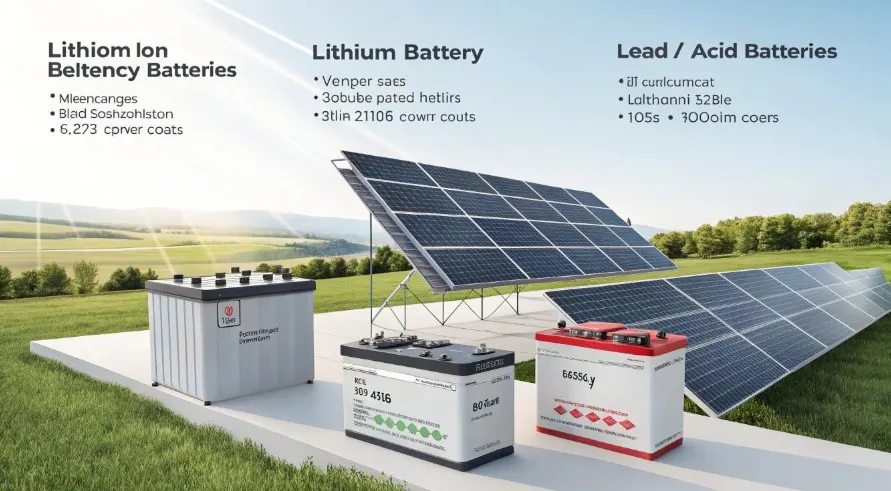
Deep cycle batteries are actually not a single type of battery, but rather a classification based on “usage style.” Because the same chemical system can exist in both deep cycle and non-deep cycle versions. For example, both are lead-acid batteries, but the battery in a car is a starting type, while the one used in an RV is a deep cycle type. Common batteries that can be deep cycle include the following.
Moreover, in the battery industry, the core indicator for measuring deep cycle life is the corresponding curve between depth of discharge (DoD) and cycle count. Ordinary car lead-acid starting batteries are designed to withstand only about 3%–5% DoD; conventional lead-acid deep cycle batteries are recommended for use up to 50% DoD; lithium iron phosphate deep cycle batteries can routinely withstand 80%–90% or even 100% DoD while maintaining excellent lifespan.
Flooded Lead-Acid Batteries
Flooded deep cycle batteries are a classic type of deep cycle lead-acid battery. Inside the battery is flowing liquid electrolyte, not gel or AGM glass fiber absorption. This kind of battery often appears in scenarios such as golf carts, forklifts, RVs, and solar energy storage, because its characteristics happen to match the core needs of these scenarios: stable output over long periods, repeated deep discharge, controllable cost, and acceptance of regular maintenance.
Flooded deep cycle batteries have thick plates and a lot of active material, so even after several deep discharges they won’t quickly fail like car starting batteries. At the same time, their liquid electrolyte is abundant, and during discharge the voltage and capacity are relatively stable, making them very suitable for running motors and carrying loads. They can also extend their lifespan through adding distilled water and equalization charging. Although this is troublesome, for equipment like forklifts and golf carts that are used every day and have maintenance conditions, it’s actually not that bad. And if they’re not used for a long time, flooded deep cycle batteries will self-discharge and sulfated, requiring regular supplementary charging, which instead becomes an advantage of being repairable and extendable. In addition, their cost per unit capacity is low, and when building large-capacity energy storage they are much cheaper than AGM and lithium batteries, so off-grid solar and wind power systems often use them too. Although they still have disadvantages such as being large and heavy, producing gas, and having high self-discharge, if they’re placed in fixed energy storage and traction scenarios, these aren’t really big problems, since they’re cheap, tough, and can be deeply discharged.
AGM Batteries
Deep cycle AGM batteries are a type of absorbed glass mat lead-acid battery. Their electrolyte is absorbed by glass fiber mats, and the entire battery is sealed and maintenance-free. Compared with starting-type AGM, deep cycle AGM has thicker plates and a sturdier structure, and can withstand repeated discharge to 50% or even deeper. If flooded is cheap and tough but troublesome, then AGM is worry-free but expensive and afraid of heat.
Deep cycle AGM is generally mainly used in scenarios that need continuous power supply but can’t always be plugged in, such as RV camping, solar energy storage, or on boats. Because its characteristics are low self-discharge, vibration resistance, maintenance-free operation, and the ability to discharge at high current for short periods.
It can be placed in the cabin of an RV, in a closed battery compartment on a boat, or even in a UPS cabinet, without worrying about acid liquid corroding equipment or gas accumulation, because it doesn’t flow, doesn’t leak, and doesn’t produce external leakage, and its sealing is very good. Its shock resistance is also very good, so it can handle bumps on vehicles, boats, and outdoors however it likes. Its self-discharge is also very low, so it still has power when left unused, making it very suitable for seasonal use. More importantly, it requires no maintenance and no adding water.
Gel Batteries
Gel batteries, like AGM, are valve-regulated sealed lead-acid, except that silica sol is added to the sulfuric acid, turning the entire electrolyte into a gel state. This change also brings some differences: gel is more resistant to deep discharge, more resistant to high temperatures, and has a longer lifespan, but its internal resistance is high, so it’s not suitable for high-current discharge. It’s not suitable for scenarios requiring instantaneous burst power, but if you let it discharge slowly, often deeply discharge, and don’t do much maintenance or management, it actually performs better than AGM and flooded.
Places like communication base stations, streetlights, and surveillance are its main battlefield, installed in the wild or by the roadside, unattended, with extremely high maintenance costs. But gel batteries have low self-discharge, high temperature resistance, and long lifespan, and can last many years, so after installation you basically don’t need to manage them much.
Lithium Iron Phosphate Batteries
Lithium iron phosphate batteries are probably deep cycle batteries that even laypeople have heard of and are familiar with, after all, this is what made them famous. They are a very typical and currently best-performing category.
Lithium iron phosphate batteries have a very long cycle life, roughly 3,500–6,000 cycles, all thanks to their stable chemical structure, which makes them not prone to degradation. Their depth of discharge is also the deepest, able to use 80%–100%, and even if discharged very low they won’t lose battery life. Their safety is also very high, with good thermal stability, not easy to catch fire, and very durable. Their voltage changes relatively little during discharge, which is friendly to powered devices. More importantly, they are also environmentally friendly, containing no cobalt or other precious metals, with relatively low material costs, low toxicity, and easy recycling. Of course, they also have their own disadvantages. Although they’re good at resisting heat, their performance in low-temperature environments is only average, and their energy density is relatively low. Compared with ternary lithium, they store less electrical energy under the same weight or volume, so they don’t have an advantage in space and weight.
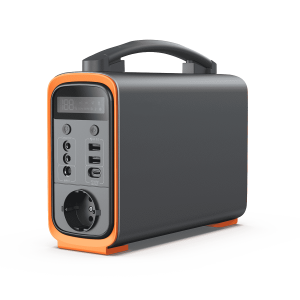
They are relatively popular in home energy storage systems and the portable power supply market. Likewise for RVs, camper vans, marine batteries, off-grid cabins, and so on, where long-term stable power supply and frequent deep discharge are needed, lithium iron phosphate is also a mainstream choice.
Where Are Deep Cycle Batteries Generally Used?
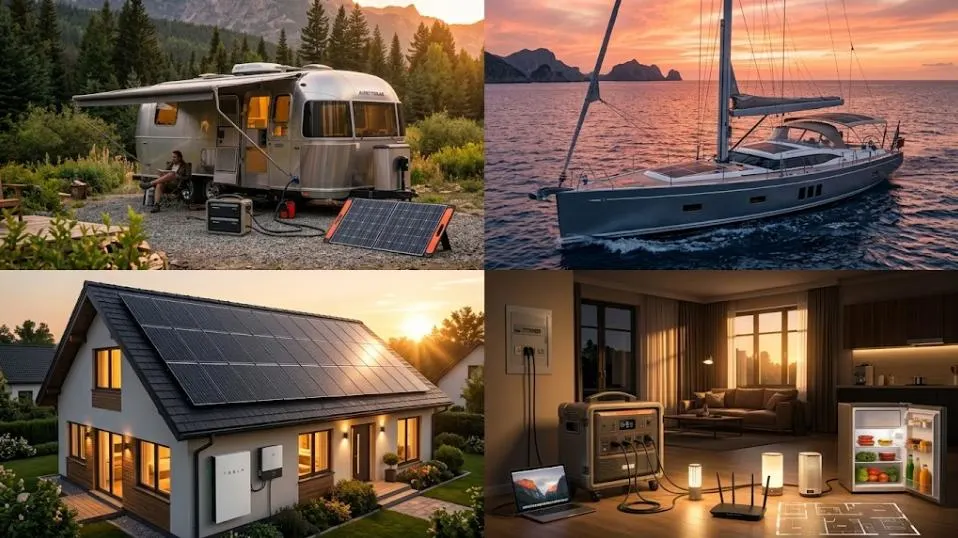
Deep cycle batteries are widely used in our daily lives, not because their capacity is especially large, but because they can be repeatedly run down to near empty and then recharged and still continue to be used normally. This is also why in some specific scenarios ordinary batteries quickly develop problems, while deep cycle batteries do not. Different usage scenarios have different needs, so naturally the requirements for batteries differ. If your usage scenario is one of the following, then you definitely need to use deep cycle batteries.
- RV or outdoor power use
If you’re using power in an RV or outdoors, the need in this case is to run devices such as lights, WiFi, phones, small refrigerators, electric fans, and other relatively small but continuously operating devices. The power usage characteristic is low power but long duration. In this situation, an ordinary starting battery is prone to damage once deeply discharged, while a deep cycle battery is better at lasting a long time rather than delivering burst power.
- Marine use
Similarly, navigation, communications, and basic lighting are indispensable in an at-sea boat environment with no support. Therefore, the requirement for the battery is not only sufficient ability to output steadily for a long time, but also a certain level of safety, and this is exactly where deep cycle batteries have an advantage over starting batteries. Boats usually divide the starting engine and supplying living equipment into two battery systems, and deep cycle batteries are exactly responsible for the latter, ensuring that at sea there won’t be a sudden power loss due to battery issues.
- Solar energy storage systems
For another example, in solar energy storage systems, electricity is generated and stored during the day and discharged for use at night, completing one charge-discharge cycle every day. Ordinary batteries will quickly decline in capacity or even become useless, while deep cycle batteries support deeper discharge and can withstand many cycles, so they often become the first choice for off-grid and energy storage systems.
As for home power outage backup, what’s needed is to keep it at home for a long time and, when there’s a sudden power outage, take it out to maintain lighting, the router, and phone charging. As we all know, even if a battery is left idle without use, self-discharge still occurs. Even backup power supplies need to be recharged or used from time to time. Because of this characteristic of normally sitting idle and occasionally being deeply discharged, it can’t be like a starting battery that gets damaged as soon as it’s drained, nor does it need to cycle every day like a solar system. Instead, it’s required to output steadily at critical moments, and even if the charge is used to a relatively low level, it won’t be rapidly damaged, and after the power comes back it can slowly be recharged.
Can a Deep Cycle Battery Be Directly Charged by Solar?
After learning about deep cycle batteries, many people naturally think of a question: since it can be repeatedly charged and discharged, can it be directly connected to a solar panel for charging? Of course it can’t. The output of a solar panel is not a stable power source; it changes constantly with the environment, which will cause its output voltage to be unstable and the current to be uncontrollable. Simply put, the battery needs managed charging, not just directly connecting and charging. If you want to use a solar panel to charge a battery, you must be equipped with a charge controller to stabilize the voltage, control the current, and prevent overcharging and over-discharging, so as to protect the safety of the battery.
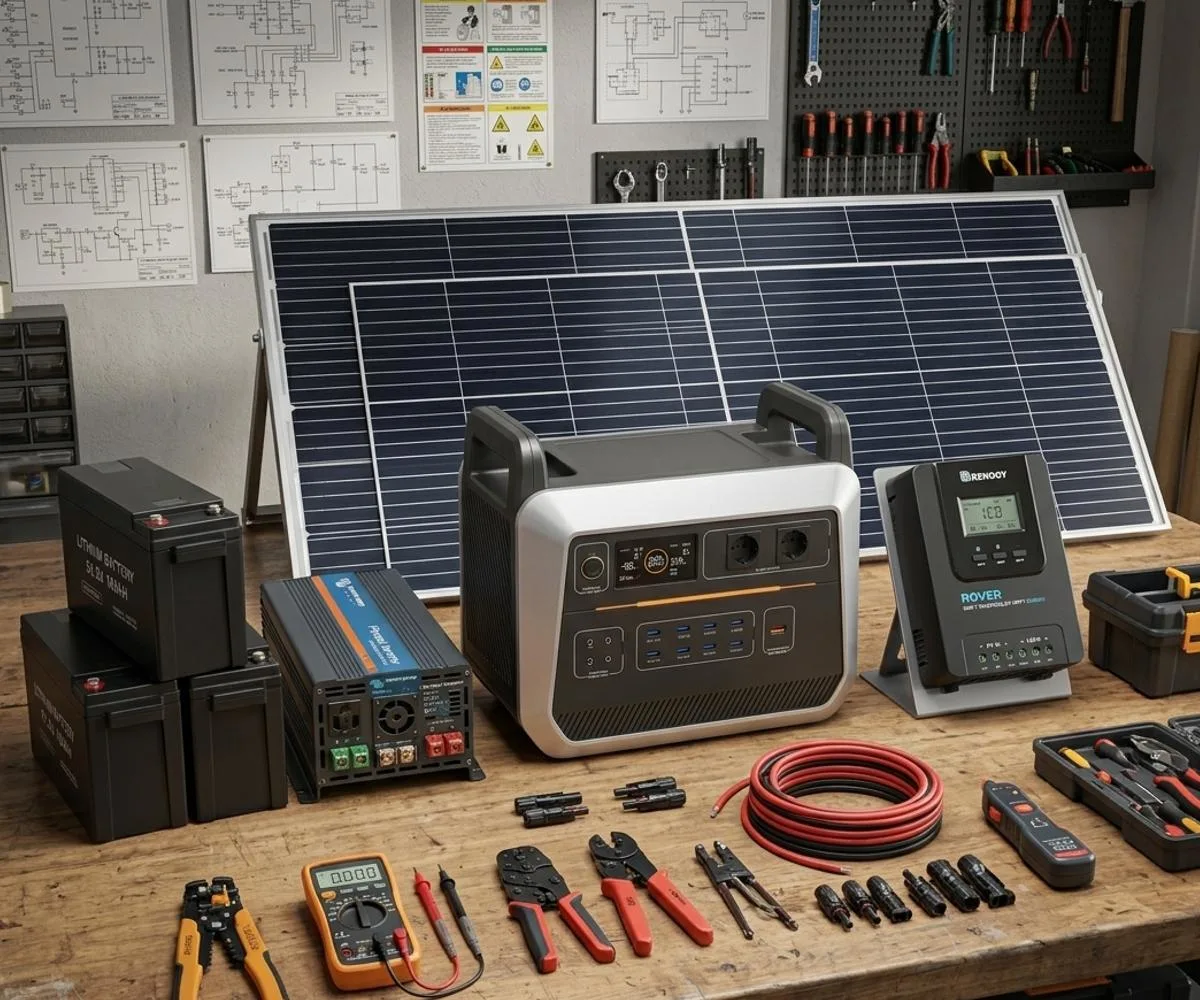
And based on my experience from selling so many orders, a lot of people really do easily treat battery + solar panel as a complete system. Often people want to buy a battery and a few solar panels and take them back to use as an energy storage system. I want to say, these devices are still far from enough. A truly usable solar power solution usually also includes a charge controller, an inverter, and a battery management system (BMS), especially for lithium batteries. It is precisely because of this that in practical applications people often don’t buy devices separately and assemble them themselves, but instead prefer already integrated devices or systems.
How Long Do Deep Cycle Batteries Last?
In actual usage testing, the lifespan of deep cycle batteries is generally between 2 years and 15 years, but specifically it still depends on the battery chemistry you choose and your usual usage and maintenance habits. And if following the industry’s common testing standards, the expected lifespan of various types of deep cycle batteries under standard use is roughly as follows:
| Battery Type | Expected Service Life | Cycle Life | Safe Depth of Discharge | Daily Maintenance Requirements | Common Causes of Wear |
| Flooded Lead-Acid | 2–4 years | 300–500 cycles | ≤ 50% DoD | Requires regular addition of distilled water and equalization charging | Water shortage exposing plates, frequent over-discharge below 50% causing sulfation |
| Sealed AGM Battery | 3–6 years | 400–700 cycles | ≤ 50% DoD | Maintenance-free, sealed against leakage, vibration-resistant | Long-term high-temperature exposure to sunlight, charging voltage too high causing internal water loss and bulging |
| Gel Battery | 4–8 years | 500–1,000 cycles | 50%–60% DoD | Maintenance-free, resistant to slow charging and slow discharging, strong weather resistance | Charging current too high, mismatch with dedicated gel charging algorithm |
| Lithium Iron Phosphate | 8–15 years | 3,500–6,000+ cycles | 80%–90% DoD (even 100%) | Maintenance-free, mainly relies on internal BMS system for intelligent protection | Forced high-current charging below 0°C, BMS failure causing overcharge and over-discharge |
Why Do Most Home Energy Storage Systems Use Deep Cycle Batteries?
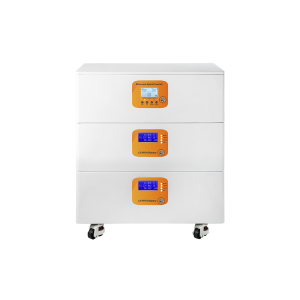
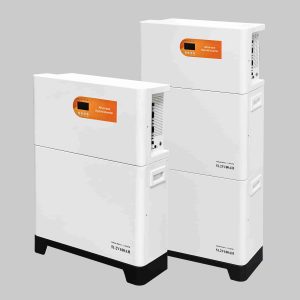
Now let’s talk about home energy storage. Anyone who has looked into home energy storage knows that, whether manufacturers or users, when it comes to batteries, the basic first choice is deep cycle batteries like lithium iron phosphate. This isn’t some industry jargon, but a choice based on the actual needs of home energy storage equipment in use. Home energy storage is not like an ordinary backup power supply that’s only used temporarily; it needs continuous power supply plus repeated cycling. It has to participate in charge-discharge cycles every day: storing electricity during the day and discharging at night. Once a power outage occurs or a natural disaster happens, it may even need to deeply discharge for several consecutive days. Under this rhythm, ordinary batteries will see capacity decay very quickly, while the original design purpose of deep cycle batteries is to withstand this kind of long-term repeated deep cycling, so they are naturally more suitable for home energy storage.
Moreover, home energy storage has higher safety requirements than general scenarios. After all, the battery is placed at home and also needs to operate unattended for a long time, so indicators such as thermal stability, overcharge and over-discharge protection, and cycle life are all critical. Deep cycle batteries, especially lithium iron phosphate, perform more steadily in this regard, and are not prone to obvious degradation or safety risks due to long-term cycling, which is also an important reason why they are widely adopted.