When choosing backup power, the trickiest part is figuring out which type to go with. Inverter generators and portable power stations can both serve as backup power sources—they have some things in common, but plenty of differences too. Before you decide which one to buy, it’s best to understand how they differ and which one actually fits your real needs in scenarios like power outages, RV trips, camping, and home backup.
Inverter Generator vs Portable Power Station: Basic Difference
First, let’s cover some basics.
What Is an Inverter Generator?
An inverter generator—also called a variable-frequency generator—is a portable generator that uses electronic inverter technology to deliver high-quality, stable current. Traditional generators just put out whatever type of electricity they generate, which isn’t great quality, and the voltage and frequency fluctuate with the engine speed, making them pretty unstable. Inverter generators, on the other hand, have an inverter that automatically adjusts the engine speed based on the load, so the output current is smoother and safer AC power. But at the end of the day, they’re still fuel-burning generators—that hasn’t changed.
What Is a Portable Power Station?
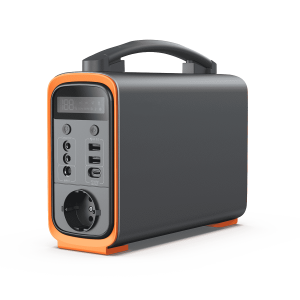
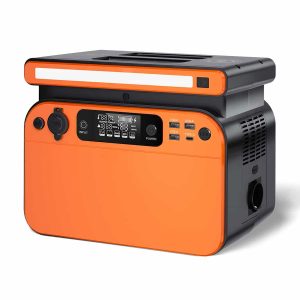
A portable power station is a large-capacity, movable power storage device that can supply electricity to all kinds of electronic devices. It has AC outlets, DC ports, and USB ports. It can’t generate its own power—it can only store it. Inside, you’ll typically find a battery, an inverter, a charger, and a BMS (Battery Management System) to keep things safe on a day-to-day basis.
Are Portable Power Stations Better Than Generators?
Which one is better? There’s no absolute answer—it really comes down to what you need.
If your main needs are indoor use, camping, RV trips, or short-term power outage backup, then a portable power station’s quiet operation and zero emissions make it a better fit than a generator. It’s also better suited for powering sensitive devices like phones, tablets, laptops, Wi-Fi routers, and CPAP machines. But if you’re facing long-term power loss with heavy electricity demands—needing to run lots of high-wattage appliances—then an inverter generator has the edge, because as long as you have fuel, it can keep generating power.
Portable Power Station vs Inverter Generator: Key Differences That Matter
A portable power station stores power in advance; an inverter generator generates its own. That’s a fundamental difference, and it’s exactly this difference that determines how they stack up in terms of safety, noise, cost, runtime, and maintenance.
Safety: Which One Is Safer to Use?
Better for Indoor Safety: Portable Power Station
When it comes to safety, the portable power station wins by a landslide. That’s because a portable power station runs on electricity—a clean energy source that produces no exhaust fumes and carries no fume-related risks. You can safely use it in apartments, bedrooms, living rooms, offices, inside RVs, and other indoor spaces.
An inverter generator, however, is still a generator at heart. It relies on burning gasoline, diesel, propane, or other fuels to produce power, which inevitably creates polluting gases. When fuel doesn’t burn completely due to insufficient oxygen, carbon turns into toxic carbon monoxide (CO). Meanwhile, the high heat and pressure inside the combustion chamber force nitrogen and oxygen in the air to combine into nitrogen oxides (NOx), and sulfur impurities in the fuel produce sulfur dioxide (SO₂). All three of these harmful gases are generated during combustion—they’re unavoidable when you’re burning fuel to make power. That means the generator has to be run outdoors in a well-ventilated area, never indoors, in garages, basements, tents, or near windows and air intakes.
Noise: Which One Is Better for Quiet Use?
Quieter Choice: Portable Power Station
Most of the time, a portable power station is practically silent. It doesn’t have an engine—the main sound comes from the internal cooling fan, and that usually only kicks in when it’s charging, inverting power, or handling a heavy load. So you can use it while sleeping at night, camping, or during an apartment power outage without much disturbance.
Inverter generators have improved a lot over conventional generators, but they’re still nowhere near as quiet as portable power stations. Even with soundproof casings, eco-modes, and smart speed control, engine noise, exhaust sound, and mechanical vibration can’t be completely eliminated. Most small inverter generators have official noise ratings in the 50–65 dB(A) range—for example, the Honda EU2200i is rated at 48–57 dB(A), the Westinghouse iGen2200 claims as low as 52 dBA, and the Yamaha EF2200iS comes in at 57–65 dB(A). Official specs show that portable power stations typically run about 20 dB quieter than small inverter generators, and in some cases the gap is even wider. In terms of human perception, a 20 dB increase sounds roughly four times louder. To put it in more relatable terms, 30 dB is close to the background noise in a quiet bedroom, while 50–60 dB is around the level of normal conversation. So in real-world quiet settings, the experience gap between these two can feel even bigger than the numbers suggest.
Runtime: Which One Lasts Longer?
Better for Extended Runtime: Inverter Generator
The biggest advantage of an inverter generator is that it can keep generating power continuously. As long as you have enough fuel and remember to top up the oil, it can run tank after tank, 24 hours a day without stopping. This makes it better suited for tough, extended scenarios like long-duration power outages, storm seasons, job site power needs, or running refrigerators, water pumps, air conditioners, and other continuous-load appliances.
Portable power stations are different—their runtime is limited by battery capacity, and once the battery is drained, you need to recharge it via wall outlet, car charger, solar panels, or another power source. That takes time—typically anywhere from 1.5 to 8 hours. For short power outages, overnight backup, or powering small loads like phones, routers, laptops, CPAP machines, small lights, and TVs, it’s usually sufficient. But if you’re facing an outage that lasts a day or two or more, a single portable power station might not cut it.
Cost: Which One Is Cheaper Over Time?
Lower Upfront Cost: Inverter Generator
Lower Routine Energy Cost: Portable Power Station
If you compare purchase prices for the same output power, inverter generators have the edge. Let’s look at an example: the Westinghouse iGen2200, rated at 1800W continuous output, has an MSRP of $579. Meanwhile, the EcoFlow DELTA 2, which also puts out 1800W but comes with a 1024Wh battery, is regularly priced at $1049. Why the difference? Because when you buy a portable power station, you’re not just buying a battery—you’re also buying the inverter, charging system, and battery management system built into the unit. Inverter generators have fewer internal components, so they typically deliver higher continuous output power at a lower upfront cost.
But if you look at long-term use, the picture might change. The Westinghouse iGen2200 runs for about 12 hours on 1.14 gallons of gasoline at roughly 25% load. At $3.85 per gallon, running it for 100 hours would cost about $36.60 in fuel. In comparison, a portable power station supplying about 450W for 100 hours would need to output roughly 45kWh. At an average electricity rate of $0.1883 per kWh, even accounting for charging and inverter losses, the charging cost would only be about $9.40 to $10. Of course, this comparison assumes you can charge the power station from the grid—if you’re relying on solar panels, car charging, or other methods, the cost calculation and whether you can even charge it at all is a whole different story.
So both have their strengths—it really comes down to what you prioritize.
Maintenance: Which One Is Easier to Own?
Easier to Maintain: Portable Power Station
Beyond just using these devices, maintenance also costs time and money.
Portable power stations don’t have engines, so maintenance is relatively straightforward. The main things are: recharge it periodically, avoid storing it at full charge or completely drained for extended periods, and keep it in a dry, temperature-appropriate environment. This makes it very beginner-friendly for people who don’t have much experience with electrical equipment.
Inverter generators, on the other hand, need to be maintained like any engine-based equipment. You’ll need to regularly check fuel, change the oil, clean the air filter, inspect the spark plug, and—if you’re not using it for a while—deal with fuel storage issues. If maintenance is neglected, the generator might have trouble starting, run roughly, or have a shorter lifespan.
Portability: Which One Is Easier to Move?
More Portable at Small and Medium Capacities: Portable Power Station
At the same output power level, take the EcoFlow DELTA 2 portable power station—it puts out 1800W and weighs 12 kg. The Honda EU2200i inverter generator also has a rated output of 1800W, but weighs 21.5 kg—and that’s without fuel.
That said, this portability advantage for portable power stations is mostly concentrated in the small-to-medium capacity range of 500Wh–1000Wh. As battery capacity increases, so does the weight. If you go for a 2000Wh, 3000Wh, or even larger model, it might require wheels or two people to move it.
Emergency Use: Which One Is Faster During a Power Outage?
Faster to Deploy: Portable Power Station
If you want to know which one can get power back on the quickest after an outage, the portable power station has the clear advantage. It already has energy stored, and typically doesn’t need refueling, ignition, or waiting for the engine to stabilize. Many portable power stations now come with UPS or EPS functionality—for example, the Piforz GT2000 can switch over in just 10ms. When the grid fails, it transfers to battery power almost instantly, reducing the risk of your router dropping, computer shutting down, or CPAP machine stopping.
Inverter generators, while also suitable for sensitive electronics, can’t take over immediately. Unlike conventional generators, inverter generators first convert the generated power to DC, then pass it through the inverter module to re-output stable AC power. The output is usually closer to a pure sine wave with more stable voltage and frequency—but you still have to move the generator outdoors, check the fuel, start the engine, and wait for the output to stabilize. That can take several minutes, and the whole process is clearly less convenient than using a portable power station.
Which One Is Better for Different Scenarios?
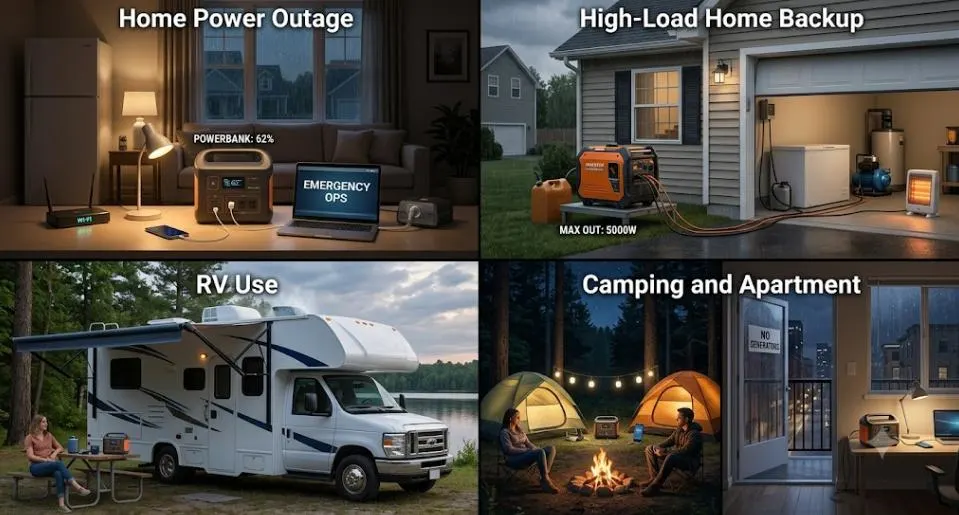
For Home Power Outages
When the power goes out at home, the first step is to list the devices you absolutely must keep running.
If you’re just trying to keep the fridge, router, lights, phone, computer, and medical equipment going—with the main goal being stable power for a small set of critical loads—then a portable power station is the best choice.
But if your goal is to keep running central air conditioning, electric heating, water pumps, well pumps, or multiple kitchen appliances, the question is no longer about which is more convenient—at this point, you need higher continuous output and longer refueling capability. In that case, an inverter generator is usually more practical.
For RVs
In an RV many appliances are hardwired into the vehicle itself. If you have additional power needs, they’re probably for small devices or occasional emergency backup. The real differentiator is the RV air conditioner. Not only does it have high running wattage, but it also has a significant startup surge. If you need to run the AC for extended periods in hot weather, battery capacity drains fast, and a generator or a more complete RV power system would be better.
For other scenarios, refer to the table below:
| Scenario | Better Choice | Reason |
| Apartment power outage | Portable power station | Indoor-safe, no CO, low noise |
| Overnight outage | Portable power station | Small loads like router, lights, CPAP |
| Multi-day outage | Inverter generator | Refuelable, longer runtime |
| Camping | Portable power station | Quiet, no fuel, fewer campsite restrictions |
| RV air conditioner | Generator or large battery system | High startup power and extended runtime |
| Water pumps / power tools | Inverter generator | High power and continuous operation |
What Can They Run?
Can They Run a Refrigerator?
For short-term emergency use, a portable power station with an output of at least 500W–1000W and a surge rating above 1500W can handle a refrigerator. But if you want the fridge to run through an entire night or longer during an outage, an inverter generator will likely work better.
In reality, a refrigerator’s running wattage isn’t extremely high, but there’s a catch—the compressor draws a significantly higher surge current at startup than during normal operation. So a portable power station that’s rated at 2000W might still struggle to start a refrigerator smoothly if its peak power isn’t sufficient. Inverter generators are generally better suited for compressor-type loads, because they handle startup surges more effectively and, as long as there’s fuel, can keep running for much longer.
Can They Run a TV, WiFi Router, CPAP, or Laptop?
Both can power these devices. These are typically low-to-moderate power loads, which is exactly where portable power stations shine. TVs, routers, laptops, and CPAP machines draw relatively little power, and most don’t have significant startup surges, so they don’t place high demands on instantaneous power output. For this kind of need, a portable power station is usually more convenient than an inverter generator—just move it next to your devices and plug in. No refueling, no exhaust concerns, no need to place it outdoors.This quiet, stable output is also why battery setups are the go-to solution for remote connectivity gear—if you are taking your setup off-grid, check out our tested guide on the best portable power station for Starlink Mini to see exact runtimes, DC efficiency, and watt-hour recommendations.
Inverter generators can also run these devices—after all, they’re designed to be better than conventional generators for sensitive electronics. But from a practical standpoint, there’s more to consider. If your goal is simply to keep the internet, lights, computer work, or CPAP running through an outage, you’re probably more concerned with quiet operation, simplicity, and indoor use, rather than high power output.
Should You Have Both?
Some people ask: after all this comparison, why not just get both? If your budget and usage needs allow it, owning both devices does give you a more complete backup power solution—use the portable power station for indoor needs, and the inverter generator when you need high power over extended periods. That said, you probably don’t want one to get regular use while the other just collects dust. So figuring out your actual needs is still the most important step.