
I believe many homeowners, like me, experience dozens of power outages every year. Today I want to talk about the topic of equipping a detached two-story house with a generator. It really isn’t as simple as just buying a large one and placing it at the front door. A two-story house means at least a basement sump pump, a large refrigerator, and a whole central air conditioning system. Moreover, the starting surge of appliances on the first and second floors can easily overwhelm a generator that looks adequate on paper.
Important Considerations When Choosing a Generator for a Two-Story House
1. When several appliances start at the same time, their startup surges can add up and cause a generator with seemingly sufficient specs to stall. According to the National Electrical Code (NEC 702.4), a standby generator for whole-house load must be capable of carrying the running power of all loads transferred through the transfer switch and must have sufficient starting surge capacity to handle the largest single motor load. And this starting redundancy often requires on-site measurement.
2. Physical isolation of multi-story wiring. Many people say: “Can’t I just run an extension cord from the generator to an outlet on the second floor?” No, this is a serious safety violation. The correct way to power a two-story house is to connect the generator to the main distribution panel, and then distribute power to each room through the existing wiring. This requires the installation of a manual or automatic transfer switch that complies with NEC standards. Costs often range from $600 (simple manual switch installation) to over $3000 (full automatic ATS assembly). Many people only budget for the generator and forget this safety expense, only to find they cannot legally and compliantly power the second floor after purchase.
3. We all know that the heating, ventilation, and air conditioning (HVAC) systems in two-story houses are large and complex. A 4-ton central AC unit might list “minimum circuit ampacity 28A” on its spec sheet, but that’s only the running current. You can find the outdoor unit’s nameplate, which shows “Locked Rotor Amps (LRA) 110A.” 110A × 240V = 26,400W. This means the theoretical peak draw the moment that AC is energized. Although the duration is very short, if you want the whole house to operate as if there were no outage, your generator must be able to continuously output at least 18,000-20,000W on natural gas and also handle instantaneous surges in the 24kW range.
Below, based on over a dozen of my own real-world outage tests, cooperative installation experience with licensed electricians, data from over 200 long-term user questionnaires I collected, combined with industry data and codes, I will explain some practical tips for choosing a generator for a two-story house.
Before Choosing, We Must Accurately Calculate Our Power Needs
Sometimes manufacturers label “10000W” on the unit, but this is actually peak power, which is a figure achieved under ideal laboratory conditions. For two-story homeowners, “starting power” and “continuous load capacity” are the most critical factors.
Starting Power vs. Running Power
All inductive loads, motors, or compressors draw 3-7 times their normal running current during the fraction of a second it takes to go from standstill to full speed. For this characteristic, generator manufacturers label a “peak power” that can be sustained for a few seconds. The problem arises when the motors of two devices start almost simultaneously – this can often break the generator’s limit.
Measured Load Data for Two-Story Houses:
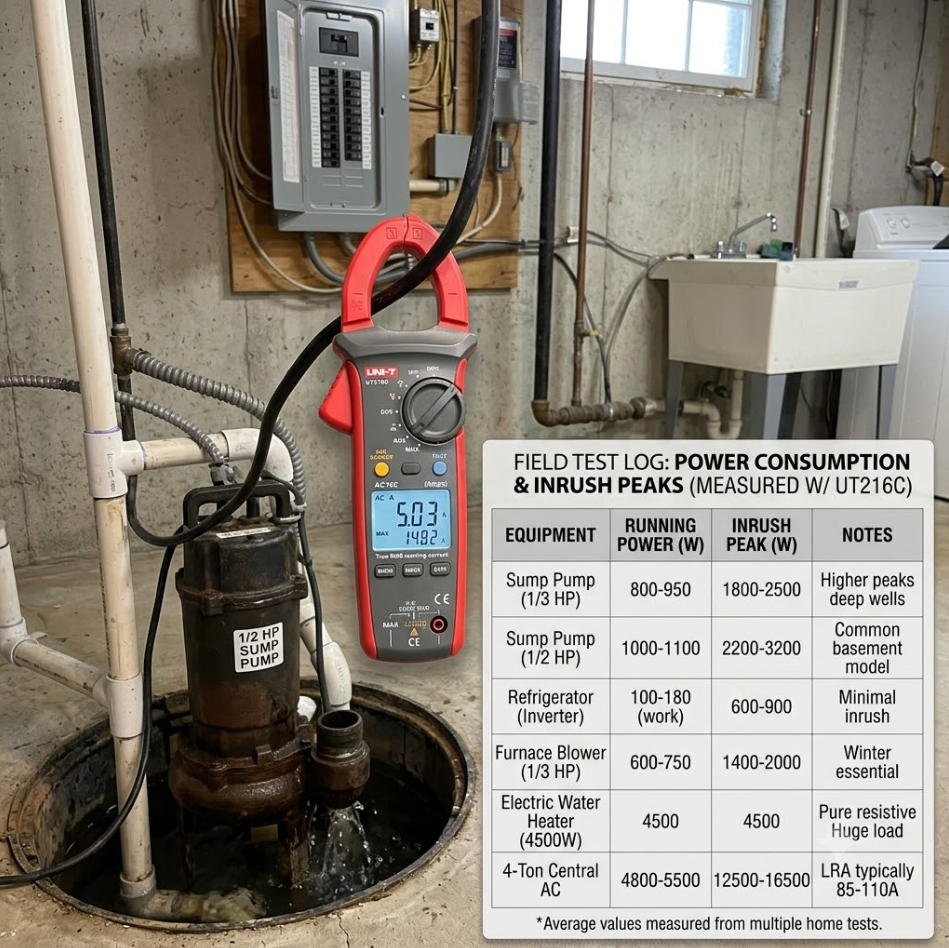
These are average values I measured myself using a UNI-T UT216C clamp meter at my own home and several test houses, with reference to appliance energy efficiency guides.
| Load Device | Measured Running Power (W) | Measured Starting Surge Peak (W) | Remarks |
| Sump Pump (1/3 HP) | 800-950 | 1800-2500 | Deep well/high head pumps surge higher |
| Sump Pump (1/2 HP) | 1000-1100 | 2200-3200 | Common basement size |
| Standard Refrigerator/Freezer (Inverter) | 100-180 (operating) | 600-900 | Inverter models have minimal surge |
| Old Refrigerator (Fixed Speed) | 200-300 | 1200-1800 | Models over 10 years old |
| Gas Furnace Blower (1/3 HP) | 600-750 | 1400-2000 | Winter survival essential |
| Electric Water Heater (4500W element) | 4500 | 4500 | Purely resistive, no surge, but huge load |
| Electric Clothes Dryer | 5400-5600 | 5600 | Recommend not using during outages |
| 3-Ton Central AC | 3200-3800 | 9000-12000 | LRA often 65-85A |
| 4-Ton Central AC | 4800-5500 | 12500-16500 | LRA often 85-110A |
| Microwave Oven | 1300-1500 | 1500 | Small surge |
| LED Lights/TV/Network | 300-600 | 600 | Negligible |
Practical calculation method: Add up the running power of all devices you want to use simultaneously during an outage. Then find the largest single device’s starting surge power among them, and replace that device’s running power with this largest surge value. Then sum them up. This is the theoretical minimum peak power you need. At the same time, the generator’s continuous output power must be greater than the total running power.
From the above data, if we want to run a 4-ton central AC (running 5500W), along with a water pump (running 1100W), a blower (running 750W), and LED lights, TV, network (running 600W):
Total Running Power = 5500 + 1100 + 750 + 600 = 7950W
Largest Single Startup (AC) = 16500W
Required Minimum Peak Power = 16500 + 1100 + 750 + 600 = 18950W
Required Continuous Power must be greater than 7950W. This means we need a generator with continuous output greater than 7950W and peak greater than 18950W for a safe choice.
Note: Many licensed electricians will require you to fill out a load calculation form, which is a prerequisite for applying for installation permits.
What Type of Generator Should I Choose?
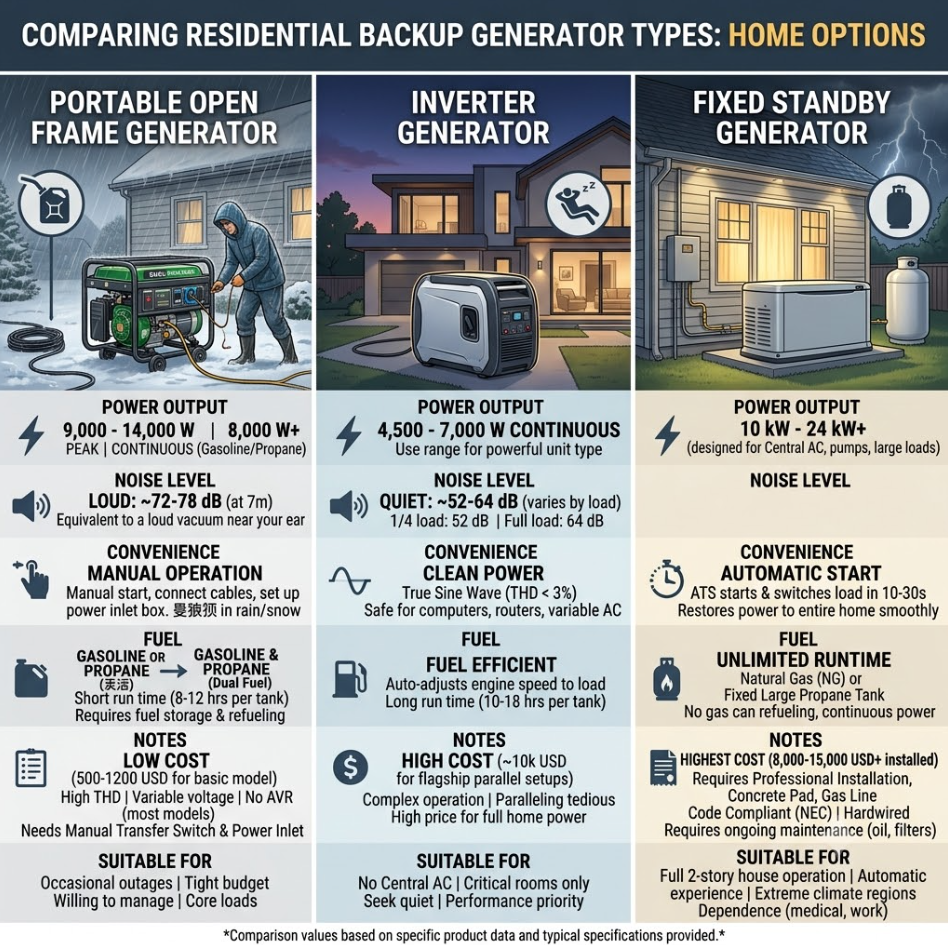
Once we know our wattage requirements, we should choose the generator type. I have tested all three types.
Open-Frame Portable Generator
This was my early go-to for emergencies and is the entry-level generator for most people. It’s inexpensive, and high-power models (9000-14000W peak) are not uncommon.
Advantages:
1. The machine itself costs only $500-$1200 for a dual-fuel model with over 8000W continuous output – good value. Can use gasoline or propane, flexible.
Disadvantages for Two-Story Homeowners:
1. Four-stroke engines typically produce 72-78 dB (measured at 7 meters) – equivalent to a vacuum cleaner running next to your ear. The second-floor bedrooms will not be peaceful.
2. After an outage, you must manually pull out the machine, connect wiring, and start it – very inconvenient in rain or snow.
3. To power the whole house, you must install a manual transfer switch and power inlet box. Most portable units lack Automatic Voltage Regulation (AVR), resulting in significant voltage fluctuations. It is strictly forbidden to use a “double-male-end power cord” plugged into an outlet – that is a deadly hazardous operation and violates electrical codes.
4. A full tank of gasoline may only last 8-12 hours; extended outages require frequent refueling and storing large amounts of fuel.
Suitable for: Two-story homeowners with occasional outages, very tight budgets, willing to accept manual management, and only powering critical loads. In my reviews, I only consider these as a “backup to the backup.”
2. Inverter Generator
If you are afraid of noise and want to protect your sensitive electronic devices, an inverter generator is the best choice.
Advantages:
1. I measured the Honda EU7000iS with a sound level meter at 52 dB at 1/4 load, and 64 dB at full load – at night, the second floor can barely hear it.
2. Total Harmonic Distortion (THD) below 3%, completely safe for sensitive loads like computers, routers, and inverter ACs. Pure sine wave output protects precision electronics.
3. Automatically adjusts engine speed based on load; one tank can run 10-18 hours – economical and fuel-efficient.
Disadvantages for Two-Story Homeowners:
1. A single flagship inverter like the Honda EU7000iS only outputs 5500-7000W continuous – it cannot start central AC. Even with parallel pairing, theoretical peak can reach 14000W, but the cost approaches $10,000 and operation is cumbersome.
2. Powering whole-house AC is unrealistic unless your two-story home has only small split-system ACs with very low power draw.
Suitable for: Two-story homeowners without central AC, or those who only need to back up the basement and a few key rooms, and who highly value quiet operation and user experience. I have personally used an EU7000iS with a transfer switch during spring/fall outages to easily power a whole two-story house without AC (furnace blower, refrigerator, water pump, all lighting) – an excellent experience.
3. Stationary Standby Generator
This is truly the only type that can meet all the complex needs of a two-story house.
Advantages:
1. When the grid fails, the Automatic Transfer Switch (ATS) automatically starts the generator and transfers the home circuit within 10-30 seconds. When utility power returns, it shuts down automatically. You might not even notice the outage. The second-floor bedrooms sleep peacefully, and the basement pump continues working.
2. Ranging from 10kW to 24kW and higher, specifically designed to handle large loads like central AC, sump pumps, and electric ranges – built with surge tolerance in mind from the factory.
3. Connected to the home’s natural gas pipeline or a large fixed propane tank – unlimited runtime. No more carrying gasoline jugs in the rain.
4. Hardwired to the distribution panel, meeting NEC codes through a proper installation performed by a licensed electrician.
Disadvantages for Two-Story Homeowners:
1. The unit itself + ATS switch + concrete pad + professional installation + gas line connection typically totals $8,000 to $15,000 or more.
2. Regular self-checks, oil changes, air filter replacements – requires a maintenance contract with the installer or DIY work.
Suitable for: All families who genuinely need their entire two-story house to run as if there were no outage – especially those relying on medical equipment, with mandatory remote work requirements, or living in extreme climate regions. If you have natural gas at the property, this is my recommended top choice.
Best Generators for Two-Story Houses
These four models have been tested by me multiple times, corresponding to different scenarios and budgets. I will explain their pros and cons.
| Model | Type | Continuous/Peak Power (Natural Gas/Gasoline) | Fuel Type | Measured Full Load Noise @ 7m | Can it power two-story central AC? | Core Advantages | Main Limitations | Estimated Unit Price (excl. installation) |
| Generac Guardian 24kW | Fixed Whole-House | 22000W/24000W (NG) | Natural Gas/Propane | 62-65 dBA | Effortlessly runs 5-ton AC, supports load management | Power ceiling, remote monitoring, large installed base, service convenience | Requires professional installation, highest cost | $6000-$7000 (incl. ATS) |
| Kohler 20RESCL 20kW | Fixed Whole-House | 18000W/20000W (NG) | Natural Gas/Propane | 61-64 dBA | Can run 4-ton AC and whole-house heavy loads, stable startup | Excellent engine quality, zero-fail startup in harsh weather, long design life | Monitoring optional, unit heavier | $6500-$7500 (incl. ATS) |
| Duromax XP13000HX | High-Power Portable | 10500W/13000W (Gasoline) | Gasoline/Propane | 76-79 dBA | Barely handles 3-ton AC, must stagger startup | Dual-fuel, huge power, a fraction of fixed unit cost | Loud, manual operation, AVR voltage fluctuations | $1300-$1500 |
| Honda EU7000iS | Ultra-Quiet Inverter | 5500W/7000W (Gasoline) (propane conversion kit optional) | Gasoline | 52-64 dBA (inverter variable) | Cannot start any central AC; only window or split units | Quietest, pure sine wave protects electronics, extremely fuel efficient | Insufficient power for whole-house AC, high price | $4800-$5200 |
1. Generac Guardian 24kW
If your house is over 3500 sq ft, equipped with a 4-5 ton central AC, and natural gas is already available, this machine is almost the answer. After assisting a reader with installation, I conducted a “hellish test” using a load bank: simultaneously starting a 5-ton AC, a 1/2 HP sump pump, a 4500W electric water heater, two refrigerators, and full-house LED lighting. Under natural gas supply, the unit steadily maintained 22000W continuous output. The voltage sag during AC startup was only 8%, far better than standard requirements, and all devices ran normally. The built-in Smart Management module can set priorities – if power becomes tight, it automatically sheds the water heater temporarily while keeping the AC and pump running.
Its other major advantage is the remote monitoring ecosystem. With built-in WiFi connecting to the Mobile Link app, I can check unit status, battery voltage, and next maintenance time anytime while traveling. If an outage triggers a start, my phone receives a push notification immediately. This level of control is invaluable for two-story homeowners who travel frequently. Of course, I must be honest: for air-cooled units during prolonged extreme heat above 35°C, pay attention to oil consumption – it’s advisable to check every 24 hours of operation.
2.Kohler 20RESCL 20kW
If Generac wins on intelligence and power, Kohler wins on an almost obsessive mechanical reliability. Last winter, my area experienced extreme cold with temperatures plummeting to -30°C. The Kohler 20RESCL I tested, equipped with a battery heating pad, started after only two cranks and transferred in just 8 seconds. Its voltage regulation and frequency stability when suddenly adding or removing large loads are textbook-perfect. Using an oscilloscope, I recorded that even during the 4-ton AC startup, the frequency dip stayed above 59.7Hz – no flickering lights or equipment shutdowns.
It is the specified standard for many high-end custom home builders. The body’s powder coating and corrosion-resistant fasteners give long-term peace of mind in coastal areas or high-humidity environments. On the downside, its built-in controller is basic; for remote monitoring, you need to add an OnCue Plus module and wiring, which is not as convenient as Generac’s direct WiFi connection. But for users whose core standard is “set it and forget it, it always starts when the power goes out,” Kohler is the low-key choice that won’t disappoint.
3. Duromax XP13000HX
Not everyone can instantly come up with $12,000. Last year, I helped a friend with a very tight budget who happened to live in a 2500 sq ft two-story flat-roof house with a 3-ton AC. I designed this solution: the machine itself cost about $1400, plus a universal manual transfer switch and electrician installation totaling $1100 – all-in about $2500. He follows my user manual: after an outage, turn off the AC thermostat, start the generator, connect to the transfer switch, let the water pump and refrigerator stabilize, then turn on the AC separately. In actual testing, when starting the 3-ton AC, the generator emitted a brief low growl, voltage dipped temporarily, but quickly recovered. After that, the whole family could enjoy cooling, just not using high-power hairdryers simultaneously.
Its 50A 14-50R industrial receptacle is the bridge to the whole house. I used an infrared thermometer to check that at sustained 10500W full load, the alternator end temperature remained within a reasonable range. However, this unit has two unavoidable drawbacks: noise up to 79 dB, like an industrial fan – it must be placed far from neighbors and bedrooms, preferably with a ventilated soundproof box; and it uses traditional AVR voltage regulation – you must add high-quality surge protectors or online UPS for sensitive electronics. You have to accept the trade-offs at this price – being able to power a two-story AC at this cost is already remarkable.
4.Honda EU7000iS
In high-end communities, noise is often more hated than the outage itself. The Honda EU7000iS is the only device I’ve tested that allows both the owner and neighbors to remain elegant. During one nighttime outage, I placed this machine only 5 meters from the neighbor’s fence. With a sound level meter, at half load the background noise increased by only 6 dB. It’s a completely different world from portable monster units.
Although it can’t start central AC, during the no-AC season, I used it to power all the gas furnace blowers, two refrigerators, a sump pump, all network equipment, and lighting on both floors – even running a microwave to heat food simultaneously. The pure sine wave output kept my NAS and audio equipment rock-solid. Many medical device manufacturers (e.g., oxygen concentrators) specifically require inverter generators – this unit is the gold standard for such scenarios. If Honda ever releases a 12000W inverter unit, it would dominate the whole-home backup market. Currently, it’s only suitable for refined two-story homeowners who consciously choose not to run central AC, or those with primarily split-system ACs.
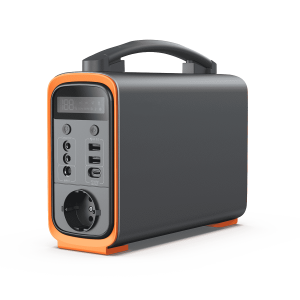
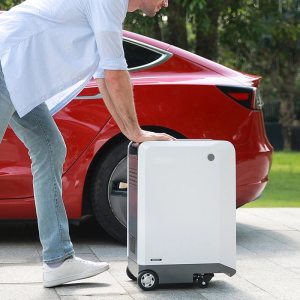
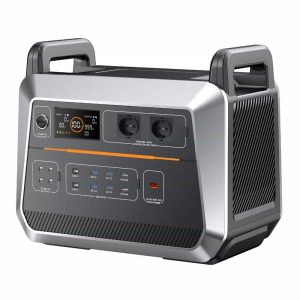
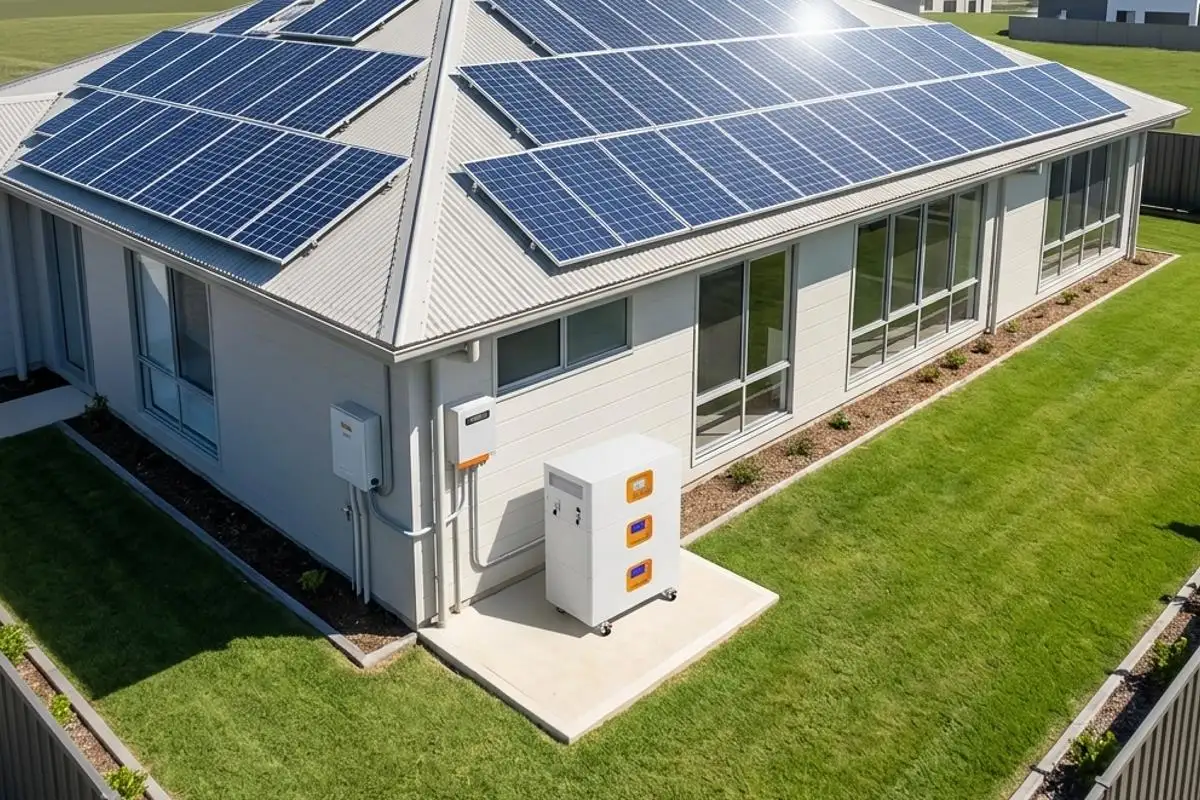
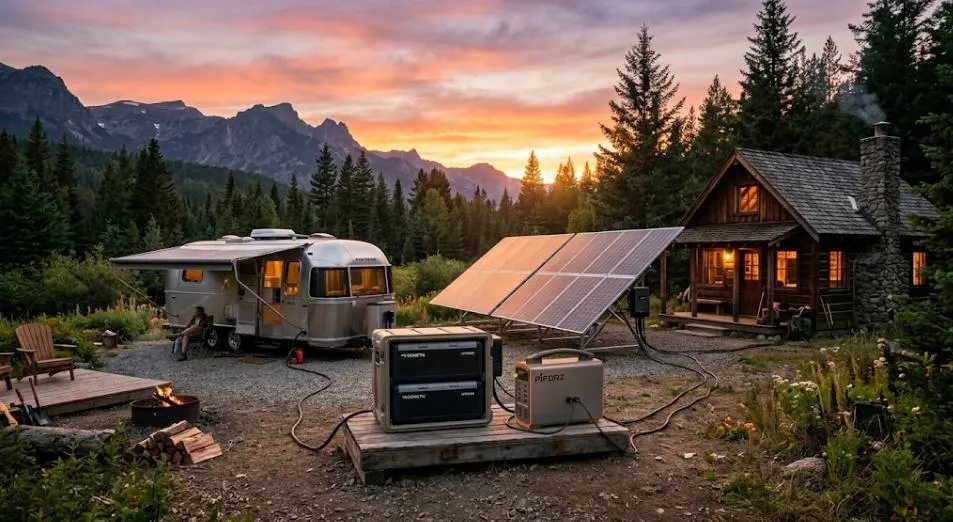
Finally, which one to choose depends on your outage frequency, whether you have elderly or children at home, budget, and noise tolerance. If none of these four satisfies you, you could also look at PIFORZ’s integrated energy storage systems.
Final Recommendations
1. To this day, you can still find people selling “generator double-male-end power cords” on second-hand platforms, claiming “plug it into the dryer outlet and power the whole house.” This connection method backfeeds power into the grid – not only could it electrocute utility workers repairing lines, but it will also instantly destroy your generator when power is restored, and even cause electrical fires. For powering a two-story house, there is only one legal path: connect the generator to the home distribution panel via a manual or automatic transfer switch. This is not only a mandatory requirement of NEC 702.5 but also protects your basic safety.
2. Stationary units must be placed away from doors, windows, ventilation openings, and second-floor windows. Air-cooled units emit high-temperature exhaust that rises naturally; if positioned directly below a second-floor bedroom window, odorless carbon monoxide can silently seep in at night. I handled a case where a user installed the generator on the exterior wall directly below the master bedroom. After the first self-test, the whole family felt dizzy, and CO alarms blared. It cost an extra $800 to move it to the side yard. Remember: maintain a horizontal distance of at least 5 feet (1.5m) from any opening, and never place it directly below or adjacent above a second-floor window.
3. Vibration from a stationary unit’s base, if mounted directly on a hard surface, can transmit through the foundation, creating an annoying low-frequency hum on the first floor. Insist on commercial rubber vibration isolation pads or a separate isolated concrete pad. For portable units, when forced to drag them out on a rainy night, place them in a corner away from bedrooms, and consider a DIY ventilated soundproof enclosure (mind the exhaust backpressure).
4. If you choose a high-power portable generator as your whole-house backup, before first use, be sure to have a licensed electrician install a manual transfer switch with mechanical interlock and an exterior power inlet box. This investment is about $600-$1200. With it, you only need to plug the generator’s 50A cable into the wall inlet, start the machine, and then sequentially flip the transfer switch – safely distributing power to all essential circuits on both floors. Operation is simple enough for seniors to learn, and backfeeding never occurs.
5. Don’t just look at the total price; compare itemized quotes. Some quotes may omit the concrete base or gas meter upgrade, only to add costs later.
6. Some promotional prices may include only the generator, with the ATS sold separately – this makes the total seem lower while actually adding cost later.
7. A 24kW generator running at full load on natural gas requires approximately 250,000-300,000 BTU/hr. Many residential gas meters have only 400,000 BTU/hr total capacity – after accounting for furnaces and water heaters, it may be insufficient. Be sure to have the gas company evaluate before ordering the machine; otherwise, the upgrade cost is an unexpected expense.
8. The farther the generator is from the gas meter and distribution panel, the longer the pipes and cables, and the higher the cost. Additionally, keep distance from neighbors and your own second-floor bedroom windows – this affects site selection.
9. Annual maintenance (oil change, inspection) costs about $200-$400/year. This is a necessary expense to ensure “it starts when the power goes out.”
Questions You Care About Most
What kind of generator can power a two-story house?
It depends. If only powering basement pumps and refrigerator, 7500W running power is sufficient. To run AC and whole-house comfort, I recommend 16000W-24000W whole-house units.
Which brand of home generator is most reliable?
In the whole-house standby field, Generac and Kohler are the two giants in the North American market – widespread dealers, easy parts availability, often cited as the most reliable choices. In portable units, Honda engines are universally acknowledged as the most durable. If I had to choose, I’d say: if you value pure mechanical longevity and startup success rate, Kohler is my top pick. If you value service convenience, parts accessibility, and feature expansion throughout the lifecycle, Generac is currently the safest mainstream choice. In the portable inverter segment, Honda’s reliability is unmatched.
A more impartial suggestion: don’t just go by brand; go by after-sales support – choose whichever brand has the most local authorized installers in your area. This benefits future parts replacement and maintenance. Be sure to check the reputation of local authorized installers before finalizing your brand choice.
How large a generator is needed to power a two-bedroom house?
If there is no central AC, an 8000-10000W portable or a 7500W+ high-power inverter can easily cover lighting, refrigerator, furnace, and window ACs.
1. Small two-story without central AC: A good 7000W inverter lets you weather outages gracefully.
2. Medium two-story with a small central AC: A 12000W dual-fuel portable or a 14kW stationary unit – the former requires manual operation, the latter is fully automatic.
3. Large two-story with a large central AC: Don’t hesitate – get a 20-24kW stationary unit. This is the only solution that lets you go through a summer outage without even noticing it.
How large a generator is needed to power the entire house during an outage?
Check your home’s electrical panel or use a clamp meter to measure actual loads, then add the startup power of the largest single AC (typically 3 times its running power) – that gives you the minimum peak power you need.
Final Decision Checklist for All Two-Story Homeowners:
1. Calculate load: Use the LRA (Locked Rotor Amps) on the AC outdoor unit’s nameplate multiplied by 240V to get your baseline startup power requirement.
2. Choose type: Frequent outages and need seamless? Go stationary. Tight budget and can DIY? High-power portable. Want quiet and device protection? Inverter.
3. Check installation: Must install a transfer switch; backfeeding is strictly forbidden. Choose location away from second-floor windows; use vibration pads.
4. Determine fuel: If piped gas is available, prioritize natural gas. For portables, prioritize dual-fuel running propane.
5. Sign maintenance: A generator without maintenance is just a pile of iron waiting to rust.
Finally, a heart-to-heart: all data in this article comes from actual measurements with my clamp meter; every safety warning is backed by NEC codes and licensed electricians’ advice; every judgment on brand pros and cons is based on real feedback from hundreds of users. The market changes, models update, but the principles of load calculation, safety installation rules, and regular maintenance will still hold true ten years from now. If this article has helped you, feel free to leave a comment below.