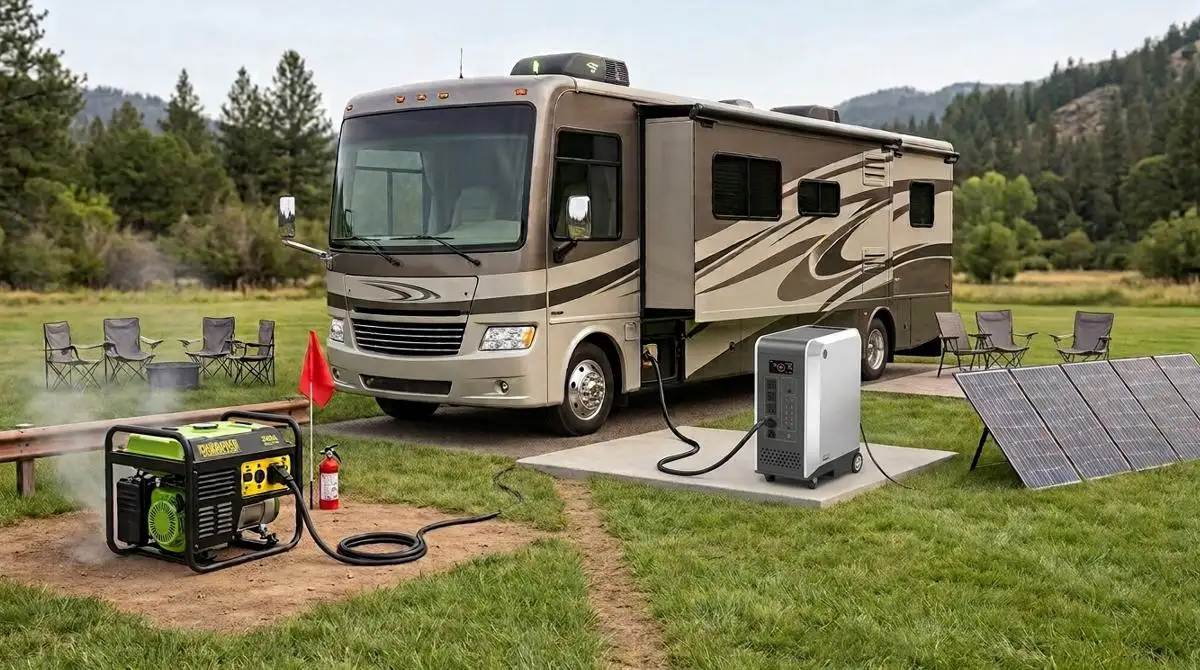

As technology and the economy develop worldwide, more and more people enjoy taking a free and comfortable RV trip with their family during the holidays. Along with this comes the need to consider power usage during RV travel.
I believe most people have some doubts when looking for the most suitable portable power station.
Four Core Factors for Choosing a Portable Power Station for RVs
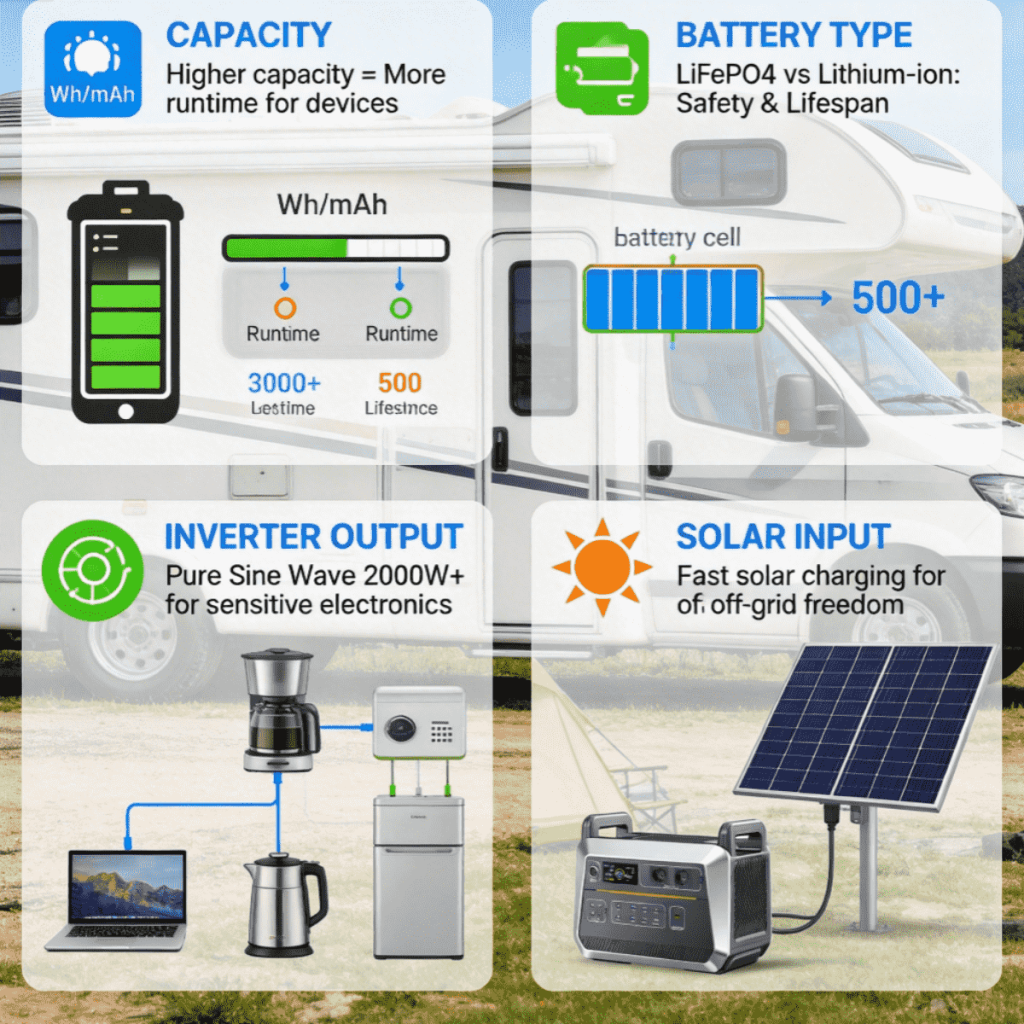
Capacity
Make a list of the appliances you need to use (e.g., laptop 65W, small fridge 60W), multiply by the estimated usage time, and keep the total power consumption (Wh) within 80% of the power station’s capacity. For example, if your daily total consumption is 800Wh, buying a 1000Wh power station will give you more flexibility.
Battery Type
In an enclosed vehicle interior, safety comes first. LiFePO4 battery cells not only offer extremely high thermal stability but also typically have a cycle life of over 3,000 cycles (equivalent to about 10 years of daily charging and discharging). This is the absolute baseline for quality energy storage products.
Inverter Output
Van life often requires the use of high-power appliances (e.g., hair dryers, induction cooktops, or even small RV air conditioners). A sustained output capacity of at least 2000W is essential for a good quality of life.
Solar Panel Input
True RV living relies heavily on solar panels. A good power station should have a built-in efficient MPPT controller and support at least 800W of high-voltage solar input, allowing for rapid recharging during a few hours of strong sunlight.
Based on these core factors, you can quickly select a portable power station that meets your needs.
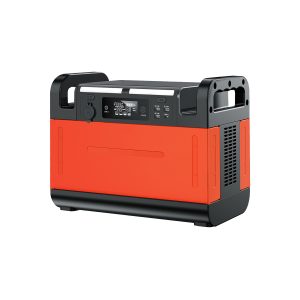
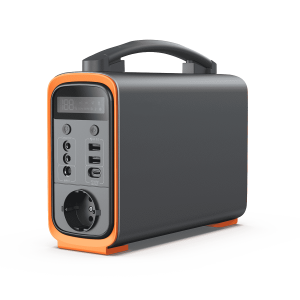
Best 2000-Watt Portable Power Stations
For the 2000W class of portable power stations:
| Feature | PF2000 | EcoFlow DELTA 3 Max Plus | Jackery 3000 Pro 2 |
| Rated Power | 2000W (peak 4000W) | 3000W | 3600W |
| Battery Capacity | 2073Wh | 2048 Wh | 3000 Wh |
| Weight | 28 kg | 22.1 kg | 26.9 kg |
| Fastest AC Charging | 1.7 hours | ~1 hour (0→80%) | ~1.3 hours |
| Key Advantage | Cost-effective, full-featured | Extreme fast charging, professional ports | Large capacity, lightweight |
| Positioning | High-value “all-rounder” | ech-leading “performance flagship” | Long-range “lightweight king” |
In the 2000W class, the PF2000 has very solid specifications across the board with no obvious weaknesses, making it a reliable choice that can handle most RV living scenarios.
If your total power consumption is within 1800W and you want to trade a reasonable budget for a solid 2 kWh of capacity, the PF2000 is well worth considering — its value for money is significantly higher than those flagship models.
If your RV needs to run high-power appliances like air conditioners, then you should consider a portable power station above 3000W.
Important Considerations for Van Life
Hey friend, don’t rush into selling your house just yet to go RV living. While van life looks free and romantic, it also requires careful planning. Here are the four most important things to consider for van life.
Power System & Energy Management
This is the most critical factor determining your quality of life in an RV. Without reliable power, modern RV living becomes unsustainable.
- Range anxiety with electricity:
Whether you’re running an RV air conditioner, fridge, induction cooktop, or powering laptops and networking equipment — you need a strong energy reserve. - Charge/discharge balance:
You must precisely calculate your daily power consumption (Wh) and ensure your solar panel array, alternator charger, and portable power station can keep up with recharging. On cloudy/rainy days or during long stationary stays, having a reliable power system with large capacity (e.g., 2000Wh+) and high-pure-sine-wave output is essential.
Mobile Work & Internet Connectivity
If you need to handle work while on the road, or stay in touch with family and friends via electronic devices, a stable internet connection is indispensable.
- Redundant internet:
You cannot rely solely on your phone’s hotspot. You typically need a multi-carrier router (e.g., 5G CPE), and even consider Starlink when heading deep into remote areas.
- All-weather workstation:
The work area inside your van needs to be ergonomic and have an uninterrupted power supply. This is why power stations with UPS (uninterruptible power supply) functionality are extremely popular for mobile work scenarios.
Water System & Temperature Control
- Water management:
Storing fresh water and disposing of gray water (from washing dishes/bathing) and black water (waste) are very real and frequent tasks. You need to plan refill and dump stations along your route. - Extreme temperatures:
A van is essentially a metal box. Good insulation is the first step. In winter, you need a reliable diesel heater. In summer, if you rely on an RV air conditioner, that again places huge power demands on your battery system.
Parking Safety & Legality
- Finding campsites:
Not everywhere allows overnight RV parking. You need to become proficient with RV camping apps, distinguishing between paid campgrounds, free BLM (public lands), and “stealth camping” spots in cities (often in supermarket parking lots or industrial areas). - Safety precautions:
Installing a dash cam, external security cameras, and a carbon monoxide alarm is essential.