Introduction
Camping comes in many forms: tent camping, rooftop tents, and RV travel. But regardless of the style, there is one thing you simply cannot avoid—electricity. Phones need charging, drones need power to fly, and at night you need lighting. If you want a more comfortable setup, you may even bring a portable fridge or a coffee machine.
Last month, I went on a solo two-day camping and filming trip. After returning, I researched the topic in detail and summarized everything into this article to help you avoid the mistakes I made.
This article will take a deep dive into 200W vs 2000W portable camping power station inverters, helping you clearly understand the difference between a few hundred watts and a few thousand watts of output power—and ultimately choose the right inverter size for your camping needs.
What Is a Portable Power Inverter for Camping?
We all know that the main function of an inverter is to convert the DC power stored in a battery into AC power that household appliances can use, but the internal working principle is not well known. According to The Engineering Mindset, an inverter uses a series of electronic switches (MOSFETs) to rapidly switch the one-directional flow of DC power into a “left → right → left → right” back-and-forth flow. This back-and-forth movement of electricity is what we call AC power.
More specifically, the inverter first uses high-speed switching to chop the DC power into pulses. Then, through precise chip control, it adjusts the width of those pulses to mimic the shape of a sine wave. Next, a transformer steps up the voltage to the appropriate level. Finally, a filtering circuit smooths out the “spikes,” producing a stable, clean sine-wave AC output.
Table of standard voltages and charging interfaces for various countries, for reference.
| Country | Standard Voltage | Frequency | Common Plug Types |
| Malaysia | 230V | 50Hz | Type G |
| Philippines | 220V | 60Hz | Type A / B / C |
| Nigeria | 230V | 50Hz | Type D / G |
| Kenya | 240V | 50Hz | Type G |
| United States | 120V | 60Hz | Type A / B |
| China | 220V | 50Hz | Type A / C / I |
Why do they need to mimic a pure sine wave?
Because every household appliance in the world is designed to run on sine-wave electricity. If the waveform is off—say it’s a square wave or a modified wave—the appliance can’t “digest” it properly.
Cheaper inverters may output modified sine waves or even square waves. That’s like someone walking with a limp—they can still move, but awkwardly, and it strains the knees. Appliances behave the same: they may run, but with more noise, more heat, and a shorter lifespan.
A pure sine wave inverter, on the other hand, outputs the smoothest and most standard waveform, letting your devices feel just as comfortable as they do when plugged into a wall outlet at home.
When you’re camping, the power sources you bring—whether it’s a car battery or a power bank—only output DC. But the devices you want to bring with you, such as laptops, drone chargers, car fridges, or even small fans, mostly require AC power to operate. So having an inverter makes camping much more convenient.
Portable inverters for camping are also different from home inverters in one key way: home inverters aren’t designed with weight or size in mind. Camping inverters must be lightweight, compact, energy-efficient, and able to withstand vehicle vibrations, temperature changes, and sometimes even connect to solar panels.
So a reliable camping inverter doesn’t just change the voltage—it has to strike a balance between sufficient performance and energy efficiency. It needs to power your devices without wasting your limited battery reserve. That’s the biggest difference between it and a regular inverter.
200W Portable Power Inverter — What It Can Run
A 200W portable inverter is a lightweight option. It can’t power high-wattage appliances, but it easily handles several low-power camping devices at the same time. Common camping items it can run include:
Communication: smartphones, routers, drones, weather radios, and satellite communicators.
Entertainment: laptops, tablets, and handheld gaming consoles.
Daily Use: car fridges, small Bluetooth speakers, camera battery chargers, single-person electric blankets, small desk fans, camping lanterns, and LED light strings.
Because of its power limitations, it can’t run high-wattage appliances like coffee makers. But its biggest advantages are its light weight and portability. You can plug it directly into the car’s cigarette lighter and draw power from the vehicle, without needing a separate battery. For one- or two-day short camping trips, it’s more than enough.
My Field Test: Is a 200W Portable Power Station Enough for Real Camping?
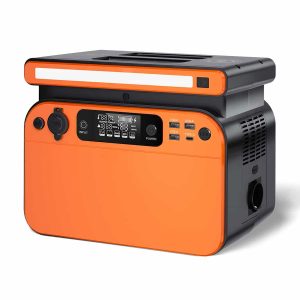
In May, I brought a 200W portable power station—the Piforz GT200—with an actual usable capacity of about 240Wh. I went on a two-day, one-night wilderness camping trip at the Linxi campsite. Here are the real measured loads:
- iPhone 15: charged twice (about 20Wh)
- Nikon Z30 batteries: charged 3 units (about 26Wh)
- DJI Mavic 3 battery: charged once (about 80Wh)
- Camping light: 4 hours of use (about 20Wh)
- Laptop: light use for 2 hours (about 60Wh)
Result:
By the evening of the second day, the power station still had about 15% remaining. The conclusion is that 200W is completely sufficient for single-person lightweight camping. But if you want to run a car refrigerator, 200W definitely won’t cut it.
Small tip:
Since I camped by the lake and portable power stations shouldn’t get wet, I usually place it on a table or a mat to keep it off the ground.
2000W Portable Power Inverter — What It Can Run
A 2000W portable inverter can meet most of our power needs while camping.
Cooling equipment: Small household refrigerators are no problem.
Heating equipment: electric kettles, small space heaters, compact microwaves, and coffee makers.
Entertainment: projectors and higher-powered speakers.
However, it’s important not to run multiple high-wattage devices at the same time to avoid exceeding 2000W and causing a shutdown.
Since appliances like refrigerators use compressors, they produce a surge wattage when starting up. So when choosing a high-power inverter, you should also check its peak power rating. For example, the ST2000 from Piforz has a rated power of 2000W and a peak power of 4000W, which can easily handle a car fridge.
The downside is that a 2000W inverter requires a large-capacity battery, which inevitably increases the weight.
In addition, a 2000W inverter cannot simply be plugged into a cigarette lighter. Cigarette lighter fuses are usually only 10–15A, providing at most 120–180W at 12V. Therefore, a 2000W inverter should ideally be paired with an auxiliary battery or used with a portable power station.
Power Consumption Comparison Chart
| Category | 200W Inverter | 2000W Inverter |
| Positioning | Lightweight, basic power | High power, supports small appliances |
| Best Use Case | Short trips, light-duty devices | Camping/RV, outdoor cooking |
| What It Can Run | Phones, routers, drones, laptops, Bluetooth speakers, small fans, camping lights | Car fridge, electric kettle, space heater, small microwave, coffee maker, projector |
| Limitations | Cannot power high-watt appliances | Cannot run multiple high-watt devices at once |
| Advantages | Light, portable, plugs into car cigarette lighter, no extra battery needed | Powers most camping appliances, high surge rating (can start fridge) |
| Disadvantages | Low power, limited usage | Heavier, requires auxiliary battery or power station, cannot use cigarette lighter |
| Power Source | Car cigarette lighter (10–15A) | Auxiliary battery / portable power station (not via cigarette lighter) |
Battery Size vs. Runtime
This is the most commonly miscalculated part of portable power for camping. Many people assume that the higher the inverter wattage, the longer it will run. But what actually determines your runtime is not the number written on the inverter — it’s the battery capacity and the power consumption of your devices.
The formula is simple:
Runtime (hours) ≈ Battery capacity (Wh) × 0.85 ÷ Device power (W)
Why multiply by 0.85?
Because when an inverter converts DC to AC, there’s always some energy loss. Industry testing shows efficiency typically falls between 85% and 92%. Using 85% gives us a conservative estimate.
For example, a 200W inverter paired with a 200Wh battery powering a 60W laptop, a 10W camping light, and a 20W mini fan would run for:
200 × 0.85 ÷ (60W + 10W + 20W) = 1.8 hours.
Now, if a 2000W inverter is paired with a 2000Wh battery and the load is the same 90W total:
2000 × 0.85 ÷ 90W = 18.8 hours.
So as you can see, don’t just look at the inverter wattage: a 2000W inverter paired with a 200Wh battery is just a decorative piece — it can output high power, but it won’t last more than a few minutes.
| Camping Type | Recommended Battery Capacity | What You Can Power |
| Tent Camping | 300–500Wh | Phones, drones, laptops, camping lights — enough for one night |
| Overlanding / Rooftop Tent Camping | 1500–2000Wh | Add fridge, electric blanket, small rice cooker — lasts 1–2 days |
| RV / Camper | 3000Wh+ | Full lighting, fridge, microwave, coffee maker, fan — 2–3 days or longer |
Solar Options — Extending Runtime for Camping
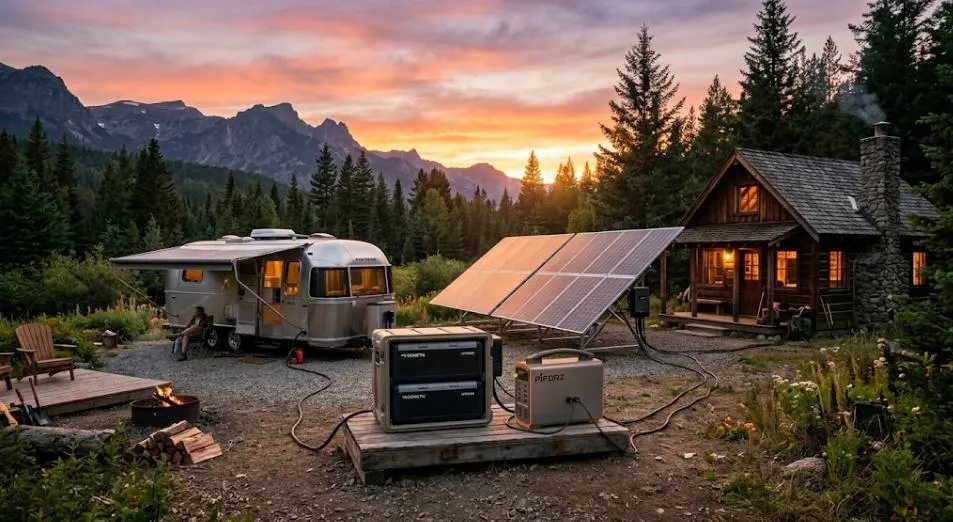
No matter how large your battery capacity is, it will eventually run out. If you’re staying outdoors for more than two days, or you don’t want to sit in your car listening to engine noise just to recharge, solar power is the most reasonable solution. Solar isn’t a replacement for your portable inverter and battery — it’s their perfect partner. Charge with sunlight during the day, use electricity at night, and form a continuous cycle.
And the charging speed of a solar panel depends on three things: solar panel wattage, sunlight intensity, and battery voltage. The following estimates are based on a 12V system with moderate sunlight on a clear day:
100W solar panel: Charges about 60–80Wh per hour. With 5 hours of effective sunlight → around 350Wh. Enough to fully recharge a 300Wh portable power station with some left over.
200W solar panel: Charges about 140–160Wh per hour. With 5 hours → around 700Wh. Suitable for a ~1000Wh battery system, replenishing most of it in a day.
400W solar panel: Charges about 280–340Wh per hour. With 5 hours → around 1400Wh. Can support a 2000Wh+ battery system, enabling a “charge by day, use by night” cycle that’s essentially self-sustaining.
Note: These are theoretical estimates. Cloudy weather, shade from trees, and mornings/evenings will all reduce output. If you often camp in spring/fall or in wooded areas, it’s recommended to choose a solar panel one size larger than the theoretical calculation.
If you’re assembling your own inverter and battery setup, you’ll need to install an MPPT controller when connecting the solar panel. It tracks the panel’s maximum power point and matches the voltage. But if you buy a portable power station, it’s much simpler, because many modern units come with a built-in MPPT controller.
If you’re only spending one night outdoors and your battery is enough, you don’t need solar. But if you stay more than two days or want unlimited off-grid power, solar becomes essential. It frees you from anxiety.
Three things to note
Trap 1: Thinking a car cigarette lighter socket can handle a high-wattage inverter
I once tried plugging a 1000W inverter directly into the cigarette lighter socket, and the fuse blew instantly. After looking it up, I finally learned that cigarette lighter fuses are usually 10–15A. At 12V, the maximum output is only 120–180W. A 2000W inverter must be paired with an auxiliary battery, or you should just buy an all-in-one portable power station.
Trap 2: Laying the solar panel flat on the ground
The first time I used a solar panel, I just threw it on the ground. After charging all day, it barely collected any power. Later I found out that angling it 30–45 degrees toward the sun can double the output. Now I always bring a foldable stand.
Trap 3: Ignoring the startup surge power of devices
I assumed a 200W inverter could run a 150W car fridge, but it shut off the moment I plugged it in. Only then did I realize that a fridge needs 800–1200W of surge power at startup. So now, when choosing an inverter, I always make sure the rated power ≥ the device’s running power, and the surge power ≥ the device’s startup surge.
That’s why everything in this article is based on the basic lessons I learned from these exact mistakes.
Safety Tips for Using a Portable Power Inverter Outdoors
For using an inverter outdoors, remember these hard rules:
- Keep it dry — inverters are not waterproof. If you place it on the ground, put something underneath. Don’t let it get rained on or damp.
- Ensure ventilation — inverters generate a lot of heat. Leave about 20 cm of space around it, and don’t seal it inside a closed box.
- Connect the battery first, then the devices — when unplugging, do the reverse: disconnect the devices first, then the battery.
- Use thick cables; avoid cheap extension cords — high power loads heat up the cables. The longer and thinner they are, the more dangerous it gets.
- Don’t overload it — keep continuous loads within 80% of the inverter’s rated power to leave room for surge power.
- Turn it off completely when not in use — inverters consume power even with no load. Disconnecting it saves the most power and worry.
If you think DIY is too much trouble, you can check out Piforz’s portable power station lineup. Buying a ready-made unit saves you from a lot of hassle—no installation, no electrical knowledge needed, just plug and play.
Which One Should YOU Choose?
Before choosing a camping inverter, you first need to define what type of camping you are doing and what your actual power needs are. A simple way to do this is to take a piece of paper and list all the devices you plan to bring, their wattage, and how long you intend to use them. Once you add everything up, you can determine the battery capacity you actually need.
Below, I will walk through different camping scenarios to help you understand which type of inverter is more suitable.
1. Weekend Tent Camping
If you are like me and go out on weekends for filming or just to reconnect with nature and escape the city noise, your setup is usually very simple.
You drive a regular car, with the trunk filled with a tent, sleeping bag, folding table and chairs, and a cooler box. The trip lasts one night and two days. You don’t need to cook in the wild or keep an entire box of drinks ice-cold. You only need enough power to light up your campsite at night, keep your phone charged until you return home the next day, power your camera and drone for a few shots, or maybe watch a movie on your laptop inside the tent.
In this case, a 200W inverter paired with a 200–400Wh battery is more than enough. It can simultaneously power phones, drone batteries, laptops, camping lights, and camera batteries, easily lasting through the night. These devices are compact, lightweight, and can even fit into a backpack.
2. Family Camping Trip
If you are traveling with family or friends in an SUV or RV and plan to stay at a campsite for three days and two nights or longer, your power needs increase significantly.
You may bring a small portable fridge to store food and drinks, use a coffee machine in the morning, cook meals with a rice cooker at noon, and heat food with a microwave in the evening. You also expect phones, tablets, and cameras to stay charged at all times, while children may watch a projector at night.
At this point, a 200W inverter is no longer sufficient. You will need a 2000W-class inverter paired with at least a 2000–3000Wh battery system to comfortably handle multiple devices at the same time.
Products like the ST2000 series, with 1536Wh and 2073Wh configurations, are good examples. When paired with a 200W solar panel, it typically takes about 5–6 hours of good sunlight to recharge a full day’s usage. This creates a practical cycle of charging during the day and using power at night—shifting your camping experience from “rationing electricity” to “using power freely.”
3. RV or Long-Term Travel
If you are living out of an RV or staying in one campsite for a week or longer, you are no longer dealing with occasional device usage—you need continuous power support.
This includes running a refrigerator 24/7, using air conditioning or electric heating at night, occasionally using a microwave, charging laptops and cameras anytime, and keeping communication devices like signal boosters running.
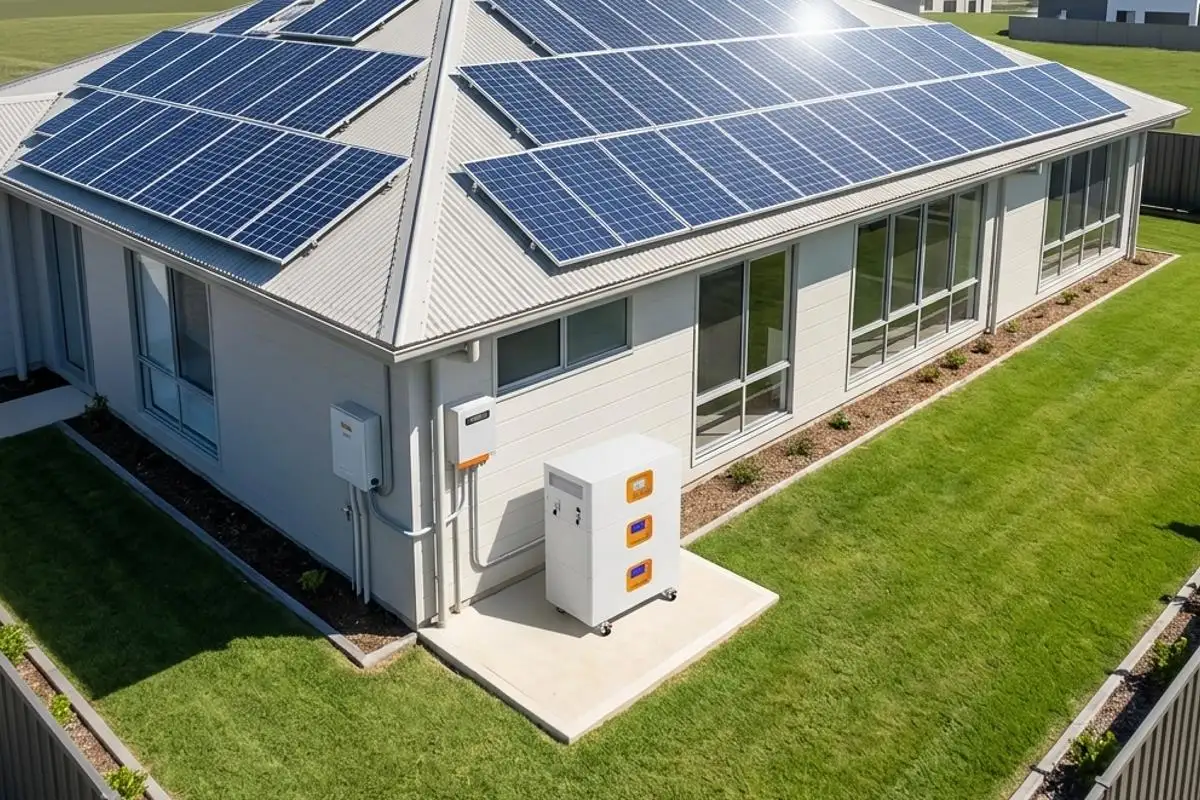
In this scenario, a single 2000W inverter can be a starting point, but it should be paired with a larger battery system (5kWh or more) and multiple solar panels. If possible, a fixed home-style energy storage system is even better.
At this stage, you are no longer just looking for a portable power station—you are building a small-scale energy system that supports daily living.
If you want to learn more about energy storage systems, you can click here to continue.
So, based on your camping style and actual power needs, choose the appropriate inverter and battery combination accordingly.versions, and when paired with solar panels, it can easily support the essential daily needs of camping.