In today’s market, high-capacity units ranging from 1000W to 3000W are becoming increasingly common as homeowners prepare for off-grid living or emergency blackouts. With the rise of massive home backup systems, one might wonder: Is a 300W unit too small to be useful?
The answer is a resounding “No.” In the world of power solutions, smaller can often be smarter. A 300W specification maintains a vital position in the market by perfectly balancing portability with practical utility. It isn’t just an oversized power bank, nor is it a cumbersome home backup battery. [cite_start]Instead, it is a precision tool engineered for lightweight camping, mobile offices, and a modern digital lifestyle.
Comprehensive Analysis: The Pros and Cons of a 300W Power Solution
Unmatched Advantages: Why It’s the Best Portable Power Station for Camping
A 300W portable power station offers a primary advantage that larger models simply cannot match: Extreme Portability. This is the core competitive edge of the 300W category.
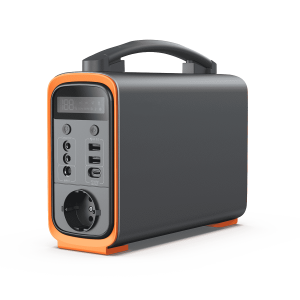
Take the PIFORZ PF300 as a benchmark:
Ultralight Design: Weighing only 4.3kg, it is easy to carry with one hand.
Compact Dimensions: Measuring 257 x 160 x 165 mm (roughly the size of a shoebox), it fits effortlessly into a backpack or car trunk without becoming a burden.
Furthermore, unlike standard power banks that only offer DC output via USB for small gadgets, a portable power station provides a much wider array of charging interfaces:
Pure Sine Wave AC Output: Typically equipped with two AC outlets (300W rated). This is the “heart” of the device, capable of powering laptops, monitors, fans, or portable car fridges. High-Speed USB-C: Often supporting up to 100W PD fast charging for high-performance laptops and tablets.
USB-A Ports: Usually featuring two QC3.0 ports for smartphones, headphones, and other small digital devices.
12V Car Socket: A 12V/10A port for automotive accessories like vacuums or air pumps.
DC Input: A dedicated port for recharging the unit via a wall outlet or solar panels.
Integrated LED Lighting: Most units, like the PF300, include an LED light for night-time illumination or SOS emergency signals.
For those new to the outdoor scene or looking for a weekend power solution, the 300W model represents a High-ROI Entry Choice, with costs significantly lower than high-power alternatives.
Understanding the Limitations
The compact nature of a 300W unit does come with trade-offs. Its light weight is achieved by sacrificing capacity, which inherently limits the maximum output power.
Due to the peak power constraints, it cannot support heating appliances such as hair dryers, electric kettles, or rice cookers. Additionally, while it is sufficient for 1-2 days of short-term camping or emergency use, it may struggle to meet the demands of week-long RV trips or large family gatherings.
Application Scenarios: What Can a 300W Power Station Run?
Despite its small stature, the 300W unit is a powerhouse for specific applications. [cite_start]It utilizes a Pure Sine Wave inverter, ensuring that even sensitive electronic equipment can be charged safely without damage.
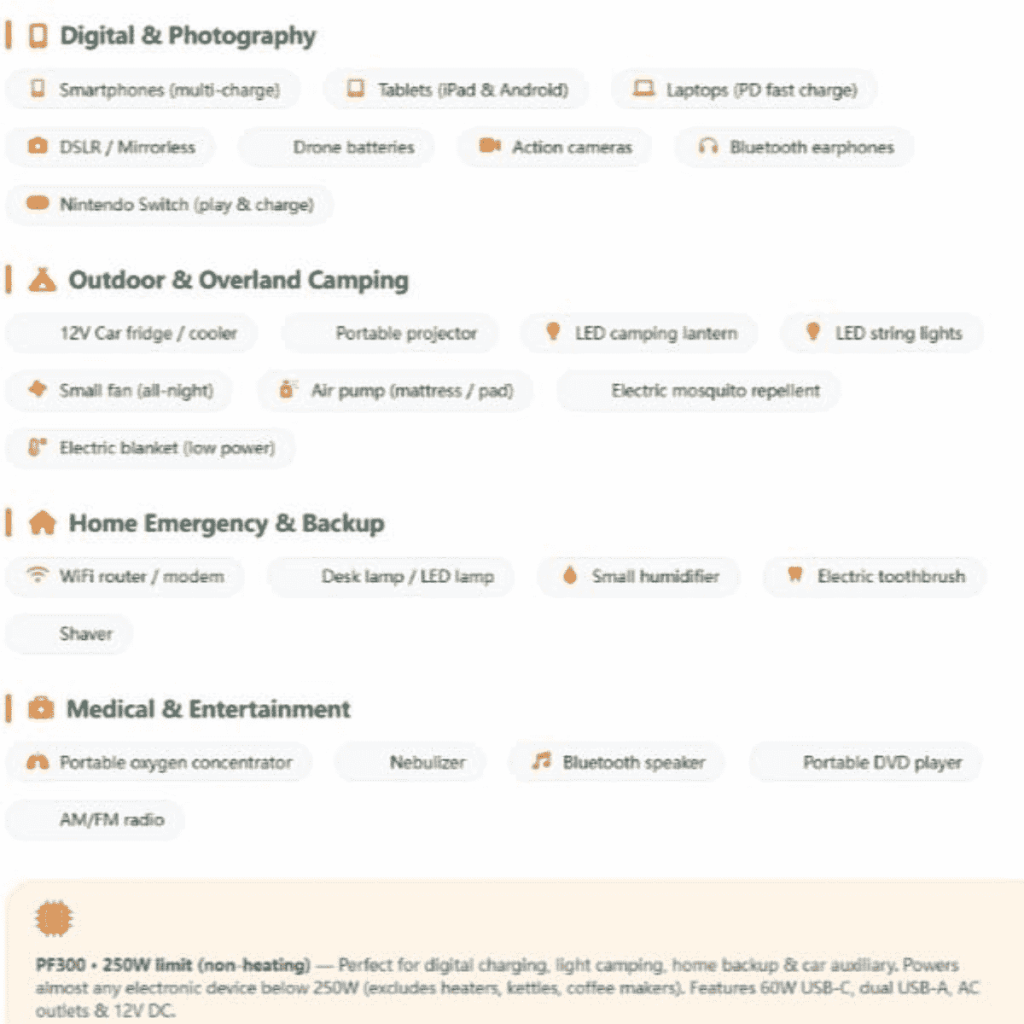
Digital & Photography Gear
Smartphones & Tablets: Simultaneously charge multiple phones or provide a full charge to an iPad.
Laptops: Supports PD fast charging for MacBook Pros and other high-end workstations. Photography & Drones: Ideal for outdoor photographers to recharge DSLR batteries or drone batteries for multiple flight missions.
Entertainment: Powers Nintendo Switch consoles (play and charge), Bluetooth speakers, and portable DVD players.
Outdoor & Lightweight Camping
Essentials: Powers small car fridges for several hours, portable projectors for an outdoor movie night, and electric mosquito repellents.
Comfort: Runs small electric fans all night or low-power electric blankets for a warm night’s sleep.
Utility: Quickly inflates mattresses with an air pump or maintains camp lighting with LED lanterns and string lights.
Home Emergency & Medical Backup
Home Office: Keeps your WiFi router and modem running during a blackout to ensure connectivity.
Portable Power Station for CPAP & Medical Needs: In emergencies, it can power small oxygen concentrators or nebulizers for several hours.
Daily Grooming: Provides power for electric toothbrushes and shavers.
Performance Metrics: How Long Will It Last?
To maximize the efficiency of your best small portable power station, it is crucial to understand its actual runtime. Energy loss occurs during the conversion process, so we use a standard industry formula for estimation:
Estimated Runtime (Hours) = [Total Capacity (Wh) × 0.85 (Efficiency)] ÷ Device Power (W)
Example: Powering a 60W laptop with a 300Wh unit.
Actual usable power: ~260Wh.
Result: 260 ÷ 60 ≈ 4.3 hours.
By planning your device load in advance, you can effectively eliminate “range anxiety” during your outdoor excursions.
FAQ
Q1: Is a 300W power bank good?
If a standard phone power bank is insufficient for your needs—specifically if you need to power a laptop or a fan—then a 300W portable power station is your best upgrade path.
Q2: Can 300 Watts power a house?
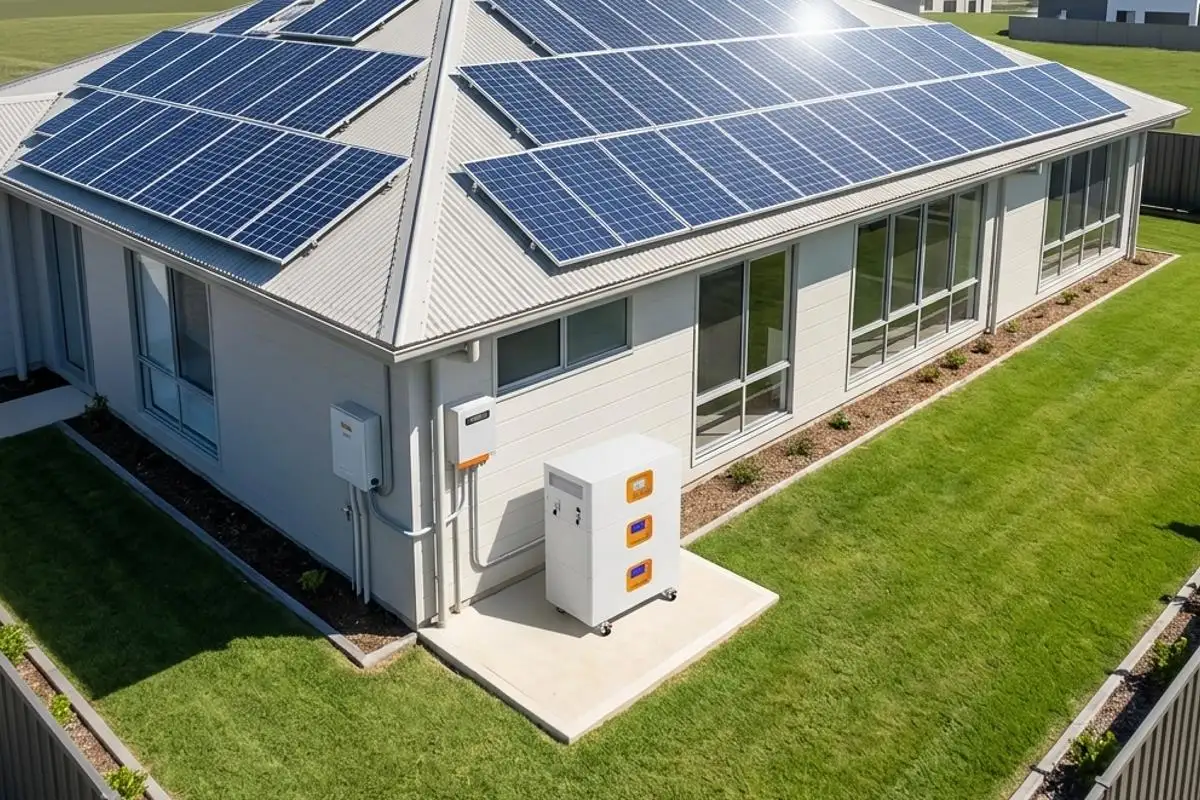
No. A typical household requires much higher wattage for appliances. However, during a blackout, a 300W unit is an excellent emergency tool to keep your router, phone, and lights operational. For full-home backup, we recommend 2000W+ models.
Q3: How long will a 300W power station run a TV?
It depends on the TV size. A standard 32-inch LED TV (approx. 40W-60W) can run for 4 to 5 hours, enough for two football matches or a feature-length film.
Q4: Can I take a 300W power station on a plane?
Generally, no. Most airlines and aviation authorities (IATA) limit lithium batteries to 160Wh. Since 300W units typically have capacities between 280Wh and 320Wh, they must be transported via ground logistics.