A friend called me the other day, totally frustrated.
“Dude, I’m so pissed,” he said. “I spent over a thousand bucks on a portable power station for camping. Thought I could charge my drone multiple times. You know what happened? I charged it twice, and on the third time, it died halfway through! Did I get scammed?”
I asked him: “What specs did you look at before buying?”
He said confidently: “Capacity, of course! 30,000mAh – way bigger than my phone power bank. Looked pretty impressive.”
That’s the problem right there –only looking at “mAh” is the easiest way to get ripped off.
Here’s the thing about picking a power station: it’s kinda like dating. Don’t just judge by the cover (the capacity number). You gotta look at what’s inside – real energy, output capability, safety. Something that looks good on paper might not last.
I’ve worked with power supplies for years and seen so many people throw away money on the wrong ones. Today I’m breaking down the 5 most important specs in plain English. After reading this, you’ll know exactly which one fits your needs.
Trap 1: Only Looking at “mAh,” Ignoring “Watt-hours”
Ever notice how most power station listings put“30000mAh”or“50000mAh”in huge fonts?
Looks impressive, right? But that’s onlyhalf the story.
mAh (milliamp-hours)is like “how many liters are in your gas tank.”
Wh (watt-hours)is “how far those liters can take you” – aka theactual energy.
These two get mixed up all the time. Here’s the simple math:
Wh = mAh ÷ 1000 × voltage (V)
Here’s the catch –different power stations run at different voltages. Some use 3.7V, some use 5V, or even higher. Same mAh number? The actual energy can be 30% off depending on voltage.
Example:
Power Station A: Claims 30000mAh, voltage 3.7V → real energy = 30000÷1000×3.7 =111Wh
Power Station B: Claims 20000mAh, voltage 5V → real energy = 20000÷1000×5 =100Wh
See that? The 30000mAh station A only gives you 11% more juice than the 20000mAh station B. If it costs twice as much, you’re getting robbed.
Here’s another sneaky trick: Some cheap brands list theraw cell capacityin mAh. But after voltage conversion, you actually lose 20-30% of that. That’s why people buy these and think “why does this feel way less powerful than I expected?”
How to avoid this trap
Stop looking at mAh numbers. Ask the seller or check the specs for“rated energy (Wh)”.
If a brand only lists mAh but not Wh, they’re probably trying to confuse you with big numbers.
When comparing two options, do Wh ÷ price to see how much energy you’re getting per dollar.
Trap 2: Ignoring “Continuous Output Power” – Then Your Hotpot Shuts Down
I’ve heard this story way too many times:
“I bought a 600W power station thinking I could cook hotpot while camping. Plugged it in, water started boiling, thenpop– the thing just turned off. Turned it back on, plugged it in, shut down again. Took an hour just to finish one meal.”
Why?Because it overloaded.
Every power station has two power specs:
- Peak power:What it can handle for a split second
- Rated power:What it can actually sustain
Lots of brands advertise the peak number because it sounds better. But what you actually need is therated power.
Here’s something people miss: Some appliances draw way more power when they start up than when they’re running. Like:
- Fridges, AC units (anything with a compressor): startup can be 3-5× the normal power
- Motors: also have a power spike when starting
- Even some hotpots draw extra power right when you turn them on
If your power station’s rated power just barely matches your appliance’s normal draw, that startup spike might trip the overload protection.
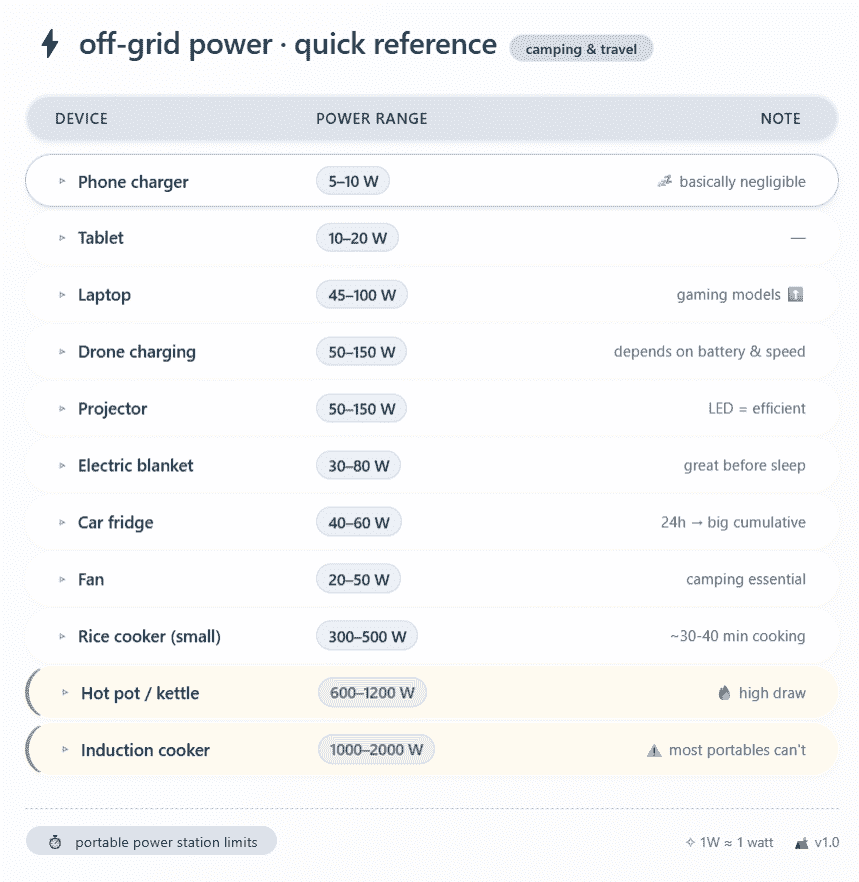
Quick power reference for common gear:
How to avoid this trap
Make a quick list: your 3-5 most-used devices, add up their wattage, then leave 20% extra room.
If you’re running heating stuff like hotpots or kettles, get at least 1000W rated power.
Ask the seller: “What’s the continuous output? Any limits on peak?” If they can’t answer clearly, walk away.
If you’re mainly charging phones, laptops, drones – 300W to 500W is plenty. Don’t overpay for power you won’t use.
Trap 3: Not Knowing the Battery Type – Then You Get Something Heavy and Unsafe
Most people don’t pay attention to this, but itaffects safety, lifespan, and weight big time.
Right now there are two main types:NMC andLiFePO4 . Let me break it down simply:
NMC :Higher energy density (more power in less weight), but shorter lifespan (~500-800 cycles), less heat-resistant (can be risky if temps get high)
LiFePO4 :Lower energy density (heavier for the same capacity), but way longer lifespan (2000+ cycles), safer, handles heat well, almost zero risk of thermal runaway
Think of it this way:
NMC = sports car:Fast and light, but high-maintenance, shorter life, sensitive to heat
LiFePO4 = off-road truck:Heavier, but tough as nails, lasts forever, no worries
Real-world comparison:
- NMC power station, used weekly: noticeably weaker aftertwo years
- Same capacity LiFePO4, same use: still going strong after8-10 years
Fun fact:LiFePO4 lasts so long that even daily use won’t kill it for years. NMC with daily use? Might need new cells in a year or two.
How to avoid this trap
Camping or home backup?Get LiFePO4 without thinking twice.Safety and longevity come first.
If you absolutely need lightweight and only use it occasionally (like twice a year camping), NMC is okay – just know it won’t last as long.
Before buying, ask: “What battery type? Is it LiFePO4?” If they dodge the question or say “high-quality cells,” that’s probably NMC. LiFePO4 is a selling point – they’d tell you.
Trap 4: Ports – Looks Like Enough, Then You’re Left Screaming
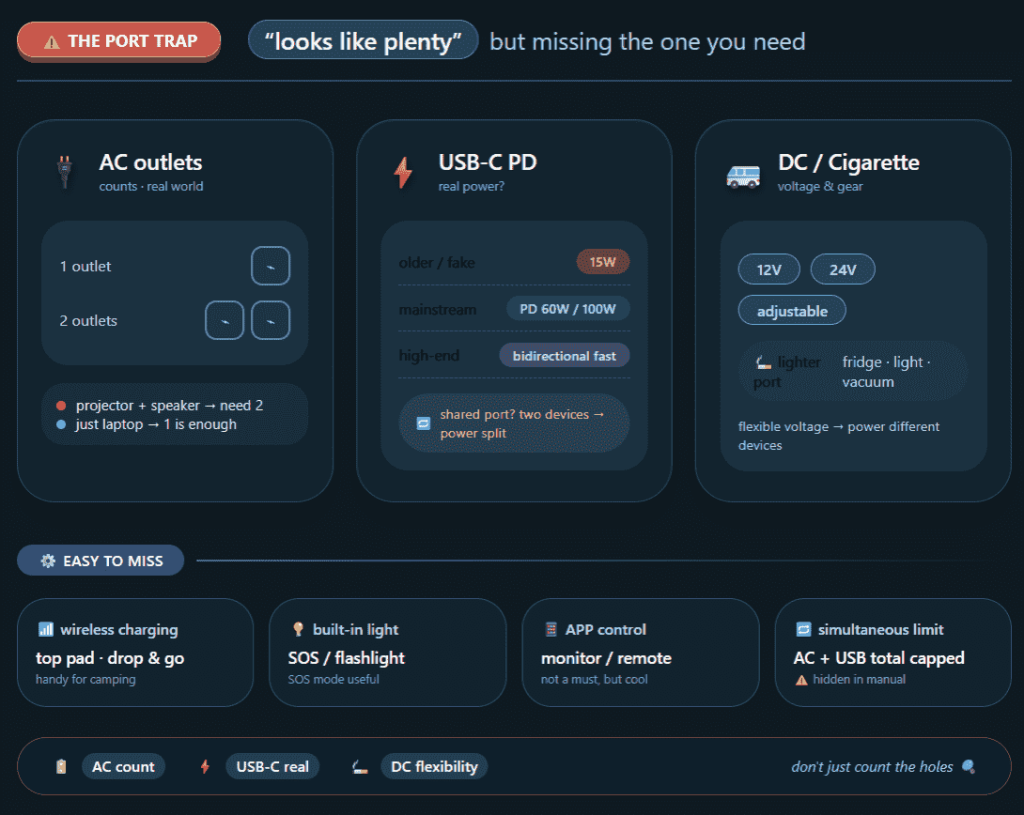
This one’s sneaky. You look at a power station photo, see a bunch of ports, and think “yeah, this’ll work.” Then you get it home and realize the one port you actually need is missing or weak.
Three things you must figure out:
1. How many AC outlets?
1 vs 2 matters more than you think.
Running a projector and speakers at the same time? You need 2.
Just charging a laptop? 1 is fine.
2. Does USB-C support fast charging? How many watts?
Older Type-C ports: only 15W. Charges phones slowly, useless for laptops.
Current standard: PD 60W or 100W – actually charges most laptops.
High-end: Some support bidirectional fast charging – charges your gear fast, and charges itself fast too.
Heads up: Some USB-C ports are “shared.” Plug in two devices and the power gets split.
3. DC output adjustable? Got a cigarette lighter port?
If you run a car fridge, camping lights, or a car vacuum, you’ll want 12V DC output.
Fancier models let you switch voltage (12V/24V) – more flexible for different gear.
Cigarette lighter port is a lifesaver if you have 12V car accessories.
Also, don’t miss these:
Wireless charging:Some have a pad on top – just drop your phone and it charges. Super handy at camp.
Built-in light:Lots come with LED lights. SOS mode? Even better.
App control:High-end ones let you check battery, control outputs from your phone. Not essential, but cool.
Simultaneous use limits:Some units limit total USB power when AC is in use. Only mentioned in the manual.
How to avoid this trap
List every device you own that needs charging. Count the ports you need. Match it against the power station’s ports.
Think about stuff you might buy later (camping fridge, etc.) and plan ahead.
Don’t just count ports – ask about max power per port and any limits when using multiple at once.
Trap 5: Ignoring “Standby Drain” – Come Back to a Dead Battery
Ever had this happen?
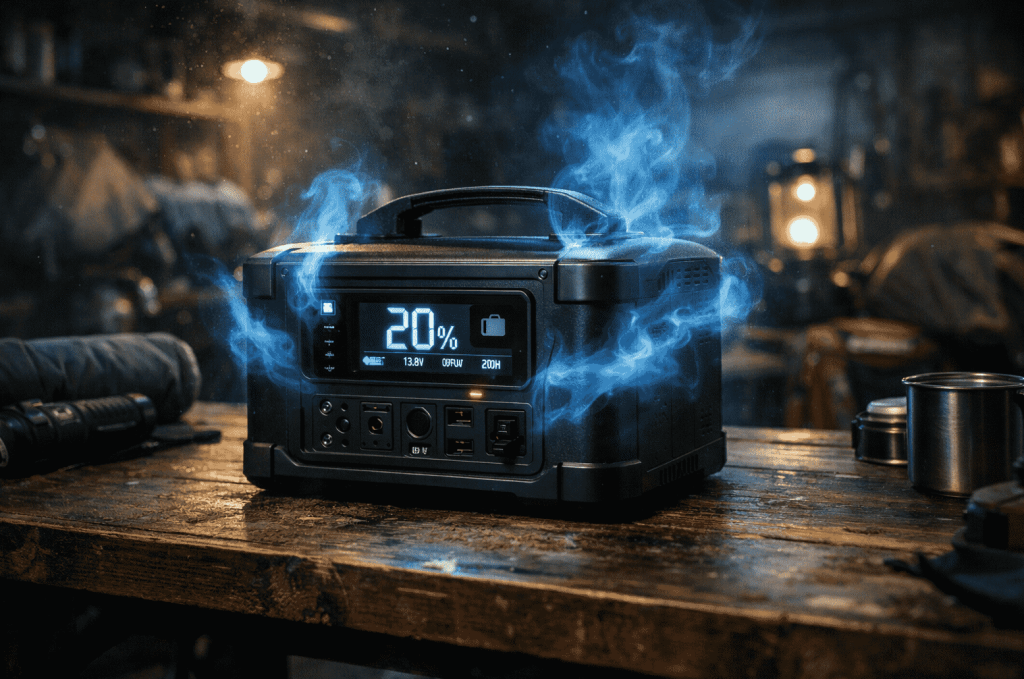
You come back from camping, power station still at 60%. You think, “I’ll charge it before the next trip.” A month later, you grab it for another outing – and it’s at 20%. You didn’t use it once. Where’d the power go?
That’sstandby drain– also called self-discharge. Every power station has it. But the difference between good and bad ones is huge.
Why does it happen?
The internal circuit board, display, standby chips – they’re always sipping power.
Like your TV plugged in but off – that little red light is still using juice.
Good vs bad:
- Cheap power stations: poor design, high standby drain – lose 1-2% per day. After a month, 30-60% of your battery is gone.
- Decent ones: low-power mode, auto sleep – lose less than 0.5% per day. After a month, maybe 15% gone. Totally fine.
One more thing:Some power stations drain faster in cold weather. Or the battery just performs worse, so your usable capacity shrinks.
How to avoid this trap
Ask the seller: “What’s the standby power draw? Does it have a sleep mode?” If they look confused, that model probably hasn’t been optimized.
Or check the manual for “standby time” – longer is better.
If you don’t use it often, store it at 50-80% charge. Not full, not empty.
If it’s sitting for more than three months, top it up once to keep the battery healthy.
Your Checklist – Run Through This Every Time
Next time you’re shopping, don’t fall for fancy ads. Pull out this list:
- Real energy:Look for Wh, not mAh
- Rated power:Does it cover your gear + 20% buffer?
- Battery type:LiFePO4 first (unless weight is your only concern)
- Ports:Does it fit everything you own (and might own)?
- Standby drain:Did you ask? Sleep mode?
Do these five, and you won’t get burned.
One more tip: Before buying, hit Amazon or forums and read the bad reviews. Not to see if there are any – to seewhat they’re complaining about. If it’s shipping damage, whatever. If it’s “stopped charging after three months,” run.
If you don’t wanna dig through all this yourself, piforz actually follows these standards. Specs are transparent. Check them out: https://piforz.com/
What About You?
Ever gotten burned buying a power station? Or got questions you still can’t figure out?
Drop a comment. Maybe your question becomes my next guide.
Because honestly, the best lessons come from getting screwed over.