
I was tidying up the warehouse recently and came across several strings of Christmas lights. I remembered spending last Christmas at home. It was supposed to be a happy time, but we almost had an accident because of the lights. The problem was the cords. Everyone was excited for the holidays, and kids were running around inside the house and in the yard. Right after I hung up the lights and plugged them in, the kids tripped over the cords without noticing them, and even pulled the plug out of the socket. For a moment, sparks flew at the socket. Thankfully, it didn’t start a fire. So this Christmas, I plan to learn from that lesson and solve the problem at its source – no more long cords running everywhere. But the question is, how should I power the Christmas lights? My partner and I discussed several options, and we all had different opinions. We talked for a long time. I plan to list them all and make an objective comparison, which led to this article.
The Challenges of Christmas Lights
For the lights themselves, LEDs are definitely the first choice. They are not only more energy-efficient than traditional incandescent bulbs, but their surface temperature is also much lower, greatly reducing the risk of igniting flammable materials like Christmas trees and curtains.
For safety, we also chose LED light strips. These strips come in lengths of 10m, 20m, 30m, etc. Sometimes, a single strand is enough to decorate the Christmas tree.
The light strings aren’t much of an issue; the main thing to consider is how to power them.
Methods to Power Christmas Lights
We listed several methods, comparing them across four dimensions: safety, runtime, aesthetics, and device compatibility, to find the most suitable solution for powering Christmas lights.
Power Strip
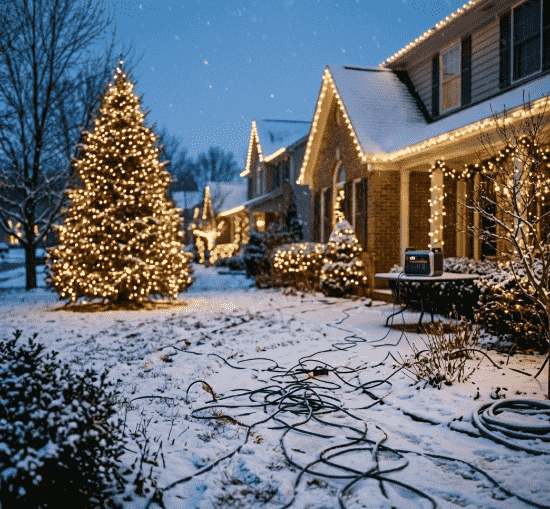
Plugging directly into a socket means the cord will be too long. It affects aesthetics, and more importantly, poses a safety hazard. It’s easy for people to trip over, and kids might play with it or animals might chew on it. What if I use an extension cord, a power strip? It’s essentially the same as plugging directly into a socket – there’s still at least one cord running across the way. But you certainly don’t have to worry about insufficient power; you can use it as long as the mains power is on. However, in winter during Christmas, bad weather like snow or rain isn’t uncommon. If moisture gets tracked in from outside and the power strip gets wet, it could cause a circuit breaker to trip, or even lead to a short circuit or fire. So this solution is a no-go.
Power Bank
My partner wanted to use a power bank. It’s possible, but it seems like it might not have enough capacity. So I looked into it. Whether a power bank can power Christmas lights depends on the type and scale of the light strings. Regular power banks can work for small decorative lights, but for a complete Christmas setup, they tend to fall short.
- Connector Mismatch:Most regular power banks output 5V DC via USB, while traditional outdoor Christmas light strings typically require 110V or 220V AC. Regular power banks don’t have a built-in inverter, so they simply can’t connect to these lights.
- Limited Battery Capacity and Runtime: A 20,000mAh power bank might power a single string of LED lights for only about 6 hours; for a slightly larger setup, it could die in less than 1 hour.
- Low Temperature Effects: Cold winter temperatures can drastically reduce power bank battery performance, severely cutting runtime.
To prove this, we specifically bought two common power banks (Xiaomi/Anker 20,000mAh) and tested them.
| Scenario | Lighting Setup | Total Power | Traditional 110V/220V AC Plug | Runtime with Power Bank |
| Window | 1 x 2m USB copper wire light | 5W | Cannot plug directly | ~12.5 hours |
| Living Room Tree | 1.8m tree, 3 x 10m LED strings | 20W | Cannot connect | ~3.1 hours |
| Balcony Setup | 5 LED strings + 1 icicle light | 40W | Cannot connect | ~1.5 hours |
Moreover, the runtime data above is calculated theoretically at standard room temperature. Used outdoors on a winter night, the actual runtime will be further reduced due to low temperatures.
This shows that power banks are only suitable for small-scale decorations using pure USB lights, and they can’t even connect to many light strings. A more professional solution is needed.
Therefore, power banks are only suitable for small-scale, pure USB light decorations; if you want a more reliable experience, you need a more professional solution.
Battery Power
Seeing that power banks and extension cords weren’t ideal, my partner proposed another solution: buy Christmas light strings that come with a built-in battery box. Just put in a few batteries, and they light up. No high voltage risk, no cords needed – you can easily wrap them around a tree or hang them on the balcony.
Indeed, light strings with battery boxes are very suitable in terms of portability and safety. They completely eliminate the hassle of cords, and even if a child pulls on the wire, there’s absolutely no risk of electric shock.
However, when we wanted to decorate a 1.8-meter Christmas tree or spruce up the balcony, this solution seemed to have drawbacks. Let’s do the math. Common battery-powered light strings usually run on 3 AA alkaline batteries. The total energy equivalent of a fresh set of name-brand batteries is only about 4.5Wh.
If I buy a 5W Christmas tree light string, it might run out of power in just the time it takes to finish dinner.
If I want the festive atmosphere to last the entire Christmas season, with lights on for 5 hours each evening, I’d need to change the batteries 2-3 times per day. After Christmas, we might throw away dozens of used batteries. That’s such a waste, not only the cost of the batteries (enough for a nice dinner out), but also frequent battery changes are very bad for the environment.
Portable Power Station
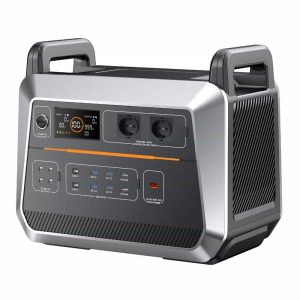
Finally, we thought of the portable power station our neighbor uses. A portable power station is a multi-functional backup battery that integrates a high-capacity lithium battery and various output ports. For decorating with lights, the biggest concern is the safety hazard posed by dense cords. If I can place the power source right next to the Christmas tree, many problems can be solved at the root.
Portable power stations have high interface compatibility. With built-in AC outlets, whether the light string has a high-voltage plug or a low-voltage adapter, you can plug it in directly without any conversion needed. They also come with multiple USB ports, allowing you to power both large light arrays and smaller decorative lights simultaneously.
Moreover, portable power stations can be used with solar panels – charge during the day, discharge at night – which is energy-efficient, green, and environmentally friendly.
They are also lightweight. Unlike fuel generators, they produce no loud noise or fumes. I can place them anywhere I want: next to the Christmas tree, under the dining table, or out in the garden. No matter how complex the setup, I can easily move it with just a light lift, no longer constrained by the location of wall outlets. It’s perfect – simply a perfect match!
More importantly, I don’t have to worry about power capacity or safety issues; I can fully enjoy the festive Christmas atmosphere.
How to Choose the Most Suitable Portable Power Station for Christmas
So, how should I choose a portable power station? There’s a lot to consider here too.
Choose the Right Capacity
When selecting, you need to focus on these values:
1. Rated Output Power: First, calculate the total power of the devices you want to power. Ensure the power station’s rated output power is greater than the total wattage of your lights. This determines whether the power station can light everything up simultaneously. A general rule of thumb is:
Ensure the power station’s rated output power ≥ Total light wattage × 1.2
2. Battery Capacity:This determines how long the lights will stay on. Don’t overdo it by chasing the largest capacity unnecessarily; just choose what’s sufficient.
The calculation formula is: Total wattage × Desired hours of operation × 1.2
Battery Type
This relates to safety and lifespan. LiFePO₄ is slightly heavier, but it offers a long cycle life and extremely high safety, making it suitable for long-term family use. NMC is smaller and lighter, but its stability is somewhat inferior to LFP. LFP’s thermal runaway temperature is much higher than NMC’s, starting to decompose at around 270°C, whereas NMC poses risks around 150°C. Its cycle life exceeds 3500 cycles – that’s nearly ten years if used daily. This is supported by a comprehensive test report comparing the long-term cycle degradation of LFP and NMC in home energy storage, published in the internationally renowned energy journal *Energies*.
After understanding this, you can choose the appropriate battery capacity based on the scale of your decorations.
For small decorative lights on a balcony, a small tree, or a door, a 300–500Wh portable power station is recommended. This capacity can support 30–50 meters of LED light strings all night long.
If you have a yard you want to decorate, choose a 500–1500Wh portable power station. This can support 80–120 meters of light strings, or a medium-scale setup, plus an inflatable Santa or snowman (motorized decorations have higher starting current requirements).
If you plan to decorate a large venue or your entire house exterior, you must choose a portable power station above 1500Wh. This is necessary to handle the simultaneous operation of high-power light strips and multiple motorized decorations.
Inverter Output
The inverter output aspect is the easiest to overlook. It mainly comes in two types: modified sine wave and pure sine wave. Modified sine wave output is choppy. If you connect delicate devices, this type of output can easily damage them. If your light strings have flashing modes or timing functions, a modified sine wave might cause the control chip to malfunction, leading to irregular flashing, buzzing sounds, or even burning out the controller. Pure sine wave output is as smooth and stable as the electricity from your home wall outlet. No matter how complex your light’s flashing patterns, it remains compatible and won’t harm your equipment.
Check the Output Ports
For the portable power station to be effective, the configuration of its output options directly determines whether it can power your devices.
- AC Outlets.The vast majority of Christmas lights use a standard wall plug design, so AC outlets are a must. And to protect your lights, you absolutely must choose a product that specifies “pure sine wave,” as many light strings have built-in microcontrollers for flashing patterns. Non-sine wave power can burn out the control box or cause the LED to flicker at high frequency.
- USB / DC Outputs. Even though the focus is plugging in light strings, modern decoration setups are often complex. Having multiple output types provides flexible backup. Also, many small decorative lights these days are actually USB-powered. Plugging them into a USB port is more efficient than plugging them into an AC outlet. For DIY light strips or car-themed decorative lights, DC direct output is the most straightforward and efficient method.
How Long Can a Portable Power Station Actually Power Christmas Lights?
How long a portable power station lasts depends mainly on three dimensions: mathematical calculation, hardware losses, and environmental factors.
Basic Formula
First, you need to determine the total wattage of all connected lights. Based on scale and usage, home Christmas lights usually fall into several categories (images later).
Then, check the Wh (Watt-hour) rating of your chosen portable power station.
Finally, use this basic estimation method, dividing energy by power:
Runtime = Power Station Capacity (Wh) × 0.85 ÷ Total Light Wattage (W)
Let’s take the Piforz PF200 Pro we bought as an example. The manufacturer describes this as an entry-level series, with a capacity of 320Wh and rated AC power of 280W. Consider a typical indoor Christmas decoration setup: a 1.8m tree with a 6m LED string (approx. 20W), plus a few small decorative lights under the tree (approx. 10W), for a total load of 30W.
Calculation: 320Wh × 0.85 ÷ 30W ≈ 9 hours
We turned the lights on at 6 PM, and they lasted until around 3 AM. For a family party or Christmas Eve, that’s sufficient. But if your decoration scale is larger, say 80 meters of light strings plus an inflatable snowman with a blower motor (which requires significantly more starting power), you would need a larger capacity model.
Factors Affecting Runtime
Of course, in actual use, the real time will also be affected by other factors.
The actual power draw of light strings often differs from their labeled wattage. We previously bought several LED strings labeled 5W, but when measured with a plug-in power meter, we found each string’s actual wattage varied, averaging around 7.3W.
Multiple Devices Running Simultaneously: When using multiple devices at once, the overall conversion efficiency decreases slightly with each additional device, but not drastically. However, if you’re selecting a model close to your calculated boundary capacity, it’s wise to leave a 20% margin.
Ambient Temperature: Although LiFePO₄ is safer and lasts longer, its discharge efficiency drops in extremely cold weather. In sub-zero environments, LFP batteries might lose about 10-15% of usable capacity, while NMC batteries lose around 20%. So, if using the power station outdoors, consider discounting the estimated runtime by 20% .
Although there are some effects, it’s clear that no matter what, a portable power station is much more suitable for powering Christmas lights for long periods than a regular power bank.
Portable Power Stations Aren’t Just for Christmas Lights
A portable power station isn’t just useful for Christmas; it comes in handy in many other scenarios too. Investing in a portable power station is definitely a good choice.
If you enjoy camping or road trips, it’s your perfect companion on the road. You can use it for lighting, charging phones and computers, or powering small appliances.
During sudden power outages or extreme weather, it acts as a home emergency backup power source, keeping basic life functions running–communication devices, essential medical equipment, basic home appliances, etc.
For people needing to work outdoors, it’s like a small, mobile workstation.
From a long-term perspective, a portable power station is not just a holiday tool; it’s a full-scenario energy solution.