
The U.S. solar energy market size, measured by installed base, is projected to grow from 203.85 gigawatts (GW) in 2025 to 412 GW by 2030, registering a Compound Annual Growth Rate (CAGR) of 15.11% during the forecast period (2025-2030).
At this scale, the U.S. solar market size in 2025 positions solar as the fastest-growing source of new electric generating capacity in the United States, with photovoltaic (PV) installations accounting for 53% of all new electricity generation capacity additions recorded in 2024 [1] Solar Energy Industries Association, *Solar Market Insight Year in Review 2024*, seia.org. Growth rests on three key pillars: stable 10-year tax incentives under the Inflation Reduction Act (IRA), a growing domestic manufacturing base now capable of meeting 70% of module demand, and corporate demand for low-carbon power purchase agreements. Developers continue to favor utility-scale projects as the levelized cost of energy in high-irradiance regions has fallen below $40/MWh, although distributed generation is accelerating as lenders introduce zero-down financing, shortening payback periods to under seven years in many states. Interconnection queues and transmission congestion remain primary obstacles, but planned grid investments and the adoption of solar-plus-storage hybrid plants are expected to alleviate curtailment pressures starting in 2026.
Data Source:mordorintelligence
Do you actually save money with solar?
Installing solar is indeed a proven way to save money, but it is fundamentally a long-term investment spanning decades. According to market research, the majority of homeowners save between $37,000 and $154,000 over 25 years. While neighbors watch their utility bills climb year after year, your solar panels generate free electricity for decades. The core metric to evaluate is whether the total lifetime electricity generation value exceeds your initial capital outlay and yields a strong return.
Does solar ever pay for itself?
A solar energy system not only recovers its initial cost but can also generate substantial returns over its entire lifecycle. The typical lifecycle of a solar system ranges from 25 to 30 years and can be divided into two distinct phases:
Payback Period (5-10 Years):
1. Initial Costs & Policy Incentives: China provides a distributed photovoltaic subsidy of 0.03 RMB per kWh, with local governments like Shenzhen offering additional rewards of 0.1 RMB per kWh. In the U.S., the Inflation Reduction Act offers a 30% Investment Tax Credit.
2. Rising Utility Rates: Traditional grid electricity prices escalate annually. As utility rates become more expensive, solar savings increase significantly, accelerating the payback period.
3. Integration of Energy Storage: While adding batteries increases upfront investment, utilizing Lithium Iron Phosphate (LiFePO4) batteries with long cycle life ensures the extended lifespan comfortably offsets the cost. Furthermore, in regions prone to extreme weather or grid outages, the “backup power assurance” provided by storage carries substantial implicit value.
Net Profit Period (15-20+ Years After Payback):
Once the system cost is recovered within the initial 5 to 10 years, the solar system continues to generate electricity. Every single kilowatt-hour produced thereafter is essentially free.
This effectively locks in electricity costs for the next 25 years. While conventional electricity bills rise with inflation and fuel costs, the cost of energy from an owned solar system remains remarkably low and stable.
How to Calculate the Payback Period for Solar Energy Investments
Case Study: 10kW System Assumptions
Initial Investment: One-time upfront cost of 35,000 RMB (calculated at 3.5 RMB/Watt).
Annual Revenue/Benefits:
Self-Consumption Savings: Assuming annual generation of 12,000 kWh, with 8,000 kWh consumed directly on-site. Calculated at a residential electricity rate of 0.55 RMB/kWh, this results in annual savings of 4,400 RMB.
Feed-in Tariff Revenue: The remaining 4,000 kWh is sold back to the grid. Calculated at the local coal-fired benchmark tariff of 0.39 RMB/kWh, this generates annual revenue of 1,580 RMB.
Total Annual Gross Benefit: 5,980 RMB.
Annual Costs:
Estimated average annual cost for cleaning and routine maintenance: 500 RMB.
Annual Net Benefit:
5,980 RMB (Gross Benefit) – 500 RMB (Costs) = 5,480 RMB.
Payback Period Calculation:
35,000 RMB (Total Investment) / 5,480 RMB (Annual Net Benefit) = Approximately 6.4 Years.
Why is my bill so high if I have solar?

Four Core Reasons for Unexpected Bills:
1. Fixed Service Charges:
The utility company maintains all the infrastructure—poles, transformers, and repair crews—from the power plant to your doorstep. As long as you want electricity available on demand (e.g., at night or on cloudy days), you must pay this infrastructure rental fee. Even if your solar generation exceeds consumption for the month, a fixed charge of $10–$25 (U.S. context) still applies.
2. The “Buy High, Sell Low” Rate Trap:
Daytime: The sun is optimal, generating 5 kW. However, no one is home except for the refrigerator (consuming 0.1 kW). The excess 4.9 kW is sold to the grid at a low feed-in rate (e.g., 0.35 RMB/kWh) .
Evening: The sun sets, generation drops to 0 kW. You return home and run the AC, cook, and watch TV (consuming 4 kW). You must buy this 4 kW back from the grid at a higher retail rate (e.g., 0.6 RMB/kWh) .
Although you earned credits during the day, the cost of purchasing power at night is significantly higher. If nighttime usage is heavy, the end-of-month bill will still show a balance due.
3. System Performance Loss or Design Flaws:
a. Inverter Clipping: If a lower-capacity inverter is installed to save costs, it will cap power output during peak sunlight hours, wasting the panel’s maximum potential generation.
b. Environmental Factors: Shade from growing trees, dust accumulation on panels, or extended periods of cloudy/rainy/snowy weather can cause actual production to fall well below estimates.
4. The Hidden “Consumption Expansion” (Jevons Paradox):
This is a common behavioral shift. After installing solar, many homeowners subconsciously feel “electricity is free now” and change consumption habits. Examples include setting the AC to a colder temperature, running it longer, or adding high-load devices like Electric Vehicles (EVs) or heat pump water heaters. The system was sized based on *pastusage history; a sudden surge in consumption will inevitably strain the original system capacity.
What are 10 disadvantages of solar power?
1. Intermittency and Weather Dependence:
Solar PV generation is entirely dependent on sunlight conditions. Overcast skies, rain/snow, or heavy haze significantly reduce panel output, causing power supply fluctuations. Unlike fossil fuel plants, solar cannot provide stable baseload power on demand.
2. Reliance on Energy Storage:
Solar systems cease operation entirely at night. To cover evening loads and provide backup during grid outages, solar installations often require expensive battery storage systems, substantially increasing the total end-user cost.
3. High Upfront Capital Cost:
Although the cost per watt of PV modules has declined annually, building a complete, functional generation system still requires a significant initial investment.
4. Low Energy Density and Large Footprint:
Solar energy has relatively low power density per unit area. Generating electricity at a utility or commercial scale requires vast tracts of land compared to conventional thermal plants.
5. Grid Impact and Interconnection Constraints (“Duck Curve”):
Large amounts of distributed solar PV export excess power to the grid during midday (low load) and disconnect in the evening. This creates the famous “Duck Curve,” placing immense pressure on grid infrastructure for peak regulation and voltage/frequency stability.
6. Module Degradation (Performance Decay):
Prolonged exposure to ultraviolet (UV) radiation and outdoor weather conditions causes aging of internal materials (encapsulant, backsheet), leading to a gradual, unavoidable decline in conversion efficiency over the system’s life.
7. Environmental Cost of Manufacturing:
While solar generation is zero-emission, the manufacturing process is energy-intensive. Furthermore, processes like silicon wafer cutting and cleaning involve hazardous chemicals such as hydrofluoric acid. Inadequate waste management at factories can cause severe pollution incidents.
8. Immature End-of-Life Recycling Infrastructure:
PV panels have a design life of 25-30 years. However, global infrastructure for collecting and recycling decommissioned solar panels remains largely underdeveloped, posing a future waste management challenge.
9. Inverter Lifespan and Replacement Costs:
While PV panels are durable, the inverter (which converts DC to AC) has a typical lifespan of only 10-15 years. This necessitates at least one full replacement during the 25-30 year lifecycle of the system, adding a significant maintenance expense.
10. Geographic and Climatic Limitations:
Solar resources are unevenly distributed globally. High-latitude regions or areas with persistent cloud cover/rainfall (e.g., parts of Northern Europe) experience significantly lower annual effective irradiance compared to sunny, low-latitude deserts or plains. This geographic constraint leads to extreme variations in Return on Investment (ROI) for identical equipment.
Solar Energy Conservation Applications and Case Studies Across Various Fields
The Current Status of Solar Energy Conservation in South Africa
The South African government formally approved the Integrated Resource Plan 2025 (IRP 2025) in October 2025, and the Electricity Regulation Amendment Act took effect on November 1, marking a fundamental transformation of the nation’s power landscape.
These policies aim to systematically resolve persistent electricity supply issues, restructure the electricity market framework, and unlock unprecedented development opportunities for the solar energy sector. The new regulatory regime seeks to optimize the energy supply mix through the introduction of dynamic pricing mechanisms and technological upgrades, establish fair tariff-setting structures, and enhance grid stability and system operational efficiency—thereby holistically improving the sustainability of the energy system.
Key Challenges:
1. Insufficient Grid Absorption Capacity:
This is currently the most significant constraint. The aging national grid infrastructure cannot accommodate the surge in connection applications, resulting in a critical bottleneck where many planned or completed projects face a situation of “generated but undeliverable.” Grid expansion and modernization have become the top priority for 2026.
2. Implementation Discrepancies (“Policy Temperature Gap”):
While national incentives exist, permitting and approval processes at the municipal level are plagued by inefficiency and inconsistent standards. Overlapping or conflicting registration requirements between Eskom and municipal authorities impose additional compliance costs and regulatory uncertainty on investors.
Solar Energy Efficiency in Hydroponic Farms
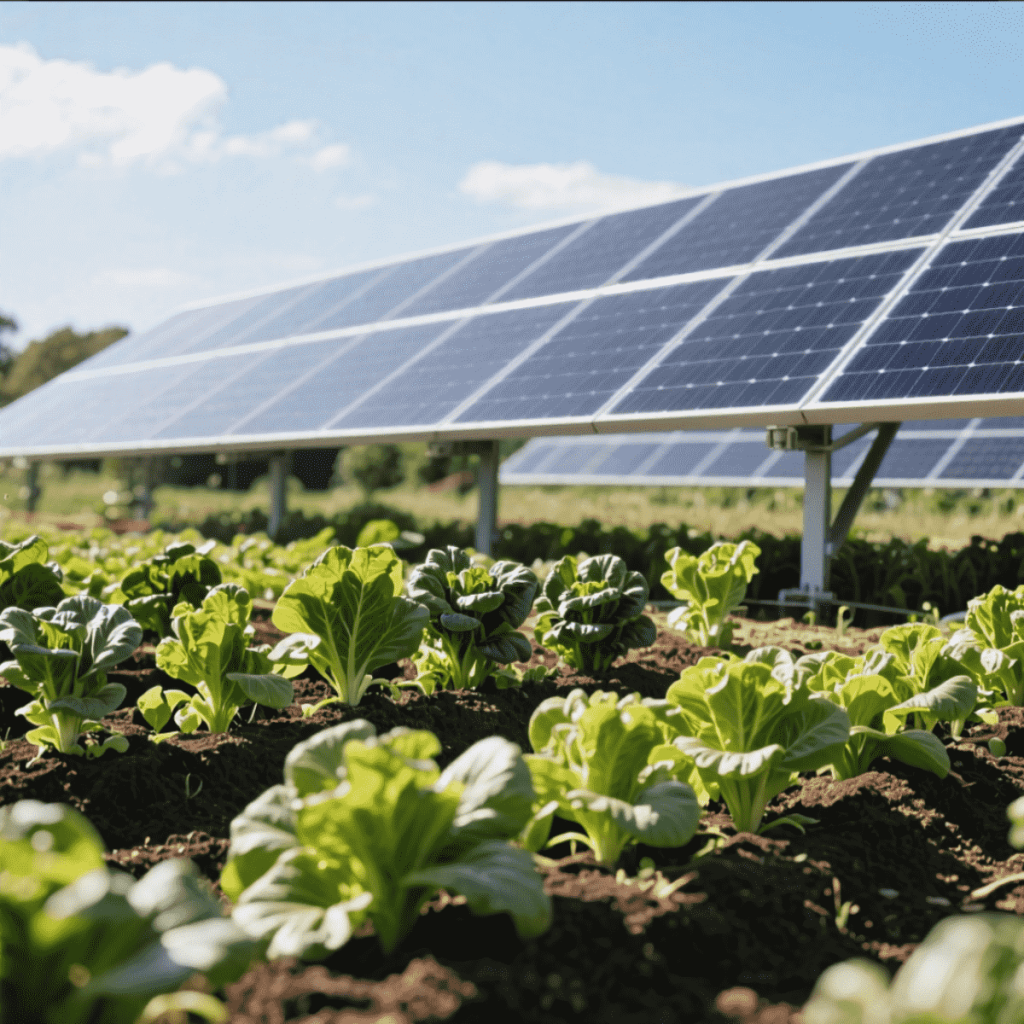
The integration of solar energy with hydroponic farming addresses the traditional pain point of high energy consumption in hydroponics, while also serving as a crucial technology for achieving sustainable agricultural development.
Case Examples:
1. Beijing Pinggu “Aerial Nursery” (China):
This is a representative case of a small-to-medium vertical plant factory in China achieving zero-carbon operation. The project has received Zero-Carbon Plant Factory certification, providing a replicable zero-carbon blueprint for small and medium-sized agricultural facilities across China.
2. Nanjing Lishui “Shenneng Plant Factory” (China):
This project demonstrates the deep coupling of large-scale commercial plant factories with ground-mounted photovoltaic power stations. Yield per unit area is 30 to 40 times higher than traditional farmland. The facility displaces approximately 7,900 tons of standard coal equivalent annually and reduces carbon dioxide emissions by 19,800 tons. The high-quality vegetables produced are consistently supplied to markets in Shanghai and Hangzhou.
3. Sundrop Farms (Australia):
This is a landmark case of extreme environment agriculture, operating entirely off-grid in the desert using only solar power and seawater. The core of this project lies in water and energy security. Solar energy powers not only the farm’s HVAC and water pumps but, more critically, drives the desalination equipment to convert seawater or brackish groundwater into a pure nutrient solution source. Large-scale thermal and battery storage ensures constant nighttime temperatures and the continuous operation of reverse osmosis equipment. With an annual yield of 15,000 metric tons of tomatoes, this project validates the feasibility of commercial hydroponics in harsh environments lacking fresh water and grid infrastructure.
Who is no. 1 in solar energy?
There is no single, definitive answer to the question of who holds the title of “number one” in the solar industry; because the metrics used for evaluation vary, the answer differs for every individual user.
What does Elon Musk have to say about solar energy?
Elon Musk has repeatedly stated that “Solar energy will comprehensively dominate the future electricity production system.” He posits that deploying solar panels on just a small parcel of land in the United States would be sufficient to meet the nation’s entire electricity demand. Both Tesla and SpaceX plan to establish 100 GW of annual photovoltaic manufacturing capacity each within the U.S. over the next three years.
Musk’s solar vision extends beyond photovoltaic panels alone; it is an integrated “Solar + Storage” solution. This includes Tesla’s energy storage products such as Megapack and Powerwall.
Does Warren Buffett invest in the solar energy sector?
Indeed, Warren Buffett has a substantial presence in the solar energy sector through his controlled entity, Berkshire Hathaway Energy (BHE) .
Gemini Solar Project: A $1 billion investment comprising 690 MW of photovoltaic capacity coupled with 380 MW of energy storage. Upon completion, it ranked as one of the largest solar installations in the United States.
Legacy Flagship Assets (Topaz/Solar Star): Through subsidiaries such as MidAmerican Energy, BHE holds a portfolio of landmark photovoltaic assets, including the Topaz and Solar Star projects.
FAQ
How long will a 300W solar panel take to charge a 100Ah battery?
Using a 300W solar panel to fully charge a 12V 100Ah battery requires approximately 5 to 6 hours of effective sunlight.
How much is a 10,000 W solar panel?
The price of a 10kW solar system varies significantly depending on the type, brand, and region, making it impossible to provide an exact quote. If you are interested in setting up a solar system yourself, we invite you to take a look at our Piforz solar energy storage products.
(https://piforz.com/product-category/energy-storage-series/)