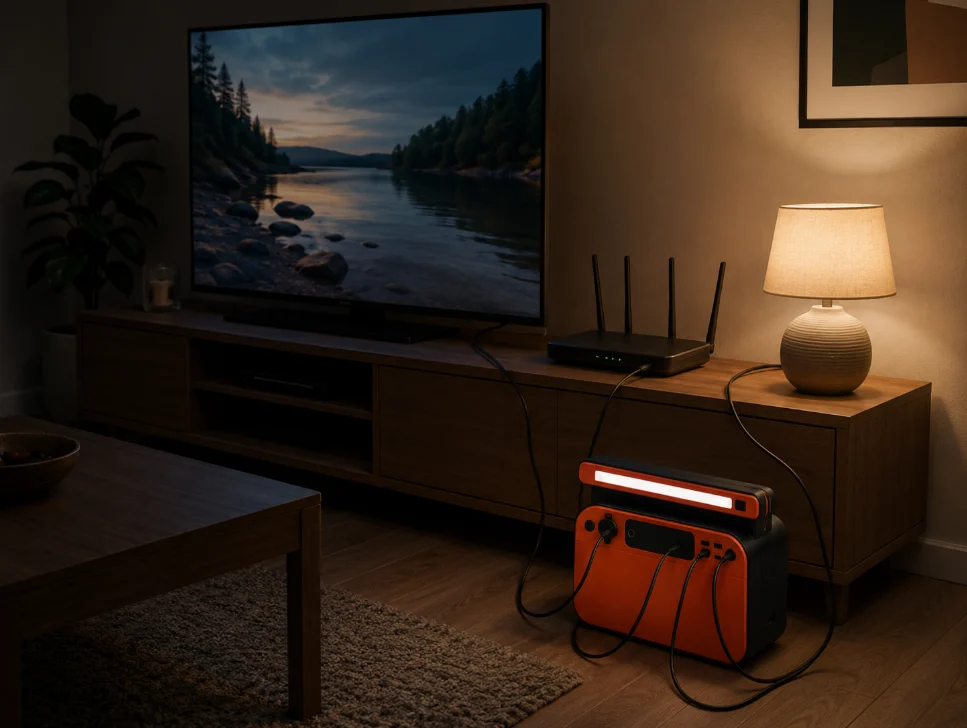
Everyone loves watching TV, but what if I told you that you can still watch TV during a power outage?
It’s not really some cutting-edge high-tech gadget or a new type of electronic device—it’s just backed by a portable power station. Maybe you’re also curious: can a portable power station power a TV? Of course, and it might even handle it with ease. To power a TV, an ordinary power bank with USB ports definitely won’t cut it. You need a portable power station. But what size exactly? How long will it last? And what else should you watch out for? These things need to be looked at on a case‑by‑case basis.
How Many Watts Does a TV Use?
Generally, a regular TV has a power rating between 30W and 200W. Among these, modern LED/LCD TVs are the most common, and most household sizes usually fall in the 50W–150W range.
Here, W refers to how much energy your TV consumes to run. In electrical appliances, a higher W value means it consumes more electricity per unit of time. And the specific power consumption of a TV is mainly affected by screen size and display technology.
1. Screen Size
This is the biggest factor influencing power variation, because a larger screen means more area needs to be lit. Take Xiaomi TVs for example: official data shows that the Xiaomi 32‑inch A Pro TV has a power rating of 50W, while the 75‑inch Xiaomi TV A Pro 2025 is rated at 215W. You can clearly see here that larger TVs consume significantly more power than smaller models.
2. Display Panel
Different panel types naturally consume different amounts of power.
- LED TVs are like a window with a light always on behind it. To make it dimmer, you use a liquid‑crystal layer to block the light, like blinds; to make it brighter, you open the liquid‑crystal layer. No matter how much you block it, the light behind it is always on, so essentially it’s always consuming power.
- OLED TVs are like a wall covered with individual small light bulbs. Each bulb can turn on and off independently, with no big light constantly on in the background. When displaying black, the bulbs in that area turn off completely and consume no power.
- Older plasma TVs are like old incandescent bulbs compared to modern LED bulbs—they stay on and also generate heat. But the difference is that an incandescent bulb might use 100 watts, while an LED bulb only uses 10 watts.
3. Picture Content
The images displayed on a TV are generally colorful. When the TV picture is whiter and brighter, it consumes more power; when it’s blacker and darker, it consumes less power.
And the screen technology used by the TV also affects its power efficiency. With OLED TVs, each small bulb on the screen is independent; if displaying black, the bulbs in that area turn off completely, so the power‑saving effect is very noticeable. With regular LED TVs, as we mentioned earlier, there is a whole row of backlights that stay on constantly, and you can’t turn off individual bulbs. But higher‑end models have a local dimming feature, which can dim the backlight in certain areas—though it can’t turn them off completely, it still saves more power than having them all fully on.
4. Brightness and Picture Settings
These are the factors we can adjust ourselves with the remote control, and they’re also the easiest places to save power.
We all know that the higher the brightness, the higher the power consumption, and vice versa.
When choosing a picture mode, selecting “Vivid” or “Dynamic” forces the TV to raise brightness and contrast significantly, causing power to spike; selecting “Standard” or “Eco” mode brings power consumption down.
And if you enable picture enhancement features like HDR effects, the processor works harder, which naturally consumes more power.
| TV Type | Power Range | Examples by Screen Size |
| Modern LED/LCD TV | 30–180W common | 32inch approx. 25–50W; 43inch approx. 40–70W; 55inch approx. 60–120W; 65inch approx. 80–160W |
| OLED TV | 60–220W common | 55inch approx. 90–120W; 65inch approx. 120–180W; 77inch can reach 200W+ |
| MiniLED / Highbrightness QLED TV | 80–250W+ | Large sizes, highbrightness HDR mode will noticeably increase |
| Plasma TV | 150–400W | 50inch common approx. 150–300W, some rated power can exceed 400W |
| Older CRT TV | 50–200W | Small sizes may be a few tens of watts; 27–36inch older CRTs may be close to 100–200W |
How Long Will a Portable Power Station Run a TV?
To know how long a portable power station can support your TV, you first need to confirm two core factors: the TV’s power rating and the portable power station’s capacity.
W stands for power, which determines how much electricity the device needs to run; Wh stands for capacity, which determines how much total energy the power station can store. The TV’s power rating can usually be found in the product manual or specifications page. Different sizes and types of TVs consume different amounts of power—for example, a small bedroom TV might be only about 40W, while a large 4K smart TV could reach 150W or more.
And the capacity of portable power stations varies by model. Take PIFOR for example: there’s the PF200 Pro with 320Wh, the PF500 with 518Wh, the PF1500 with 1210Wh, and even larger capacity power stations with 2000Wh or more.
Once you know these, you can use this formula: runtime (hours) ≈ power station capacity (Wh) × 0.85 ÷ TV power (W). Of course, this value is an estimate and not perfectly accurate, because in real‑world usage, many other factors come into play. For example, the TV’s actual power consumption changes with brightness, volume, picture content, and energy‑saving modes, so the calculation can only serve as an estimate; also, the conversion from DC power inside the power station to AC power for the TV incurs some loss, so you can’t achieve 100% utilization.
To give you a more intuitive look at runtime, we’ve estimated using three common TV power ratings:
| Portable Power Station | Capacity | Small TV / Bedroom TV 40W | LCD TV 80W | Large 4K Smart TV 150W |
| PF200 Pro | 320Wh | About 6.8 hours | About 3.4 hours | About 1.8 hours |
| PF500 | 518Wh | About 11.0 hours | About 5.5 hours | About 2.9 hours |
| PF1500 | 1210Wh | About 25.7 hours | About 12.9 hours | About 6.9 hours |
Common Mistakes When Choosing a Portable Power Station for TV
Many people think that once you know the power and calculate the runtime, you’re done. But in real life, there are many small details that go unnoticed, leading to mistakes.
1. Only checking capacity, but ignoring pure sine wave output
When choosing a portable power station, you shouldn’t just look at Wh; you also need to pay attention to the output waveform. Devices like TVs, routers, game consoles, and speakers are sensitive electronic equipment, so it’s best to choose a portable power station with pure sine wave output. Pure sine wave output is closer to the AC power from a wall outlet at home and is gentler on more delicate internal components in smart TVs, game consoles, routers, and the like. It’s smoother and cleaner power, which makes devices run more stably and safely.
2. Treating a phone power bank as a TV power source
Some people might think that as long as a power bank has enough capacity, it should be able to power a TV too. But it doesn’t have an AC outlet; even if you really want to use it, you’d need an additional inverter, and it’s not designed for continuous loads like a TV. For a temporary makeshift solution, maybe, but for serious, long‑term use? Its output power and battery capacity are not suitable for powering a TV for extended periods.
3. Forgetting the total load, not just the TV
If you’re only powering a TV, that’s fine, but during a power outage, camping, or a game‑watching party, you’re not just using the TV. You may also be using a router, phone chargers, speakers, a game console, or even a small fridge. Add all these devices together, and the total power draw increases noticeably, reducing runtime. So when choosing capacity, don’t calculate based solely on the TV; factor in all the devices you plan to use simultaneously.
4. Choosing the smallest model that barely works
Some people calculate in advance how long they need, thinking: my TV is 100W, a 300Wh power station can last a bit over two hours, so 300Wh should be enough. But in actual use, there’s inverter loss, and TV brightness, volume, WiFi, phone charging—all of these add to power consumption. So don’t buy a model that just barely meets your capacity needs; it’s best to leave a 20%–30% margin.
5. Ignoring weight, ports, and placement
Then some people might think: I’ll just buy a very large capacity one, so I can use it freely. That’s certainly possible, but it’s worth noting that larger capacity means longer runtime, but also more weight. If you’re just using it at home, that’s fine, but if you’re taking it outdoors for parties and moving it around, something too heavy and bulky can be a hassle. So before buying, be clear: is this power station going to stay at home long‑term, or will you take it out often? If using outdoors, factors like handle design, size, weight, and whether it’s easy to fit in the car all need consideration.
What Size Portable Power Station Do You Need for a TV? It Depends on the Setup
There is no one fixed answer for what size or type of portable power station to choose. Because there are actually many scenarios for powering a TV: some people just want to watch TV while camping or at an outdoor party; others want to keep the TV and WiFi running during a power outage; and still others want the TV, router, lights, and other basic devices to all last for a while.
Let’s break it down by several real‑world use cases.
Scenario 1: TV Alone
If you just want to power a single TV, this is the simplest need. Most TVs don’t have particularly high power ratings—a small TV might be around 40W, a regular LCD TV around 80W, and a large 4K smart TV could reach 150W or more.
In this case, a 300Wh–500Wh portable power station usually suffices for short‑term use. For watching a movie or the news, or playing some games, you don’t need a particularly large model. While a bigger power station offers longer runtime, it also adds noticeable weight, making daily handling less convenient. For bedrooms, small living rooms, campers, or temporary outdoor use, a lighter model is more practical.
Scenario 2: TV + WiFi
Maybe a TV alone isn’t enough—you also want to add a router so both TV and internet stay online. WiFi routers themselves don’t consume much power, usually only about a dozen watts or so, but they do draw power continuously. Adding the TV and WiFi together, total power isn’t extremely high, but runtime will be shorter than powering just the TV.
For this scenario, 500Wh–1000Wh is more reliable. 500Wh works for short‑term backup during a power outage, like a few hours; if you want the TV and WiFi to last longer, or if your TV is larger, then going with around 1000Wh gives more peace of mind.
Scenario 3: TV + Fridge
If you want to power both a TV and a fridge, then you definitely need a larger capacity. A fridge isn’t like a TV. A TV’s power draw is relatively stable, whereas a fridge has a compressor that causes power fluctuations during operation, and it may require higher startup power at the moment it kicks on.
So, the TV‑plus‑fridge combination can’t just be judged by Wh alone. If the portable power station’s output power is too low, even if the capacity seems sufficient, it may not be able to start the fridge. For this kind of home backup scenario, it’s recommended to consider at least 1000Wh–2000Wh or more, and also confirm that the inverter’s output power is adequate.
Scenario 4: TV + Game Console
The power consumption of the TV‑plus‑game‑console pairing is similar to the TV‑plus‑router combo above. 500Wh can satisfy short gaming sessions, but 1000Wh is more comfortable. If you’re only playing for an hour or two, 500Wh might be enough; if you want to play longer, or if you’re also connecting speakers, then around 1000Wh is a safer bet.
There’s another easily overlooked issue here: noise and heat dissipation.
When gaming, you’re usually sitting closer to the TV and the power station. If the portable power station is under heavy load, its fan may kick in. For living rooms, bedrooms, or nighttime use, fan noise can be quite bothersome, and you should also check whether the portable power station has enough ports for your needs.
Scenario 5: Camping TV
Watching TV while camping is entirely different from backup use at home. For camping, the TV setup should be portable, quiet, and just good enough.
In a camping scenario, maximum capacity isn’t necessarily the best choice, because you also need to consider portability, vehicle space, and recharging options. If you’re just bringing a small TV and projector equipment, 300Wh–500Wh is generally more reasonable. Portable power stations in this capacity range aren’t too heavy and are easy to store in the car, next to the tent, or under a camping table.
For camping, weight and size matter more than for home backup. A very large portable power station may last longer, but hauling it around is a hassle, especially when you also have tents and other camping gear. If you’re camping for an extended period, you might also consider pairing it with solar panels to recharge. By charging during the day and using at night, you can extend runtime.
Scenario 6: Tailgating TV
Tailgating typically involves a group of people gathering outdoors to watch games, play music, charge phones, and maybe even connect lights or small speakers. So in this scenario, the portable power station not only needs to power the TV but also have enough ports. Beyond AC outlets, you might also need USB‑A, USB‑C, or DC outputs to accommodate multiple people simultaneously.
In terms of capacity, 500Wh–1000Wh is usually a balanced choice. 300Wh is a bit small, especially for larger TVs, longer usage times, or if you’re also connecting speakers and lights. 2000Wh and above, while more powerful, are too heavy and bulky, which may affect portability.
Scenario 7: Home Outage TV Backup
For home scenarios, users don’t just want the TV to work—they want basic living functions to continue during an outage: the TV for news, WiFi to stay connected, phones to charge, and lights for illumination. In this case, 300Wh–500Wh can serve as short‑term emergency backup. But if you want the basics to last half a day or more, you should consider 1000Wh–2000Wh or above, or even a home energy storage system.
Scenario 8: RV Living / Van Life
For RV living, a portable power station isn’t usually a complete replacement for the RV’s main battery, but rather a flexible supplemental power source. It can power the TV, WiFi, laptop, small appliances, phones, and lighting, and can be used separately when you don’t want to tap into the main battery system. If you’re just watching TV at night or need emergency power, 500Wh can handle short‑term use. But if you live in the RV full‑time and regularly need to power multiple devices, then you should look at units with 1000Wh or more. If you’d like to learn more about RV power solutions, you can check here: What Size Generator for a 50 Amp RV? Can a Portable Power Station Handle the Essentials?
| Use Case | Suggested Capacity | Typical Weight | Quick Note |
| TV alone | 300Wh–500Wh | 3–8 kg | Best for short movies, small TVs, simple use |
| TV + WiFi | 500Wh–1000Wh | 6–12 kg | Better for short power outages |
| TV + fridge | 1000Wh–2000Wh+ | 15–25 kg+ | Needs more capacity and stronger output |
| TV + game console | 500Wh–1000Wh | 6–12 kg | Gaming uses more power than TV alone |
| Camping TV | 300Wh–500Wh | 3–8 kg | Portability matters more than huge capacity |
| Tailgating TV | 500Wh–1000Wh | 6–12 kg | Good balance of runtime and mobility |
| Home outage TV backup | 1000Wh–2000Wh+ | 10–25 kg+ | Better for longer backup and multiple loads |
| RV living / Van life | 1000Wh+ or expandable | 10 kg+ | Works as a supplement to RV batteries |
Finally, let’s circle back to the question we started with: yes, a portable power station can indeed power a TV. But what size you should choose really depends on your actual use case. The right portable power station for your TV isn’t necessarily the one with the biggest capacity—it’s the one that best fits how you plan to use it.