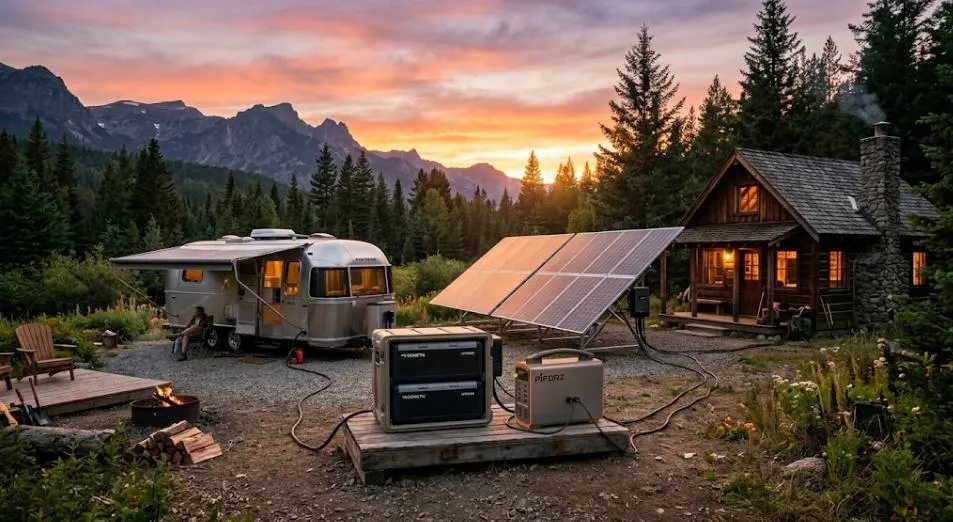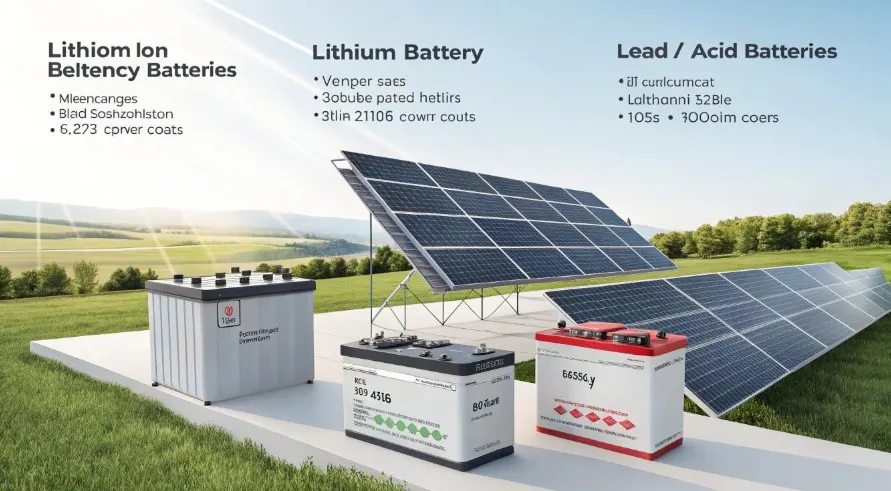

Summer is approaching, and for those embracing off-grid living or outdoor adventures, the heat can be a major source of anxiety. If a power outage hits your home during a heatwave, the situation becomes even more stressful. While most portable power stations can easily handle a fan, many wonder: Can they actually power an air conditioner?
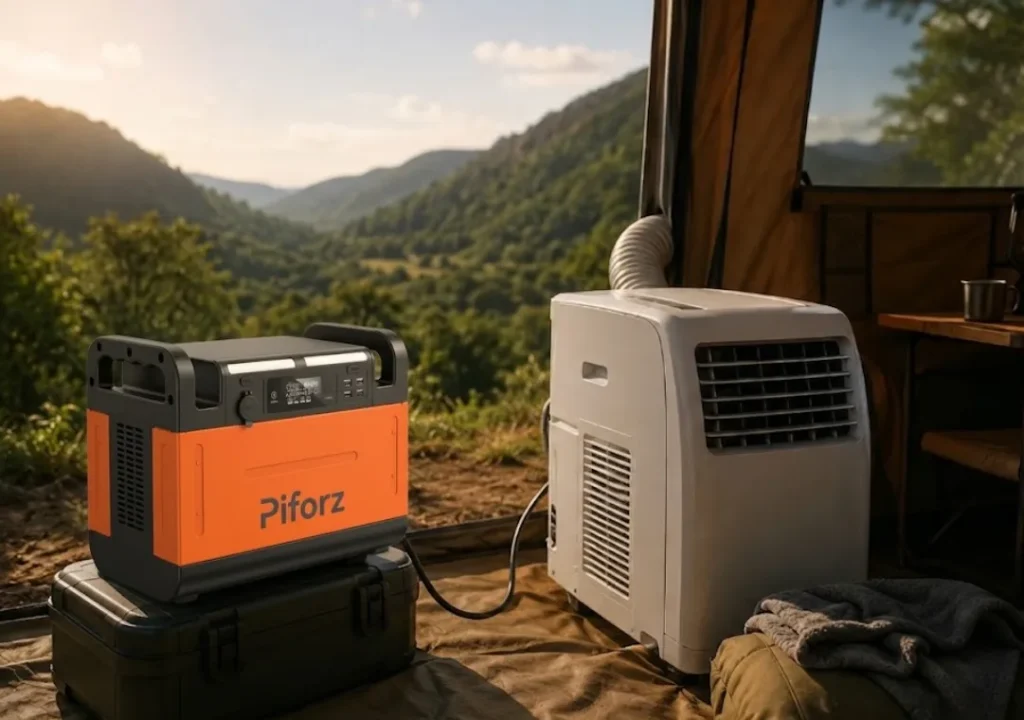
Standard household or central AC units are generally off-limits; their massive startup power requirements—often reaching several kilowatts—can instantly overload most outdoor power supplies. Therefore, our focus is on specialized portable air conditioners designed for off-grid use.
Choosing Your Setup: AC vs. DC Portable Air Conditioners
To find the right cooling solution, we first need to understand the role of current types in power efficiency.
AC (Alternating Current): Standard power from a wall outlet.
DC (Direct Current): Power stored in batteries, like power banks or car batteries.
AC Air Conditioners: High Availability, Lower Efficiency
These are common portable AC units that plug into a wall. While convenient, using them with a portable power station requires an inverter to convert DC to AC. This process typically loses 10%–15% of your total energy to heat.
DC Air Conditioners: The Best Choice for Off-Grid Living
Specifically designed for RVs, camper vans, and boats, these units connect directly to the DC battery output. By skipping the inverter, you eliminate conversion loss. While the initial price might be higher, you save money by requiring a less powerful portable solar generator to achieve the same cooling results.
Steps to Calculate If Your Power Station Matches Your AC
1.Check the Starting Wattage (Surge Power)
An air conditioner’s startup wattage can be 3 to 7 times higher than its normal running state.
Fixed-frequency AC: Rated Power × 3–5.
Inverter AC: Rated Power × 1.5–2 (Highly recommended for off-grid use).
Rule: Your power station’s peak output must be ≥ the AC’s startup surge.
2.Verify the Rated (Running) Wattage
The rated power is the energy needed for stable operation.
Formula: Power Station Rated Output ≥ AC Rated Power × 1.2.
Leaving a 20% buffer prevents overheating and extends your portable power station’s lifespan.
3. Estimate Runtime with Battery Capacity (Wh)
How long you stay cool depends on the Wh (Watt-hours) stored in your device.
Formula: Runtime (Hours) = Battery Capacity (Wh) × 0.85 ➗ AC Rated Power (W).
The 0.85 factor accounts for the 15% efficiency loss during transmission.
Why LiFePO4 is the Gold Standard for Off-Grid Power
When choosing a portable power station for AC, the battery chemistry is the foundation. While NCM batteries are lighter, LiFePO4 (Lithium Iron Phosphate) is far superior for safety and longevity.
LiFePO4: Offers 2,000–6,000 cycles and roughly 10 years of life.
NCM: Higher fire risk and shorter service life (3–5 years).
For reliable off-grid cooling, safety and durability are far more important than saving a few pounds in weight.
| Category | LiFePO4 Battery | NCM Battery |
| Full Name | Lithium Iron Phosphate | Lithium Nickel Cobalt Manganese Oxide |
| Safety | Excellent thermal stability with a lower risk of thermal runaway | More prone to thermal runaway and higher fire risk under abuse conditions |
| Cycle Life | Around 2,000–6,000 cycles, making it suitable for long-term use | Around 500–1,000 cycles, commonly used in consumer electronics |
| Service Life | Typically around 10 years with regular daily use | Usually around 3–5 years, depending on usage and temperature |
| High-Temperature Performance | Performs well in high-temperature environments with stable chemistry | More sensitive to heat and may degrade faster at high temperatures |
| Energy Density | Moderate energy density; usually heavier for the same capacity | Higher energy density; lighter and more compact for the same capacity |
| Cost | Higher upfront cost, but better long-term value due to longer lifespan | Lower upfront cost, but shorter lifespan may increase long-term replacement cost |
| Best For | Portable power stations, home backup, off-grid power, RVs, and solar storage | Smartphones, laptops, e-bikes, EVs, and applications where weight matters more |
FAQ
Q: How long can a portable power station run an AC?
It depends on the Wh capacity and the AC’s power consumption. Using an inverter AC can extend runtime as it uses less power once the room reaches the target temperature.
Q: What is the best power station for a portable AC?
A unit with at least 1200W rated output and LiFePO4 cells is the most reliable choice for most outdoor air conditioners. Check out high-performance portable solar generators for the best results.
Q: What size battery do I need?
For a short nap, 1500Wh is sufficient. For an entire night of sleep, you will need a larger capacity or solar panels to provide real-time recharging.
Q: How do the Amish stay cool without AC?
The Amish use passive cooling: high ceilings, heavy shades, and ventilation corridors. While these are great tips, combining them with a high-efficiency 1200W power station and a portable AC is the modern standard for extreme heat.