By Chloe Bai As fossil fuel volatility meets rapid battery innovation, the financial argument for personal energy is undergoing a radical transformation. Here is the 2026 balance sheet.
For half a century, the standby power market was a mono-culture. If you needed electricity off the grid, you bought a gas generator. It was a simple, if noisy, pact: you fed it petrol, and it gave you power. But as we move through 2026, the economic tectonic plates have shifted.
The rise of the clean energy portable solar station has moved beyond the realm of environmental idealism and into the territory of cold, hard fiscal sense. For the modern homeowner or digital nomad, the question is no longer “Which is greener?” but rather “Which is a more intelligent allocation of capital over the next decade?”
The Upfront Illusion: Why Sticker Price is Deceptive
The primary hurdle for many buyers remains the “initial investment gap.” In 2026, a high-quality 2kWh LiFePO4 power station from a manufacturer like piforz typically carries a higher purchase price than a budget-grade 2000W petrol inverter generator.
However, as any seasoned fleet manager will tell you, the purchase price is merely the “tip of the iceberg.” In the world of energy storage, we must evaluate the Total Cost of Ownership (TCO). When you buy a gas generator, you are signing a perpetual subscription contract with the fossil fuel industry. When you buy a solar-integrated power station, you are pre-paying for ten years of energy.
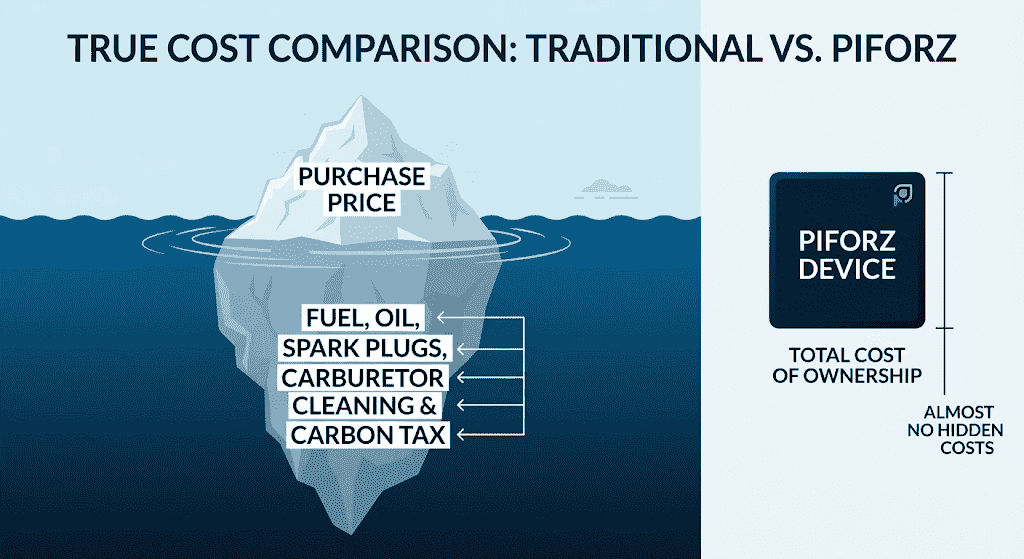
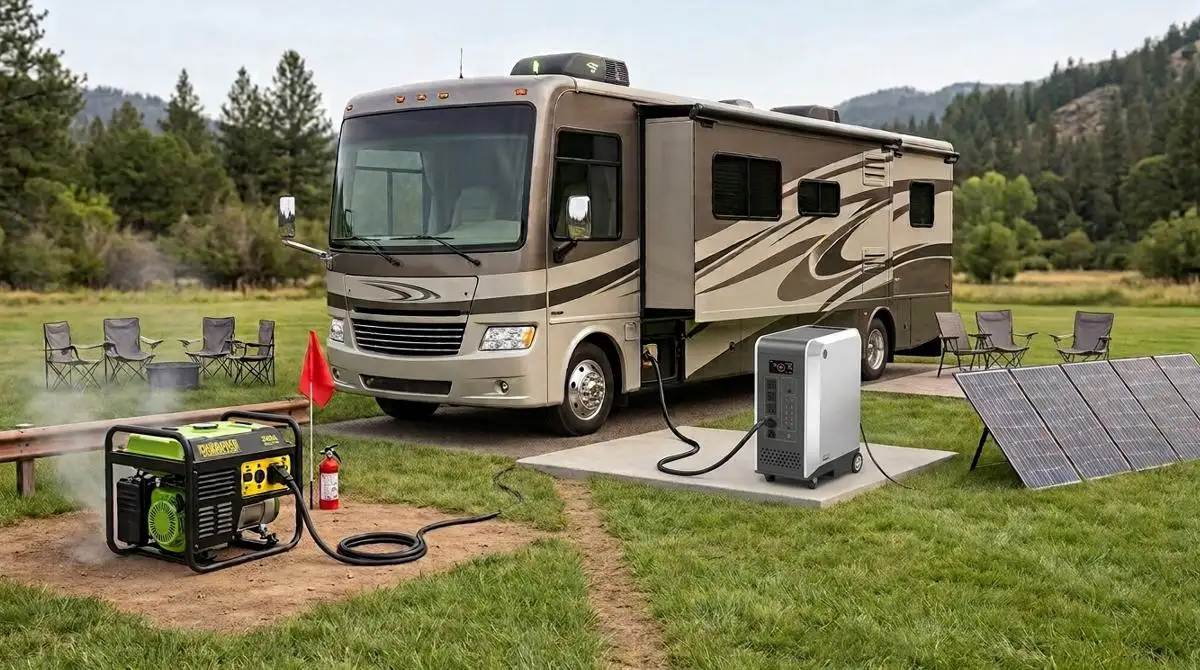
Caption: Visualising the hidden “Subscription Costs” of traditional internal combustion.
The Hidden Drain: Fuel, Maintenance, and Logistics
In 2026, the logistical burden of a gas generator has reached an all-time high. Petrol is not just expensive; it is inconvenient. It requires stabilized storage, frequent trips to the station, and carries the constant risk of spills and fire.
Then there is the mechanical toll. A gas generator is an intricate dance of moving parts—pistons, valves, and belts—all operating under high heat and friction. To maintain its reliability, a user must:
- Change the oil every 50-100 hours of use.
- Clean or replace the carburetor after periods of storage (especially with ethanol-blended fuels).
- Replace spark plugs and air filters annually.
Unlike solid-state battery stations, conventional generators rely on small four-stroke combustion engines that require regular upkeep. Over hundreds of operating hours, issues like carbon fouling, oil degradation, and wear on internal valvetrain parts—such as engine valves or tappets—can lead to compression loss and costly rebuilds.
In contrast, the LiFePO4 storage solutions of 2026 are solid-state devices. With no moving parts, the maintenance schedule is effectively zero. There are no filters to clog, no oil to leak, and no winterization routines. The “Cost of Human Time” in maintaining a generator is a significant, yet often ignored, line item in the family budget.
The Quiet Dividend: Operational Efficiency in 2026
Noise is more than just a nuisance; in 2026, it is increasingly a financial liability. Many European and North American campsites, national parks, and even residential HOAs (Homeowners Associations) have introduced “Decibel Taxes” or outright bans on internal combustion engines during night hours.
A gas generator typically operates at 60-70dB—roughly the sound of a vacuum cleaner running constantly. A piforz.com power station operates at 0-30dB, often completely silent unless the cooling fans briefly activate. This “Quiet Dividend” allows for 24-hour operation in restricted zones, enabling the user to power medical devices (CPAP) or sensitive home electronics through the night without social or legal friction.

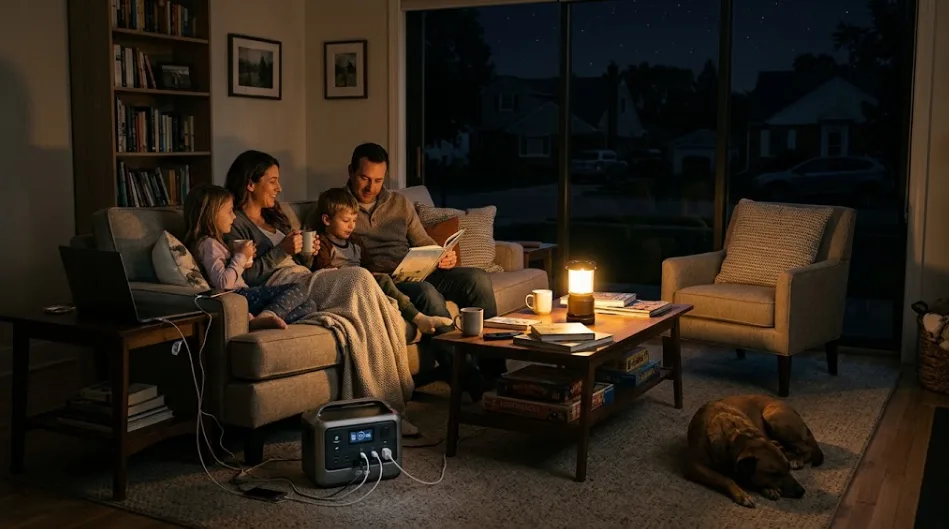
Caption: The flexibility of LiFePO4 power station manufacturing allows for safe, silent indoor usage—a feat impossible for combustion engines.
The 5-Year Financial Breakdown: A Case Study
To bring this into focus, let’s examine a 5-year projection for a moderate user (Emergency backup + 20 days of camping per year).
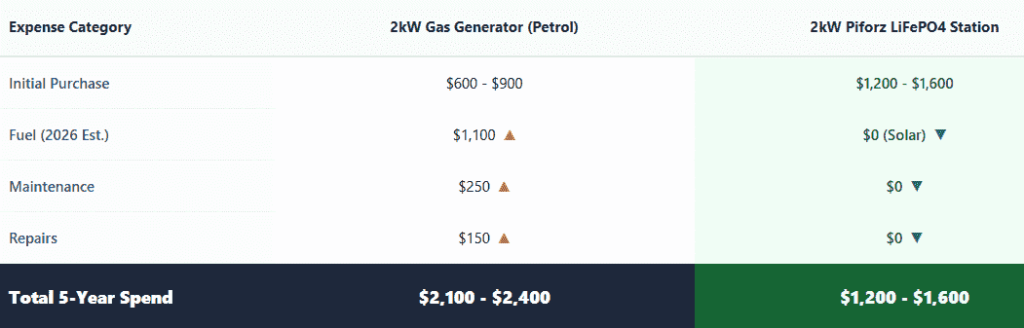
By year three, the “expensive” solar station has already reached price parity with the “cheap” generator. By year five, the solar user has saved nearly $1,000—enough to pay for a second unit or a significant solar panel upgrade. Because the 2026 intelligent BMS technology ensures the battery lasts for 3,500+ cycles, this unit will likely continue providing “free” energy for another 5 to 7 years beyond this calculation.
Residual Value: The Secondary Market
There is one final economic factor: Depreciation. A five-year-old gas generator, likely suffering from internal carbon buildup and worn gaskets, typically retains less than 20% of its original value.
In the 2026 secondary market, a certified LiFePO4 unit with a verifiable “Battery Passport” (showing 90% health) retains a substantial portion of its value. It is an asset, not just an appliance. As a professional power station manufacturer, we see that the demand for “pre-owned” long-life LFP units is soaring, as consumers recognize the inherent longevity of the chemistry.
Verdict: The Future is Silent, Clean, and Profitable
The era of the “Internal Combustion Standby” is drawing to a close. While gas generators may still hold a niche for heavy industrial construction, the individual, the homeowner, and the adventurer have a clear financial path forward.
Choosing a portable power station is not just a gesture toward environmental stewardship; it is a decisive move toward long-term financial efficiency. It is the end of the “fuel run” and the beginning of energy autonomy.
Make the smart investment for the next decade. Explore the full 2026 range of silent, high-ROI power solutions at piforz.com and secure your energy future.
FAQ
1.Is a portable power station really cheaper than a gas generator in the long run?
Yes. While the purchase price is higher, a portable power station has zero fuel costs and zero maintenance fees (no oil or spark plugs). By 2026, most users reach “price parity” within 2–3 years, after which every watt generated via solar is effectively free for the remainder of the unit’s 10-year lifespan.
2. Can I safely run a high-wattage heater or power tool on a portable unit?
It depends on the Surge Power rating. Most 2026 models from piforz.com feature high-surge inverters designed to handle the initial “kick” of power tools or heating elements. However, for sustained high-wattage use, we recommend checking the continuous AC output to ensure it matches your appliance’s requirements.
3. What happens to the power station after its 3,500+ cycles?
The battery does not “die”; it simply reaches its End of Life (EOL) threshold, typically 80% of its original capacity. In 2026, these units retain significant resale value as “secondary storage” or can be processed through Direct Recycling programs, as verified by their digital Battery Passport.