
By Chloe Bai As the mercury drops, the chemistry of our energy storage is put to the ultimate test. Here is how 2026 manufacturing innovations are conquering the frost.
For the off-grid adventurer or the winter homeowner, the onset of a cold snap has traditionally been met with a degree of “battery anxiety.” It is a well-known quirk of physics: Lithium-ion batteries, much like humans, have a preferred operating temperature. When temperatures plunge below freezing, the internal “metabolism” of the battery slows down.
However, as we move through the winter of 2026, the narrative of the “frozen battery” is being rewritten. Through a combination of molecular engineering and intelligent thermal management, the LiFePO4 power station manufacturer of today is producing units that don’t just survive the winter—they thrive in it.
The ‘Cold Reality’ of Battery Chemistry
To understand the solution, we must first understand the challenge. Inside a LiFePO4 cell, energy is moved by lithium ions travelling through a liquid electrolyte. In extreme cold, this electrolyte becomes more viscous—thickening like syrup. This increases internal resistance, making it harder for ions to migrate.
For many legacy units, this resulted in a “voltage sag,” where the battery appeared to lose capacity instantly, or worse, refused to accept a charge altogether. In 2026, however, the 2026 intelligent BMS technology has evolved to manage these physical limitations with surgical precision.
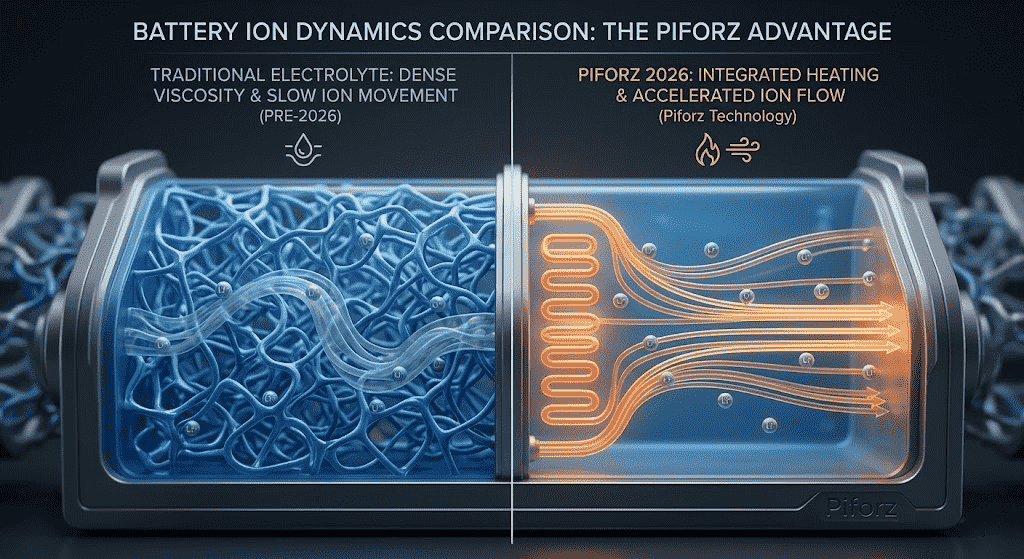
Inside the Frost: Ion Mobility in Sub-Zero Conditions
The 2026 Innovation: Self-Heating Architectures
The most significant breakthrough in 2026 is the widespread adoption of Integrated Self-Heating (ISH). Rather than relying on external blankets or indoor storage, high-end units from piforz.com now feature internal heating film wrapped directly around the cell stacks.
When the sensors detect that the core temperature has dropped below 0°C (32°F) and a charging source is connected, the BMS diverts a small portion of the incoming current to the heating elements first. Once the cells reach an optimal 5°C, the charging commences safely. This “pre-warm” cycle prevents the dreaded “Lithium Plating”—a phenomenon where charging a frozen battery causes permanent, irreversible damage to the internal structure.
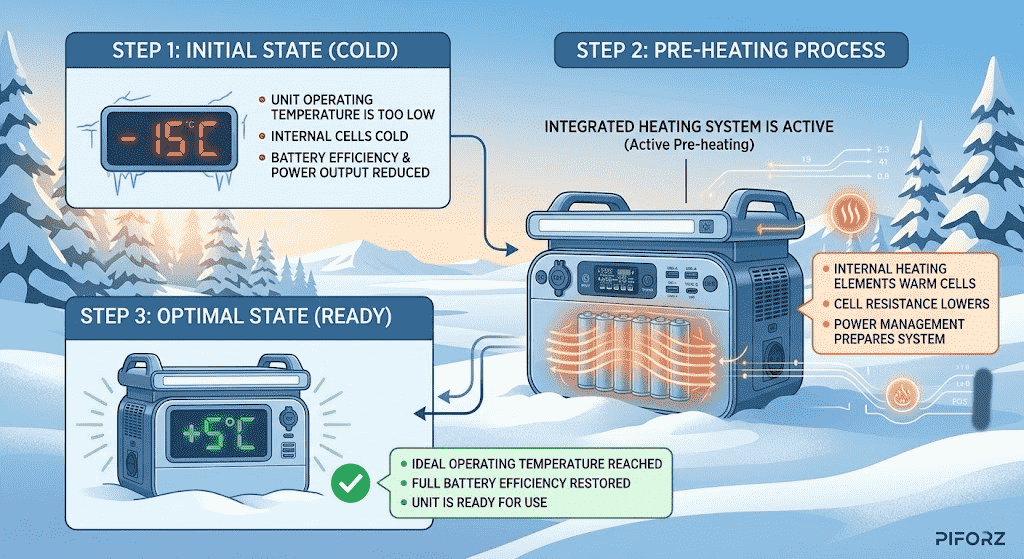
Piforz Internal Heating Protocol: The 3-Step Cold Start
3 Pro-Tips for Winter Power Management
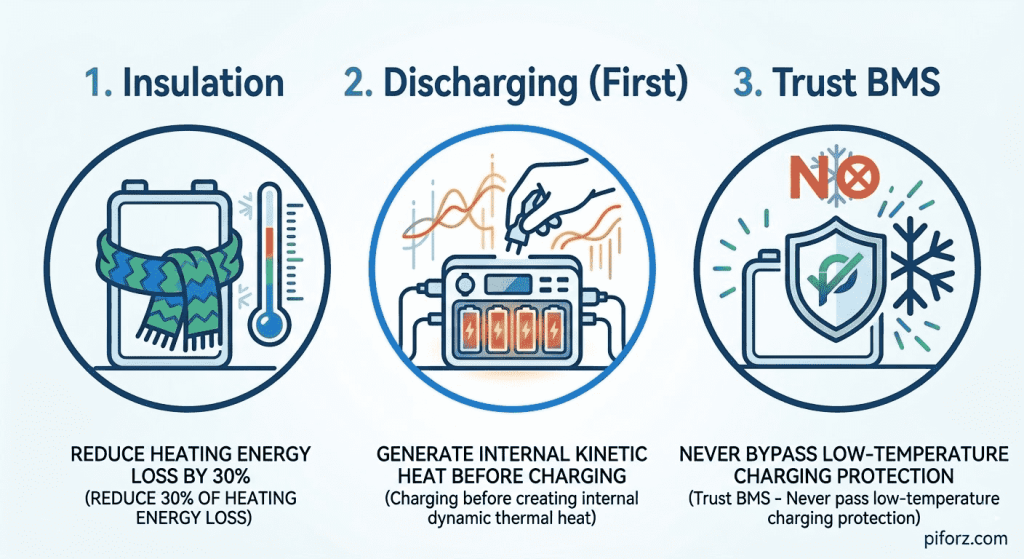
While the hardware is smarter than ever, user strategy remains vital for maximizing performance during a deep freeze:
1.The “Start-Stop” Method: If your unit has been sitting in a cold van or cabin, run a small load (like a portable heater or a kettle) for 5 minutes before trying to charge it. This “internal discharge” generates natural kinetic heat within the cells, gently raising the temperature from the inside out.
2.Insulation is Key: Even with self-heating, energy spent on heating is energy not stored. Using an insulated cover for your clean energy portable solar station can reduce heating energy consumption by up to 30%, ensuring more power stays in the “bank.”3.Mind the “Charging Gap”: Remember that while a LiFePO4 battery can discharge safely down to -20°C (-4°F), it should never be charged below freezing without an active heating system. Always trust your BMS’s low-temperature cut-off.
3.Key Rules for Sub-Zero Power Success
Manufacturing Insights: The Gauntlet of the Frost
From a manufacturer’s perspective, “Winter-Ready” is not just a marketing label—it is a certification earned in the lab. At the piforz.com engineering facility, 2026 production involves “Thermal Stress Testing,” where units are placed in industrial freezers at -30°C for 48 hours before being subjected to rapid discharge cycles. This ensures that the structural integrity of the “Blade” cells and the responsiveness of the firmware remain flawless in the most inhospitable environments on Earth.
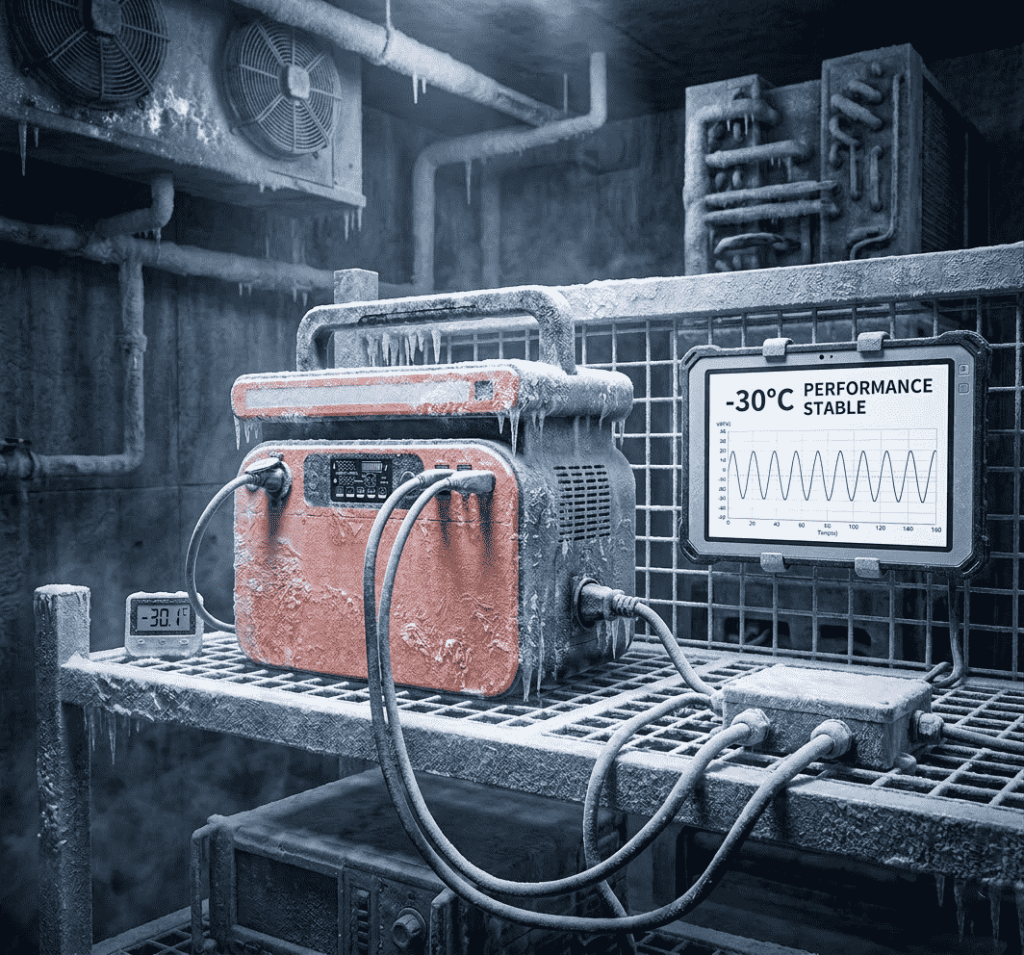
Certified Winter-Ready: The Piforz Extreme Stress Test
Conclusion: Conquering the Fourth Season
The myth that LiFePO4 is a “fair-weather” chemistry is officially dead. In 2026, the combination of robust LFP stability and proactive thermal management has turned the portable power station into a true year-round utility.
Whether you are powering a remote research station in the Alps or ensuring your family’s safety during a blizzard-induced blackout, the technology is now ready. The winter is no longer something to fear; it is simply another environment to power through.
Stay powered through the frost. Explore piforz.com’s winter-ready power solutions and discover the future of cold-weather energy storage.
FAQ :
1.Can I safely charge my LiFePO4 battery if the temperature is below freezing?
Answer: No, you should never charge a standard LiFePO4 battery below 0°C (32°F) unless it has an integrated self-heating system. Charging a “frozen” cell can cause Lithium Plating, which creates permanent internal damage and reduces safety. However, 2026 models from piforz.com feature intelligent BMS sensors that automatically pre-heat the cells to a safe temperature before allowing the charge to flow.
2. Does the battery lose its stored energy faster in the cold?
Answer: Unlike lead-acid batteries, LiFePO4 cells have a very low self-discharge rate, even in winter. However, you may see a temporary “voltage sag” when using the unit in extreme cold, which might make the capacity appear lower than it is. Once the battery warms up—either through internal resistance during use or an ambient temperature rise—the full capacity is restored. It is a temporary physical effect, not a permanent loss of power.
3. How does piforz.com’s 2026 heating technology differ from a simple heated blanket?
Answer: Traditional heated blankets are external and inefficient. The 2026 intelligent BMS technology uses internal heating films wrapped directly around each cell stack. This “Core-Heating” method is much faster and uses 30% less energy because it warms the chemistry directly, not just the plastic outer shell. This ensures the battery reaches a safe charging state in minutes, even in a blizzard.