
Ever stared at the back of a power bank and felt completely lost?
You know those numbers meansomething. But what? “20000mAh.” “5V/2A.” “65W.” They’re like a secret code, and you don’t have the decoder ring. So you do what everyone does—pick the one with the biggest number and hope for the best.
Here’s the thing: those numbers actually tell you everything you need to know. You just need someone to translate.
Let’s crack the code.
1 The Capacity Trick: Why 20000mAh Won’t Charge Your Phone Four Times
Look at any power bank. The biggest number you’ll see is themAh(milliamp hour). 20000. 30000. 50000. Bigger must be better, right?
Not exactly.
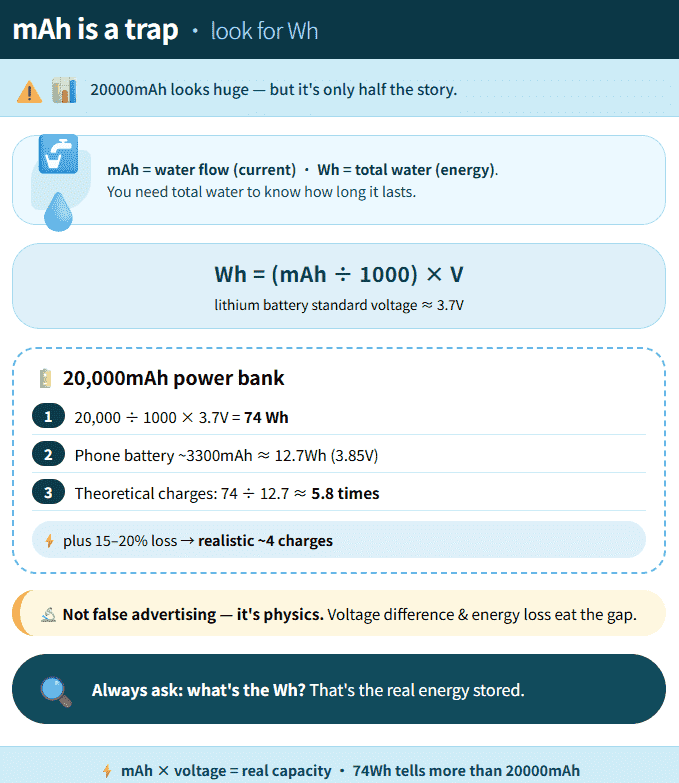
mAh measures “charge,” but it doesn’t measure “energy.”Think of it this way: mAh is like the size of your water pipe. Wh (watt-hour) is how much water actually comes out. One tells you potential. The other tells you reality.
Here’s the simple math:
Wh = mAh ÷ 1000 × V (voltage)
Most power banks run at 3.7V. So that 20000mAh power bank?
20000 ÷ 1000 × 3.7 =74Wh
That’s the actual energy stored.
Now your phone battery runs at a slightly higher voltage (around 3.85V). And during charging, you lose about 15-20% energy to heat and inefficiency. So when the math says you should get 5.8 charges, reality gives youaround 4.
This isn’t false advertising. It’s just physics.
Next time you’re shopping, ask yourself:What’s the Wh?That’s the number that actually matters.
2 The Speed Secret: Why Fast Charging Needs a Handshake
Ever bought a power bank that promised 65W fast charging, plugged in your phone, and… nothing. Charging speed feels exactly like that old 5W charger from ten years ago.
The power bank isn’t broken. The problem is thehandshake.
Fast charging is simple math:
Watts = Volts × Amps
Want faster charging? Pump up the volts or crank up the amps. Easy.
But here’s the catch: your phone won’t let just anyone “pour” power into it. That’s dangerous. So before any fast charging happens, your phone and the power bank need to agree on the rules. They need toshake handsusing the same language.
These languages have names:
PD (Power Delivery):This is the universal language. iPhones speak it. Nintendo Switches speak it. Most laptops speak it. If your power bank speaks PD, you’re covered for most modern devices.
QC (Quick Charge):This is Qualcomm’s language. Lots of Android phones speak it.
Private languages:Companies like OPPO (VOOC) and Huawei (SuperCharge) have their own secret handshakes. Only their own chargers usually speak them.
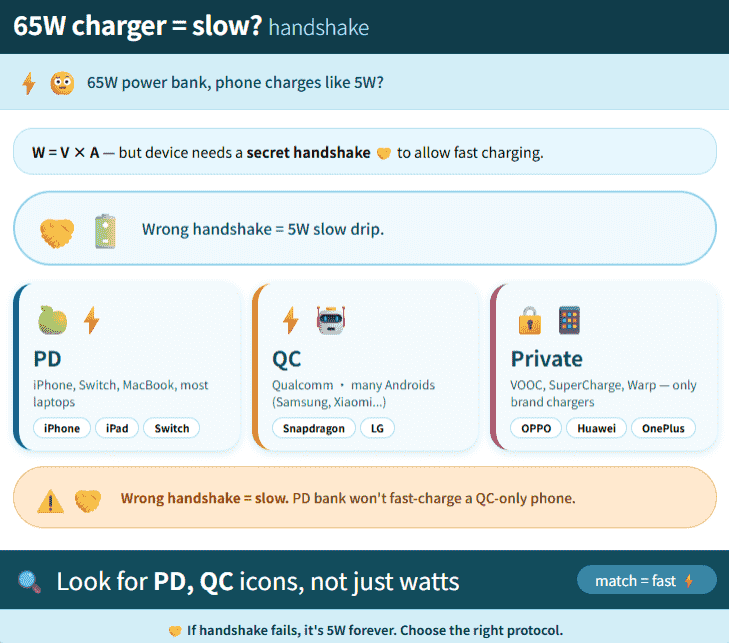
If your power bank doesn’t speak your phone’s language, they can’t shake hands. No handshake, no fast charging.They’ll still charge—just at boring old speeds.
So when you’re buying, don’t just look at the max wattage number. Ask:Does this speak my device’s language?
3 The Port Puzzle: Why Some Charge Laptops and Others Just Phones
Look at any modern power bank. You’ll see different holes:
USB-A:That classic rectangle you’ve been using forever
USB-C:The new oval one that plugs in either way
Some power banks even have two USB-C ports. But here’s the thing—not all USB-C ports are created equal.
USB-C is just a shape. Think of it like electrical outlets in your house. They all look the same, but some are connected to your lights, some to your kitchen appliances, and some to your AC unit. Same shape. Totally different jobs.
Here’s what’s really going on inside:
Basic USB-C:Just does charging. Slowly. Usually under 15W.
Mid-range USB-C:Speaks PD. Can hit 100W.
Full-featured USB-C:Does everything—charging, data transfer, even video out.
To charge a laptop, you need a USB-C port that speaks PD and can deliver enough power (laptops usually need 45W to 65W). It’s like needing a 220V outlet for your AC unit. Same shape as the 110V one, but not the same thing.
Also, power banks have smart chips inside that decide how to share power when you plug in multiple devices. Plug in one thing? Full speed. Plug in two? It might split into 45W + 18W, so both get something.
Look at the labels next to the ports.They tell you what each one can do. The information is right there.
Now You Speak the Language
Battery capacity. Charging speed. Ports. Every number tells a story. Every spec means something.
Next time you’re staring at a power bank, you’ll know what to look for:
Check the Wh:mAh × 3.7 ÷ 1000 = actual energy. That’s the real number.
Match the handshake:PD? QC? Make sure your gear speaks the same language.
Read the port labels:Some are for phones. Some are for laptops. Don’t mix them up.
When we designed Piforz power stations, this is exactly what we thought about. Not just making numbers look big, but making them make sense. Clear labeling. Smart handshake support. Ports that do what they say.
Now you speak the language. Next time, you won’t guess. You’ll know.