
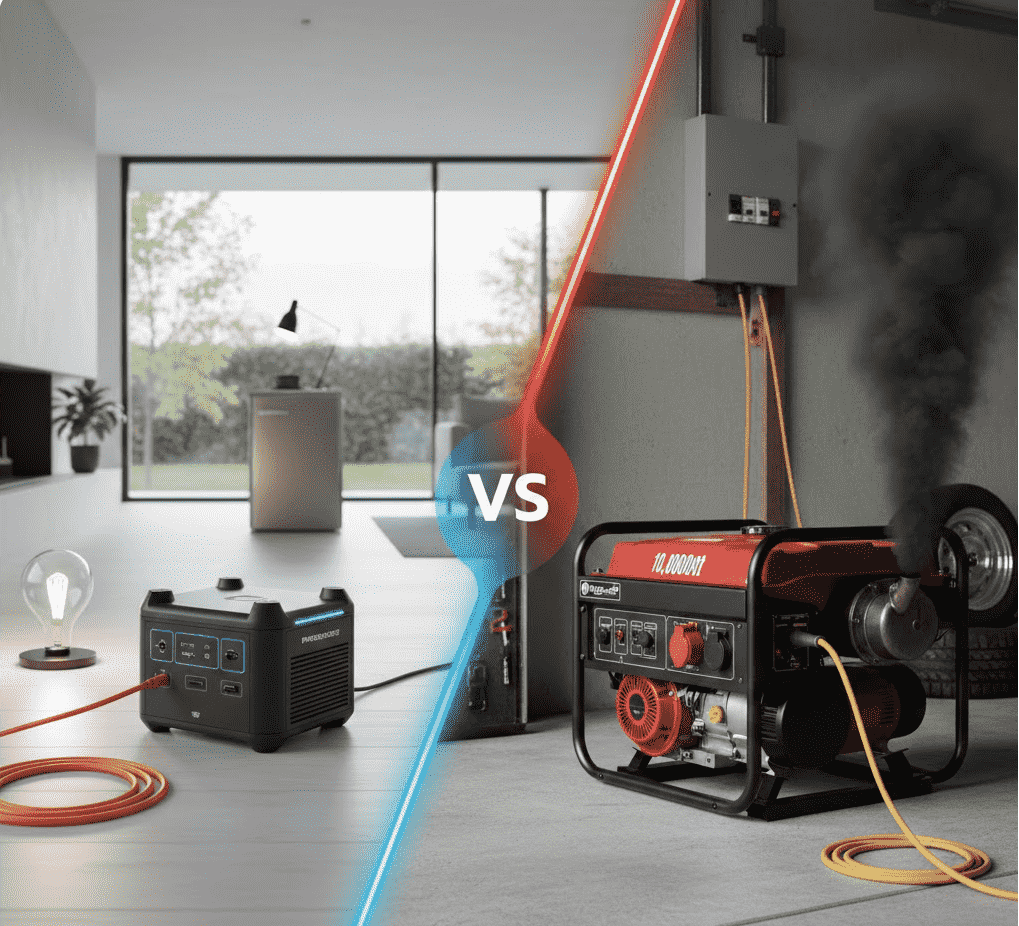
When the Power Goes Out, Are You Ready?
Bad weather, old power lines, unexpected failures… power outages are happening more and more often. When the lights go out, lots of people ask the same question: How much power do I actually need to keep my home running?
The answer to that question really decides whether you should get a traditional gas generator or go with a newer portable power station. Both can keep your stuff running when the grid goes down, but they work completely differently, and which one’s better really depends on your situation.
This article walks you through the pros and cons of 10,000-watt gas generators versus high-capacity portable power stations (the ones with LiFePO batteries, around 1200Wh-1500Wh). We’ll help you figure out what makes the most sense for your family’s emergency needs.
If you’re not sure yet how much power your home actually needs, check out our guide first: [How Many Watts Do You Need to Power a 2000 Sq Ft House?]. It’ll help you understand the basics.
Part 1: Can a 10,000-Watt Generator Really Run Your Whole House?
What It Says vs. What You Actually Get
10,000 watts really is enough to power an entire home, at least on paper. You could theoretically run all this at once:
Central AC (3500-5000W)
Electric water heater (4000W)
Clothes dryer (3000W)
Fridge, lights, TV, etc.
But Here’s What People Often Miss
Startup Surge
Things with motors–like your fridge, AC, or water pump–need way more power to start up than they do to keep running. We’re talking 2-3 times the normal power. So a fridge that uses 1000W running might need over 2000W just to kick on. Generators are usually built to handle these short bursts, but with a portable power station, you’ve got to check its peak power rating to make sure it can handle it.
You Can’t Run Everything
You won’t be able to run every single thing in your house at the same time–you’ll have to pick and choose. Most families, when the power’s out, really just need to keep the basics going, not run the house like nothing happened.
Think about a typical American home during an outage–the stuff you actually can’t live without is a pretty short list. Wondering how much juice your fridge, lights, and wifi router really need? We’ve got a whole guide with power draws and real-world tests: [How to Keep Your Refrigerator Running During a Power Outage (Step-by-Step)]
The Hidden Costs of Gas Generators
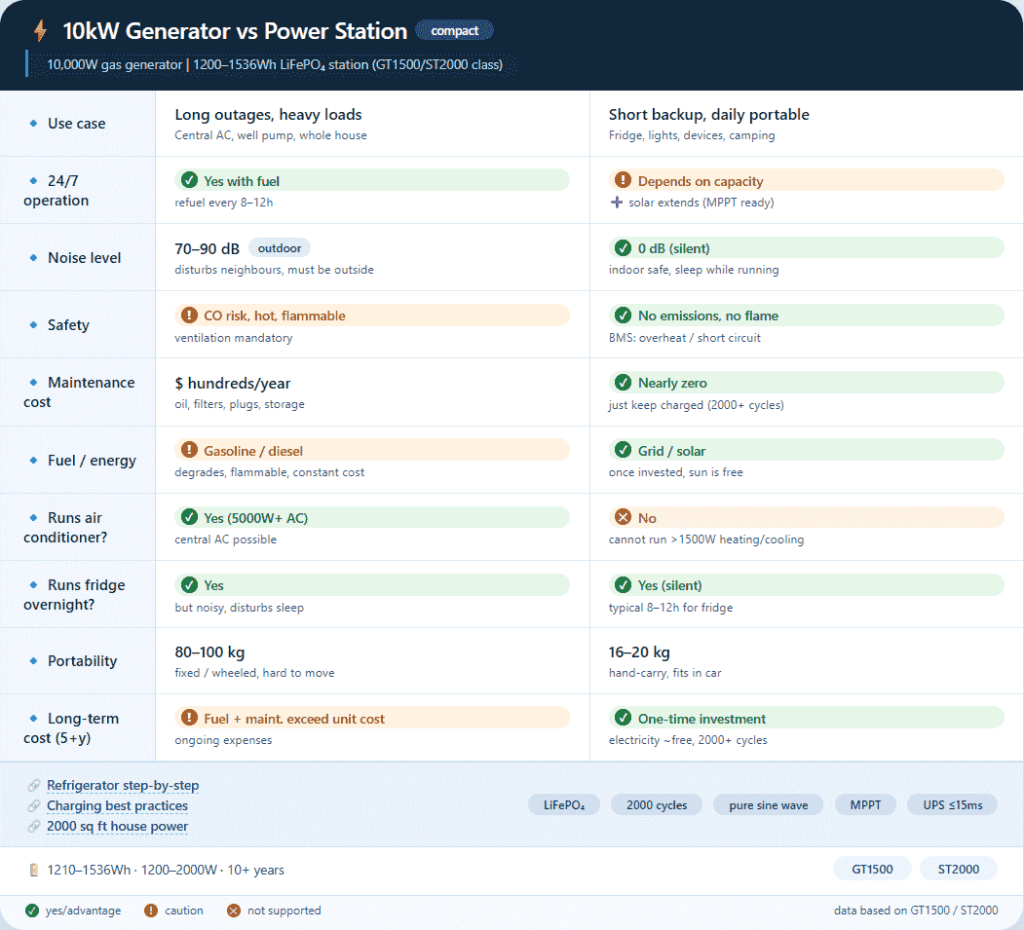
Fuel Hassle: Gas goes bad in 3-6 months. Diesel stinks. You have to store it and keep rotating it out.
Noise:They’re loud–70-90 dB, like a vacuum cleaner or city traffic. Your neighbors might not be happy.
Safety Risk:Carbon monoxide (CO) poisoning is a real danger. You absolutely have to run these outside, far from windows and doors.
Upkeep:Oil changes, spark plugs, cleaning the carburetor–it adds up to hundreds of bucks a year.
Hard to Start: Especially when it’s cold out. The carburetor gets clogged easily.
Part 2: Portable Power Stations–The Good and The Not-So-Good
The Big Question: Can It Run My Whole House?
Short answer: No, it won’t power your central AC or electric water heater. But it can handle the essential stuff.
Take the must-have devices we talked about. A portable power station with 1200-1500Wh can keep your fridge, router, lights, and phones going for 6-12 hours. Need longer? You can hook up solar panels to keep it charged.
We go into more detail about solar charging and how to do it right here: [Can I Leave My Portable Power Station Plugged in All the Time? ]
Why Go With LiFePO Batteries?
The good portable power stations these days all use LiFePO batteries. They’re widely seen as the safest, longest-lasting lithium battery tech around:
Lasts for Years:You can charge and drain them over 2000 times and they’ll still hold 80% of their capacity. If you used it once a week, that’s like 40 years.
Super Safe:LFP batteries are thermally stable. Even if you poke a hole in them, hit them, or overcharge them, they won’t catch fire or explode. Way safer than the batteries in some other devices.
Better for the Planet:No heavy metals like cobalt or nickel, so less environmental impact.
Handles Temperature:Works fine from -10°C to 40°C (charging might slow down when it’s freezing, but you can still use it).
Compare that to a regular generator, which has a lead-acid starter battery that only lasts 2-3 years and is full of toxic stuff that’s bad if not disposed of properly.
Other Tech Specs Made Simple
Pure Sine Wave:This just means the power coming out of the station is exactly like the power from your wall outlet. It’s safe for sensitive electronics like fridges, fans, and laptops. Cheaper power stations put out “modified sine wave” power, which can make motors sound funny or even damage your gear.
MPPT:Fancy name for a smart charger. It constantly checks the voltage and current from your solar panels and adjusts to get the fastest possible charge. Basically, with MPPT, you’ll charge 30% faster or more from the same solar panel.
UPS Mode:If your power station is plugged into the wall AND powering your stuff, and the grid power cuts out, the station flips to battery power in a few milliseconds. Ours switches in under 15ms–fast enough that your computer and router won’t even blink.
Why People Love Portable Power Stations
✅ No fumes, totally silent: Use it indoors, even in your bedroom at night.
✅ Just plug stuff in: No setup, no maintenance.
✅ Lots of outlets: Power your fridge, phone, and router all at once.
✅ Built-in safety: Overload, overheat, and short circuit protection.
Part 3: Side-by-Side–It’s Not About “Better,” It’s About “Better for You”
Let’s look at two real-life situations:
Family A: Lives in the suburbs, gets hit by storms that knock out power for 2-3 days at a time. They have a garage and need to run their well pump and AC.
Family B:Lives in a city apartment. Outages are usually just a few hours. They want something quiet, portable, and safe to keep a few things running.
If you’re trying to figure out exactly how much power your fridge uses, or if you’re worried your power station won’t make it through the night, check out that [fridge power guide]. It’s got real numbers and examples.
Part 4: The Hybrid Approach–Why Not Both?
For folks with the budget who want to be totally prepared, the dream team is using both together:
10,000W Generator:For the really bad, multi-day outages. Run the big stuff like AC and the water pump during the day.
Portable Power Station:For quiet overnight power, running sensitive electronics, and taking camping on the weekends.
Why This Combo Works So Well
During the day, fire up the generator for the heavy lifting and top off your power station at the same time.
At night, shut the noisy generator off. Run the fridge and lights off the power station. It’s quiet, safe, and no CO risk.
The rest of the time, your power station isn’t sitting in the garage–you can take it camping, tailgating, or to a job site.
No matter what you pick, taking good care of it and charging it right will make it last way longer.
The Choice Is Yours
Old-school generators and new portable power stations aren’t really rivals. They’re just the right tool for different jobs.
If you need your whole house to run like normal and you’re okay with noise, fuel, and maintenance, a gas generator is still the way to go.
If you care more about quiet operation, safety, being portable, and having zero fumes, then a portable power station with an LFP battery, MPPT solar input, and pure sine wave output is a smarter buy.
The most important first step? Figuring out how much power your home actually needs.That’ll give you a clear picture and help you avoid buying the wrong thing.
Whichever route you take, the main thing is: get ready before the lights go out.