
Hey Tech Enthusiasts & Outdoor Adventurers!
So, you’ve snagged a Portable Power Station (PPS). Awesome! We know you’re not just looking to top off your phone here. You’re aiming for that sweet spot of comfortable, off-grid living without being tethered to a wall socket. But let’s be real: by 2026, simply having a big battery isn’t enough. The real game-changer is how you use it. Mastering your PPS like a pro is what separates a good investment from a great one.
Forget “Huge Power Bank”: What’s Really Different?
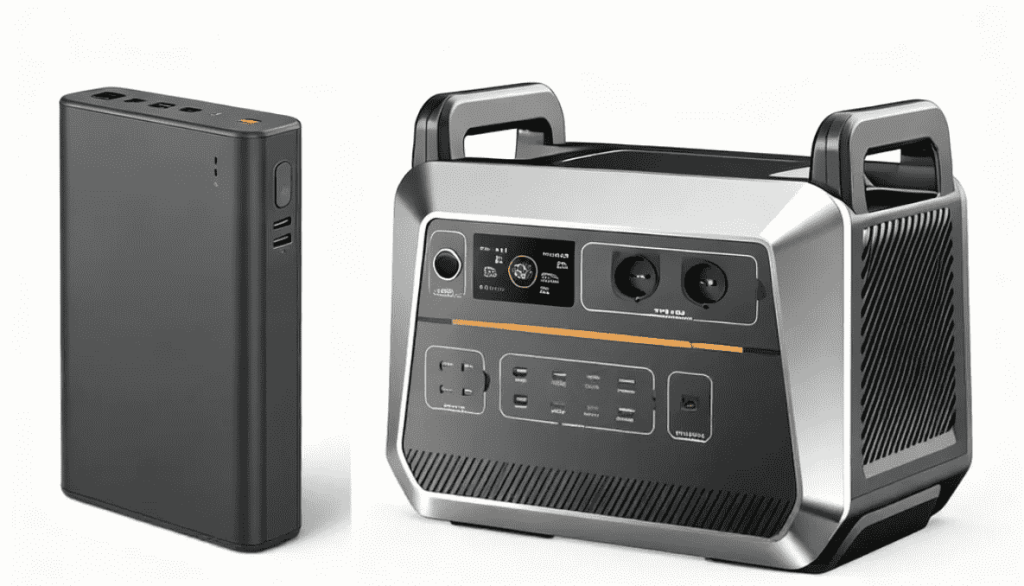
Ever get confused between a power bank and a portable power station? It’s a bit like mixing up mAh and Wh. They’re not the same beast.
The Core Difference: Definitions Matter
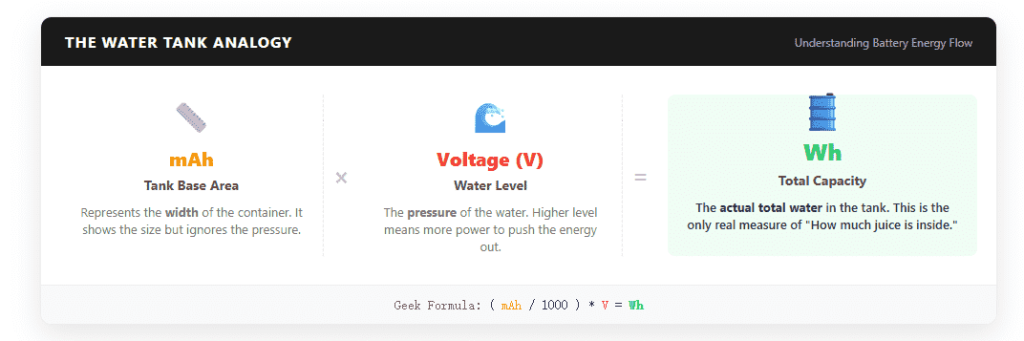
- mAh (milliampere-hour): This tells you how many hours a battery can deliver a specific current. Think of it as the “width” of your battery’s capacity, commonly used for smaller gadgets like phones and power banks.
- Wh (watt-hour): This is the true measure of energy. It’s the product of power (watts) and time (hours). This is your scientific standard for comparing energy across different voltages.
- Formula: Wh = Watts (W) x Hours (h)
- Example: A 100W device running for 2 hours uses 100W x 2h = 200Wh of energy.
Voltage: The Hidden Factor
Think of mAh as the base area of a water tank. It tells you how wide it is, but not the pressure of the water inside. Voltage (V) is like the water pressure. Higher pressure means more forceful energy. Wh? That’s the total volume of water in the tank.
“How Long Will a 20,000mAh Power Bank Last?” – A Common Misconception
Newbies often get tripped up by mAh. Search “how long does 20,000mAh last?” and you’ll likely see answers like “charges your phone 3 times.” Here’s why that’s misleading:
Most power banks operate at around 3.7V. So, 20,000mAh translates to roughly 74Wh – and it’s limited to USB output. Professional PPS units, like the Piforz PF series, start at 200Wh and go up to 2000Wh+. They also have built-in AC inverters, meaning they can power laptops, car fridges, even projectors. When you’re talking emergency power or serious off-grid living, ditch the mAh talk and embrace the Wh. That’s how the geeks roll.
The Gold Standard: Nail the 20/80 Rule for LiFePO4 Longevity
The 20/80 rule means keeping your battery’s State of Charge (SOC) between 20% and 80%. Avoid hitting 100% or draining it to 0%. Lithium batteries experience significant electrochemical stress at extreme ends of the charge spectrum. If you want your Piforz PPS to be your trusty companion for 5, 10, or even more years, you need to go beyond just knowing the 80/20 rule. Battery health is a constant battle against “oxidation” and “temperature control.” Here’s a three-pronged approach to maximizing your battery’s lifespan:
1. Physical Environment: Temperature is King
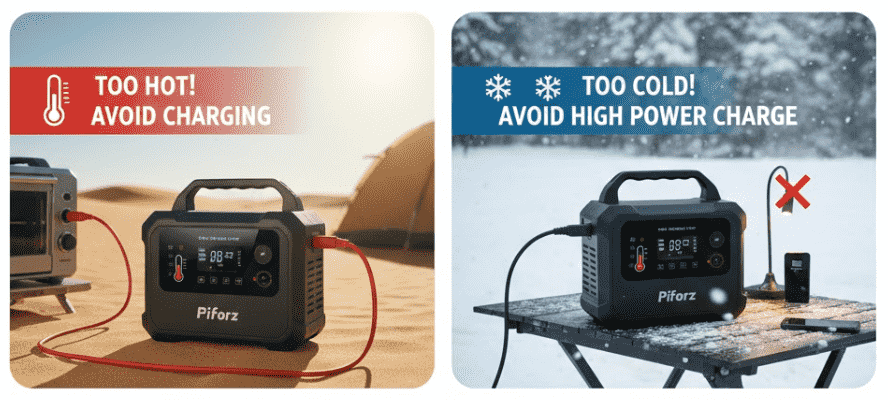
Batteries are way more sensitive to temperature than you might think. Even LiFePO4 (Lithium Iron Phosphate), known for its safety, has its “moods.”
- THE GOLDEN RULE: NO HIGH-TEMP CHARGING / NO EXTREME COLD CHARGING!
- Geek Tip: In cold weather, start by using your PPS for a low-power output (like charging your phone). This helps to gently warm up the internal battery. Once the internal temperature rises, you can safely proceed with high-power charging or discharging.
2. Charging & Discharging Logic: It’s All About the Cycles
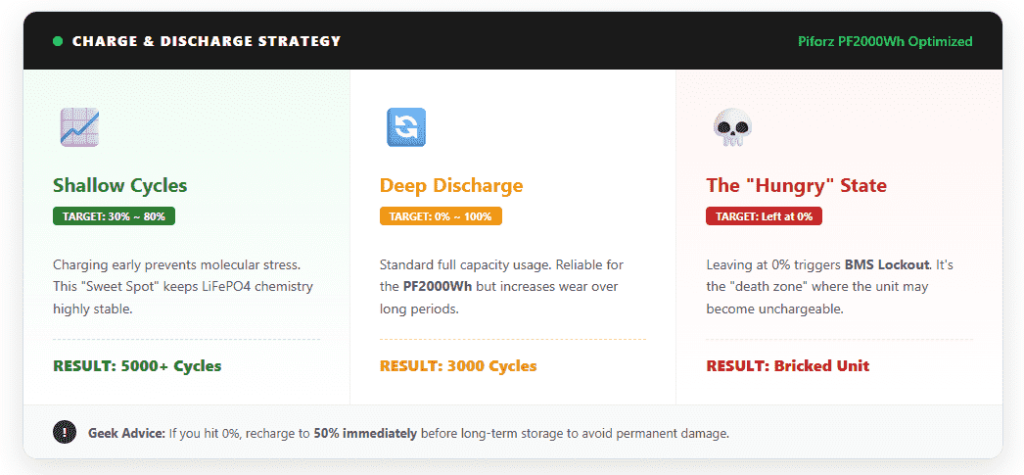
Battery lifespan is usually measured in charge cycles (e.g., the PF2000Wh boasts 2000-3000 cycles at 100% depth of discharge).
- Shallow Cycles = Happy Battery: If you tend to charge your PPS once it hits 70% or 60% (meaning you only used 30-40%), those “shallow cycles” are incredibly gentle on the battery.
- Don’t Starve Your Battery: NEVER let your PPS drain to 0% and then leave it unused until it automatically shuts down. This puts the battery in a “deep discharge” state, dropping the voltage critically low. The Battery Management System (BMS) will then lock the circuit for safety, effectively turning your power station into an expensive paperweight.
3. Long-Term Storage Strategy
If you won’t be using your portable power station for a while, here’s how to store it:
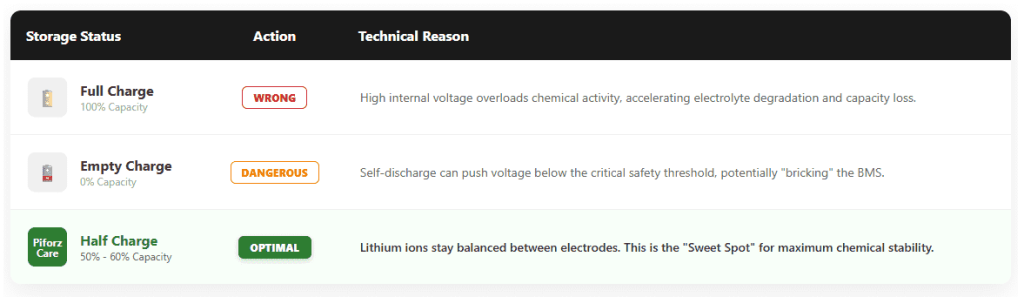
(We’re told that PiForz products come with a smart LCD screen that makes this easy. It doesn’t just show percentage, but allows precise control over charging/discharging zones, making the 20/80 rule as simple as reading a gauge.)
Smart Protection: Sleep Soundly, Your PPS Is Safe
Worried about leaving a basic power bank plugged in overnight? For lower-end batteries, “thermal runaway” is a real concern. But with a Piforz PPS? Absolutely safe. That’s thanks to our BMS (Battery Management System).
Unlike standard power banks that might keep a trickle charge even when full (a slow drip that doesn’t meet urgent needs), the Piforz BMS acts as your intelligent guardian. It constantly monitors the temperature, voltage, and current of every single cell. Once charging is complete, the BMS uses electronic switches to completely cut off the input. So, even if your PPS is plugged in overnight, the internal battery is in a fully controlled, dormant state.
Portable Reliability: Why Gas Generators Can’t Compete Indoors
Power outage strikes. Your gas generator? It takes a good 45+ seconds to crank, rev up, and stabilize before it even starts producing power. Plus, the carbon monoxide emissions make it a big no-no for indoor use.
Piforz PPS: The Instant, Silent Indoor Ally
While Piforz focuses on independent off-grid power (not automatic transfer switches), our advantage is proximity and speed:
- Zero Physical Delay: No wires to run, no gas to pour. Just hit the power button, and you’ve got instant electricity.
- Silent & Emission-Free: Keep your Piforz PPS in your trunk, your bedroom, or under your desk. While your neighbors are fumbling in the dark to start a noisy generator, you’re already back online with lights and your computer.
FAQ: Quick Fixes for Tech Enthusiasts
- Q: How should I store it if I’m not using it for a long time?
- A: Aim for the 80/20 rule: store it around 50% charge in a cool, dry place.
- Q: Why does the wattage on the display fluctuate?
- A: That’s the BMS intelligently adjusting the output based on the device’s real-time power draw. It’s a sign of smart management!
The Bottom Line
In 2026, a top-tier Portable Power Station is more than just a “big battery.” It’s the intelligent heart of your off-grid life. By understanding the 20/80 rule and how your BMS protects your investment, you’re not just safeguarding your gear – you’re ensuring your immediate power freedom.
Want to dive deeper into the tech behind long-lasting batteries? Visit our FAQpage for expert insights.
Ready to upgrade your off-grid setup? Check out the Piforz PF Series Product List.