What People Get Wrong About “Powering the Whole House”
Every time the power goes out, the same thought hits:
“I need something that can run my whole house.”
So you start looking things up. You compare wattage. You stare at numbers like “6500W,” “7500W,” “9000W.”
Search engines are full of the same kinds of questions:
Can I run my whole house with a 6500 watt generator?
What will a 7500 watt generator run?
How big of a generator do I need to run a 200 amp house?
Everyone focuses on one thing: watts.
But there’s a bigger question nobody asks:
Are you just getting “power,” or are you getting power that’s safe, stable, and built to last?
Most people only care if something “turns on.” They forget to ask about power quality.
Here’s the truth: A 6500W gas generator with high THD can actually be riskier than a 2000W pure sine wave smart station.
Why? Because protecting your appliances isn’t just about wattage. It’s about whether the power is clean, steady, and close to what you get from the grid. That’s what really matters for safe backup power.
The Three Hidden Problems with Gas Generators
When people think generators, they usually picture the classic gas-powered kind. But once you stop focusing only on “how many watts” and start thinking about “using it long term,” the downsides become obvious.
Problem 1 – The Tech Risk: It Could Be Slowly Killing Your Appliances
Will a generator damage a heat pump?
Short answer: Yes. And it happens more often than you’d think.
Especially with gas generators that have high THD.
What is THD, and why should you care?
THD stands for Total Harmonic Distortion. Basically, it measures how much the power waveform looks like a smooth sine wave. Grid power is clean and smooth.
When THD is high:
The waveform gets choppy
Harmonics mess with the current
Motors run less efficiently
Things heat up more
Think of it this way: Clean sine wave power is like driving on a smooth highway. Dirty power is like a bumpy dirt road. Your appliances will still run, but they’re constantly shaking and wearing out.
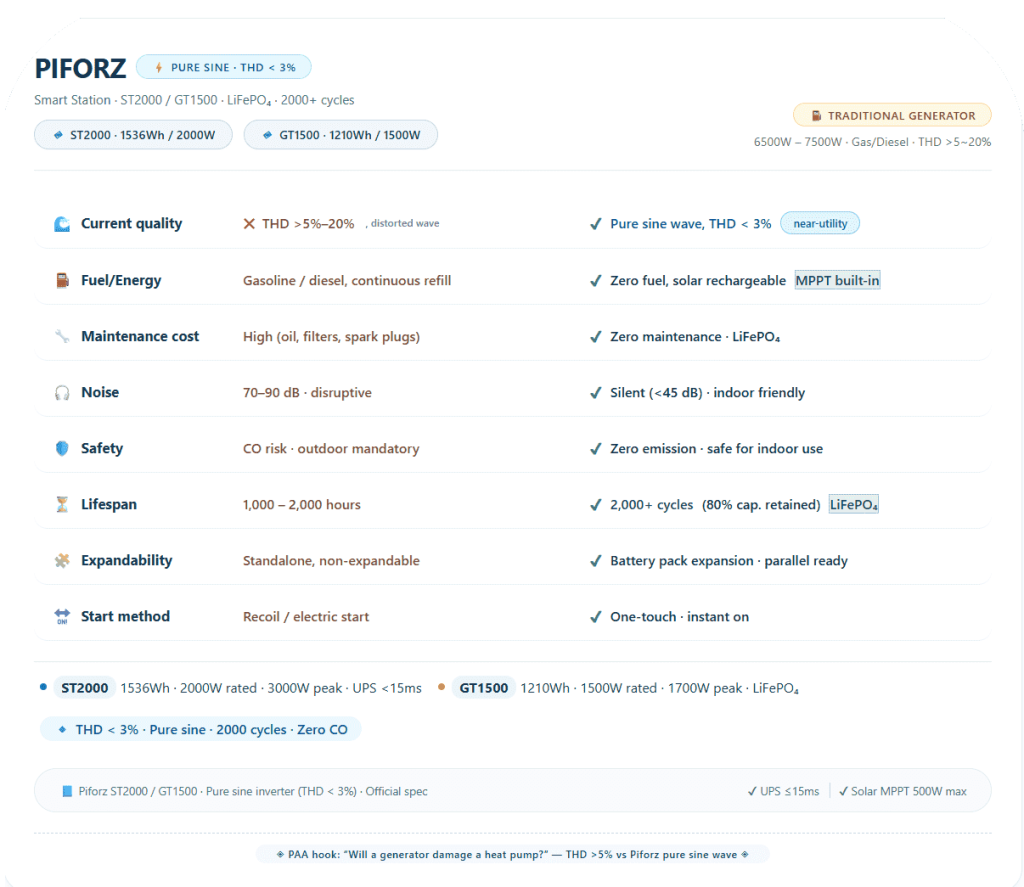
Piforz portable power stations, like the GT2000 and GT1500, use pure sine wave tech with THD under 3%. That’s basically as clean as grid power.
According to CTECHI’s official manual, the ST2000’s AC output is clearly labeled “Pure Sine Wave.” That’s the baseline for protecting sensitive gear.
Why does this hurt heat pumps?
Heat pumps have compressors, motors, and delicate control boards.
When the power is choppy or voltage jumps around:
Compressors run less efficiently and run hotter. Torque gets uneven. Over time, they wear out faster.
Control boards can glitch, lose protection, or even get permanently fried.
Here’s the kicker – this damage isn’t instant. It builds up slowly. You might not notice anything for years. Then your appliances start acting up, and you never connect it back to that generator you used ages ago.
It’s not just heat pumps either. Other gear is just as sensitive:
Inverter ACs
Smart fridges
Computers, TVs, networking gear
Modern washing machines
In today’s homes, power quality matters way more than it used to.
Problem 2 – The Hidden Costs: It Drains Your Wallet Slowly
Most people only look at one thing when shopping: the price tag.
But the real cost of owning something is way bigger.
Here’s what you should actually add up:Purchase price + fuel + maintenance + wear and tear + potential appliance damage
Fuel costs
Long outage means long hours of burning fuel
Gas prices aren’t in your control
During emergencies, fuel can be hard to find
Maintenance
Gas generators are machines with moving parts:
Oil changes, new filters, spark plugs
Starters get old and fail
Skip maintenance and reliability tanks
Depreciation
Generators have a set number of hours before they wear out.
The more you use it, the closer it gets to breaking down.
And all that wattage you bought? You only really need it for a few seconds of startup surge.
Compare that to Piforz portable power stations. They use LiFePO₄ batteries. Over 3000 charge cycles. The GT2000 still holds over 80% of its capacity after 3000 cycles.
Why do some battery stations die in a couple years while Piforz keeps going strong past 3000 cycles?
It comes down to the battery chemistry and how the system manages charging.
[Why Piforz batteries last longer]
If you used it once a week, that’s over 38 years. No fuel. No maintenance. No upkeep costs. Zero.
Problem 3 – The Everyday Annoyances Nobody Talks About
A lot of people don’t stop to think: What’s it actually like to live with this thing?
Noise
70 to 90 decibels. That’s vacuum cleaner loud. Motorcycle loud. Busy street loud.
Try sleeping through that.
Safety stuff
Risk of carbon monoxide poisoning
Has to stay outside
A pain to use in rain or snow
Ease of use
Pull cords to start
Regular refueling
Heavy, clunky
It’s not a home appliance. It’s a machine you have to manage.
You don’t want to be a “generator operator.” You just want backup power that works when you need it.
What the Wattage Numbers Really Mean
Can I run my whole house with a 6500 watt generator?
In theory, yes. A fridge. Some lights. Wi-Fi. A microwave. A few outlets.
But here’s the thing: With dirty power, those appliances aren’t running right. “Running” isn’t the same as “running well.”
What you should really be asking: Are my appliances actually protected with this kind of power?
Will a 7500 watt generator run a 3 ton AC unit?
A 3 ton AC usually needs 6000–8000W at startup.
On paper, 7500W is enough.
But that startup can still cause:
Voltage drops
Repeated failed startups
Weird power surges through the compressor
Do you just want it to turn on once? Or do you want it to run safely, reliably, year after year? Those are two very different goals.
How big of a generator do I need to run a 200 amp house?
200 amps = about 48kW.
But here’s the thing: When the power’s out, you’re not running everything at once.
So the smart move is:
Pick the stuff you really need
Power it in stages
Build up as needed
Modern home power management isn’t about matching the whole panel. It’s about:
Priorities + safe operation + room to grow
Old school thinking: Bigger watts = safer.
Real talk: Power quality and stability matter just as much.
Five Ways to Compare: Tech and Everyday Experience
How to Plan Your Home Backup – Three Simple Steps
Forget “how many watts do I need.” Start thinking structure.
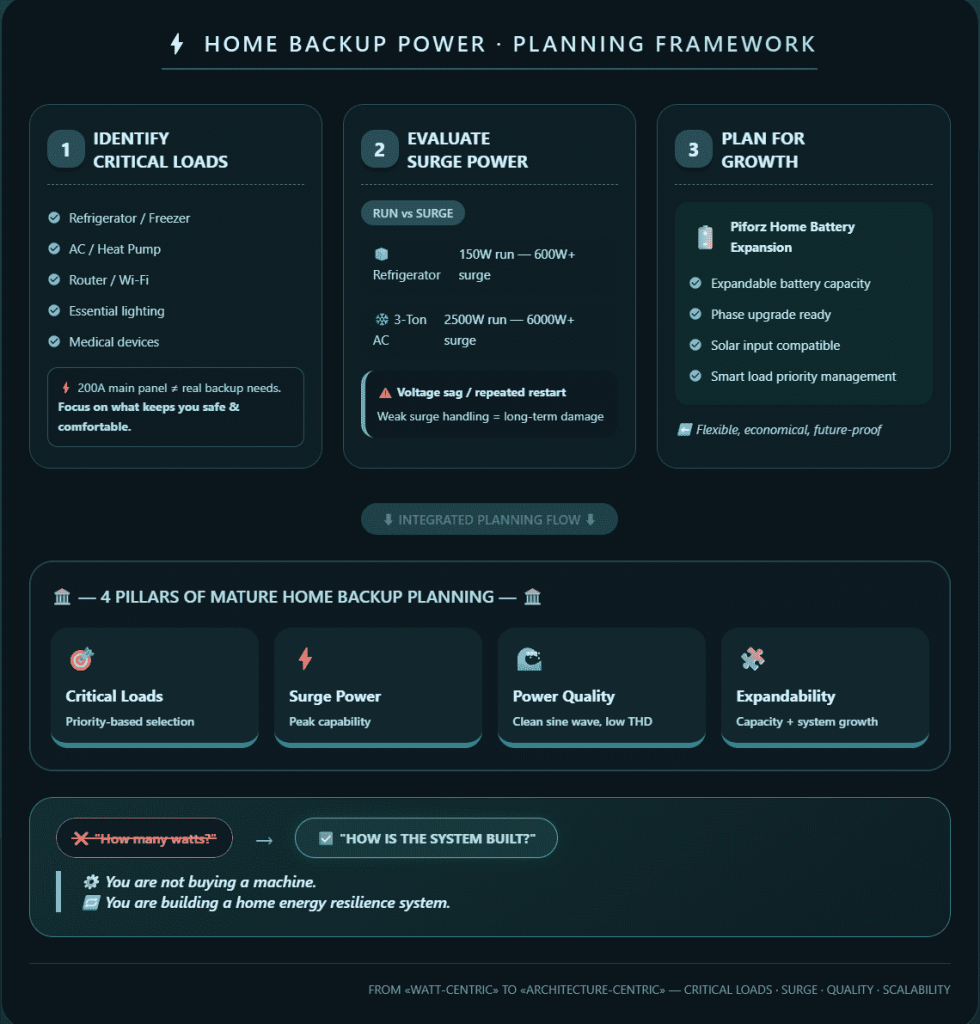
Step 1 – Figure out what you actually need to run
Everyone jumps straight to “power the whole house.” But when the lights go out, your real needs are usually pretty small.
Think:
Fridge (save your food)
AC or heat pump (stay comfortable)
Router and phones
Some lights
Medical devices if needed
That 200A panel is your max capacity. It’s not your actual outage load.
Start with the essentials. You’ll realize you don’t need as much wattage as you thought.
Step 2 – Don’t forget startup power
Some appliances need way more juice to start than to keep running.
Example:
A fridge might run on 150W, but startup can spike past 600W
A 3 ton AC runs around 2500W, but startup can top 6000W
If your power source can’t handle those surges, you’ll get voltage drops or the unit will struggle to start.
So your backup system shouldn’t just be “big enough.” It needs:
Reliable surge handling
Clean, stable power output
That’s the difference between “barely works” and “works safely for years.”
Step 3 – Leave room to grow
Your power needs aren’t set in stone.
Today, maybe you just want to keep the fridge and internet on.
Later, you might want to back up more circuits, or add solar.
Piforz expansion batteries let you:
Add more capacity over time
Upgrade in stages
Smartly manage your power priorities
It’s flexible. It’s cost-effective.
Good backup planning is really about four things:
Know your essentials · Handle startup surges · Demand clean power · Build for tomorrow
When you stop obsessing over wattage and start designing a system, something clicks:
You’re not buying a machine.
You’re building a home power safety net.
Final Choice – What’s Right for You?
Go with a gas generator if:
Upfront cost is your only concern
You don’t mind noise
You’re okay with maintenance
But choose a Piforz smart station if you care about:
Keeping your appliances safe
Peace and quiet at home
Easy, no-fuss operation
Smart features
Saving money over the long haul
Powering your whole home isn’t just about watts. High wattage is just the starting line.
What really matters is clean power, stability, safety, room to grow, and how well it fits into your life.
Next time you see “6500W” or “7500W,” maybe ask yourself a different question:
Is this thing just “powering” my home…
Or is it “protecting” it?