
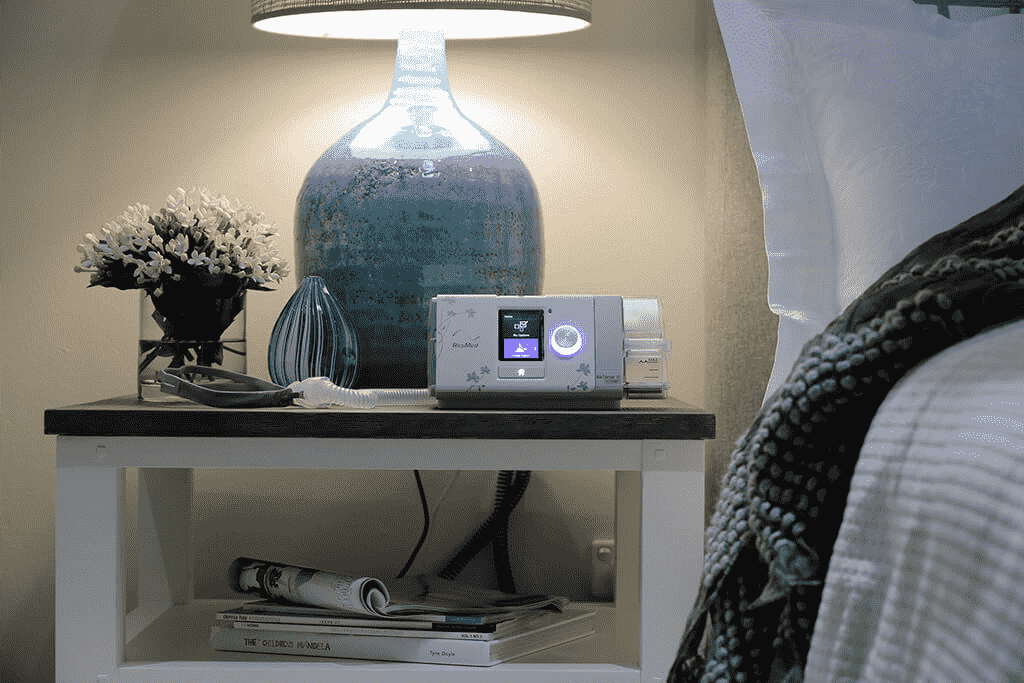
When Breathing Depends on Electricity
For those living with sleep apnea, a CPAP machine is more than just an appliance—it is a “lifeline” that ensures a safe and restful night’s sleep. However, most home CPAP units do not have built-in batteries. A sudden power outage in the middle of the night can silence this precision equipment instantly, a “blackout anxiety” shared by over 60% of users who have experienced treatment interruptions.
Whether you are planning an “off-grid” camping trip or preparing for an emergency power failure, Piforz portable power stations offer a professional medical-grade solution. Our technology features Pure Sine Wave output to protect sensitive motors, honest Watt-hour (Wh) capacities for predictable runtime, and LiFePO4 cells that remain reliable even after 2,000 cycles.
Can a 300W Power Station Run a CPAP All Night?
This is the most frequent question from users, and often the most misunderstood.
CPAP Power Consumption: Labels vs. Reality
Many users see a “90W” input label on their device and assume they need a massive power source. This is a common misconception. While a ResMed AirSense 10 adapter may be rated for 90W, its actual average consumption is much lower:
Without Humidity/Heat: Only 10–15W on average.
With Humidifier: Increases to 50–65W.
Pro Tip: Turning off the humidifier and heated tubing is the most effective way to extend your battery life significantly.
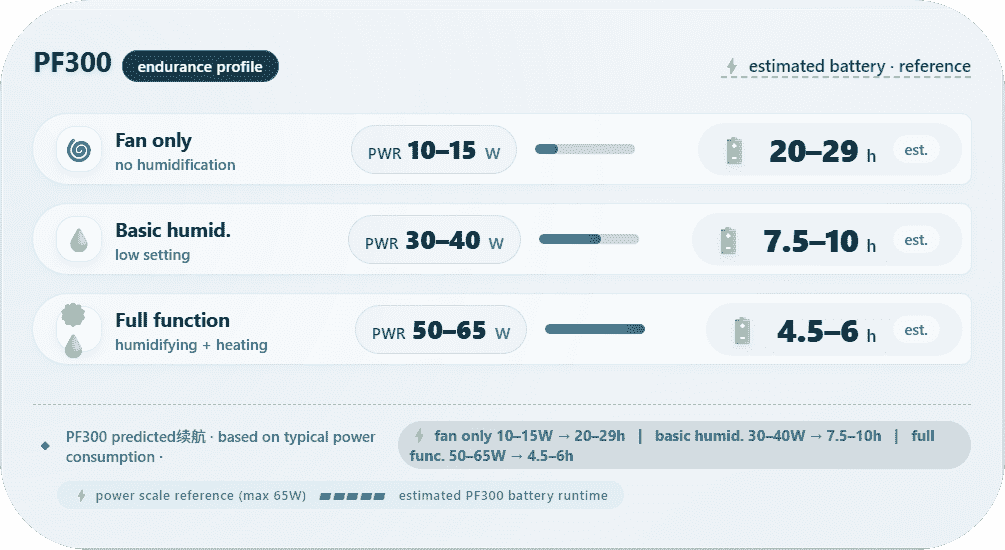
Piforz PF300 Runtime Test (299Wh Capacity)
Fan Only (No Humidification): 20–29 hours (Enough for 2-3 nights).
Basic Humidifier (Low Setting): 7.5–10 hours (One full night).
Full Function (Heat + Humidity): 4.5–6 hours (Emergency window).
Conclusion: The PF300 is perfect for users who can sleep without humidity for a night or two. For heavy users who require full heating and humidification, we recommend the PF500 or PF1500 for extra redundancy.
How Long Will a 1000Wh Battery Last? — The Science of Wh
When upgrading from “Will it work?” to “How long will it last?”, the answer lies in one unit: Watt-hours (Wh).
Why “Wh” is the Truth
In the portable power industry, some brands use misleading units found in consumer electronics. However, Watt-hour is the global standard for energy. It tells you exactly how much power the station can output over time. Piforz labels every unit based on true Watt-hour capacity—our first promise of transparency to medical users.
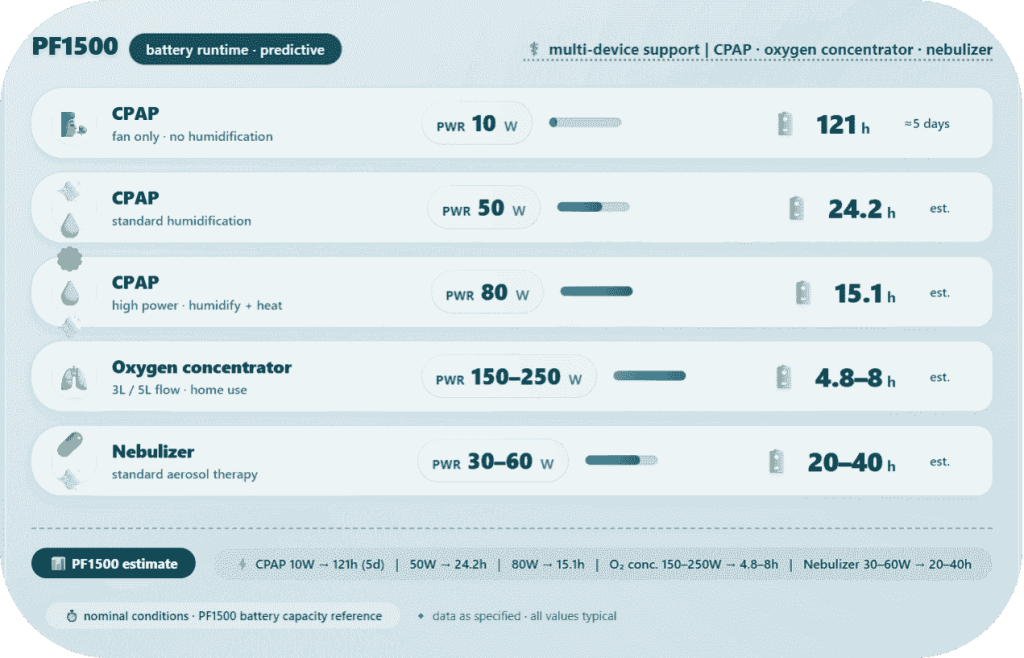
Piforz PF1500 (1210Wh) Medical Runtime Performance
CPAP (Fan Only): ~121 hours (approx. 5 days).
CPAP (Standard Humidification): ~24.2 hours.
Oxygen Concentrator (3L/5L flow): 4.8–8 hours.
Nebulizer: 20–40 hours.
The PF1500’s 1200W rated output is powerful enough to handle a CPAP while simultaneously running an oxygen concentrator or nebulizer.
Is it Safe to Use Medical Equipment with a Power Station?
Safety is more critical than capacity when it comes to medical devices.
Pure Sine Wave vs. Modified Sine Wave
Pure Sine Wave is the smooth, continuous current delivered by your home’s wall outlets.
Many cheap portable batteries use Modified Sine Wave (a choppy, “stair-step” current), which can cause serious issues for CPAP motors:
Motor Instability: Noises, vibrations, and inconsistent pressure.
Reduced Lifespan: Increased heat stress on the circuit board.
Sensor Errors: High-precision sensors may give false readings.
Piforz Commitment: Every model from the PF300 to the PF1500 provides clean Pure Sine Wave power with less than 3% total harmonic distortion. Running your CPAP on a Piforz is exactly the same as plugging it into a wall outlet.
Triple Electrical Protection
Beyond clean power, Piforz uses a Battery Management System (BMS) with three layers of safety:
Overload Protection: Millisecond-level cut-off if power exceeds limits.
Short Circuit Protection: Hardware-level instant disconnect.
Temperature Protection: Three independent sensors monitor the battery and inverter. If it hits 65°C, the system safely shuts down until it cools.
What Happens During a Power Outage?
If a blackout occurs, a CPAP without a battery stops immediately, leading to a total loss of airway pressure.
The Piforz Emergency Logic: When a Piforz station is in standby mode, its AC ports are already active. Because it is an independent power source, there is no “transfer time” required. Your CPAP continues to run seamlessly the moment the grid fails.
Medical Backup Solutions: Which One is for You?
Option A: The Light Traveler (PF300 – 299Wh) Best for 1-2 nights of basic CPAP use. Weighing only 4.3kg, it’s highly portable.
Option B: The Frequent User (PF500 – 518Wh) Ideal for those who need humidity through the night or travel frequently.
Option C: The Ultimate Home Backup (PF1500 – 1210Wh) Supports 5+ days of CPAP use. When paired with a 200W solar panel, it creates a self-sustaining “off-grid” medical station.
Frequently Asked Questions (FAQ)
Can I keep the CPAP plugged into the station permanently? Yes. Piforz units emit no harmful pulses. Keeping your machine connected to the station (and the station to the wall) ensures a seamless transition during a blackout.
How long will the battery last before it needs replacing? We use LiFePO4 cells. After 2,000 full cycles (about 5.5 years of daily use), the battery still retains over 80% of its original capacity.
Can I charge the station while using it? Yes, Piforz supports “pass-through” charging for DC outputs. You can use a DC converter cable for your CPAP while the station is being recharged by solar or AC.
Never miss a breath. Piforz delivers the peace of mind that even when the lights go out, your sleep remains undisturbed.