How Long Will a Portable Power Station Really Run?
Introduction
A portable power station breaks electricity free from fixed locations.
Before buying one, most people only care about one question: How long can it run on a single charge?
The honest answer is—there is no fixed number.
Runtime depends on battery capacity, how you use the power, and real-world conditions, not just the specs listed on a product page. In this article, we’ll start with the most basic calculations, then walk through real usage scenarios to explain what truly determines how long a portable power station can run—and whether it fits your needs.
1. How Long Can a Portable Power Station Run on One Charge?
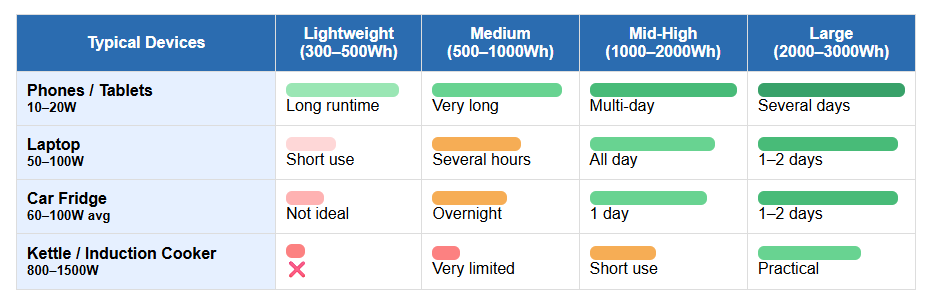
Here’s a practical way to think about capacity by use case:
- Lightweight (300–500Wh)
Best for phones, tablets, laptops, drones, projectors, and other low-power electronics. - Mid-range (500–1000Wh)
Ideal for short trips, weekend camping, and outdoor activities. Can power a car fridge, small electric kettle, or low-power cooking devices for short periods. - Mid-to-High Capacity (1000–2000Wh)
Suitable for road trips and extended outdoor use. Can handle induction cooktops, rice cookers, kettles, coffee makers, and power tools intermittently. - Large Capacity (2000–3000Wh)
Designed for home backup power, capable of running household appliances like refrigerators.
Runtime is mainly determined by two things:
- Battery capacity (Wh)– how much energy is stored
- Device power draw (W)– how fast that energy is consumed
When powering high-wattage appliances for extended periods, energy drains much faster, significantly shortening runtime.
What Really Determines How Long a Portable Power Station Runs?
Runtime is mainly determined by two things:
- Battery capacity (Wh)– how much energy is stored
- Device power draw (W)– how fast that energy is consumed
When powering high-wattage appliances for extended periods, energy drains much faster, significantly shortening runtime.
3. Understanding the Relationship Between Wh and W
- Wh (watt-hours)= total stored energy
- W (watts)= energy consumed per hour
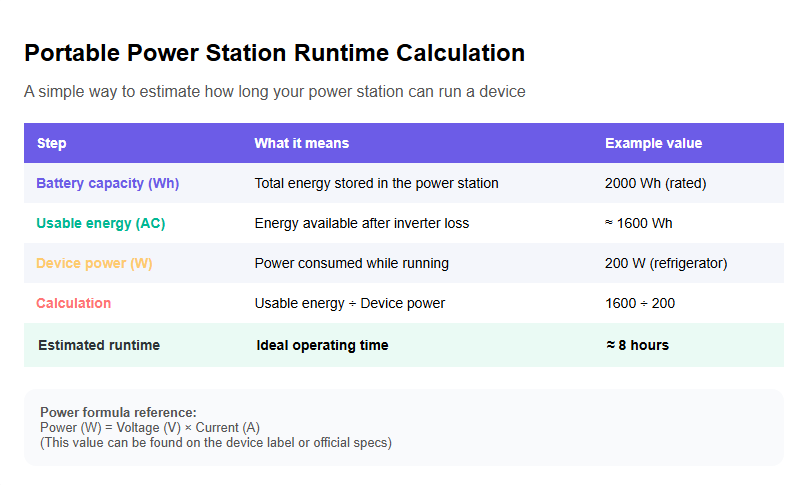
That’s why runtime can be estimated using a simple formula:
Runtime ≈ Usable Energy ÷ Device Power
Example:
A 2000Wh power station delivers about 1600Wh via AC after inverter losses.
Powering a 200W refrigerator:
1600Wh ÷ 200W ≈ 8 hours
You can usually find device power ratings on the product label or calculate them:
Power (W) = Voltage (V) × Current (A)
This method gives a realistic baseline for estimating runtime.
4. Why Usable Energy Is Lower Than Rated Capacity
A portable power station never delivers 100% of its rated capacity:
- AC output loses ~20% due to inverter efficiency
- DC/USB outputs are more efficient
- Internal protection prevents full depletion
So a 2000Wh unit typically provides:
- 1500–1700Wh via AC
- Up to ~1800Wh via DC/USB
Always calculate runtime based on usable energy, not rated capacity.
5. Why Real-World Runtime Is Shorter Than Calculations
Several factors reduce actual runtime:
- Appliances don’t draw constant power
- Startup surges increase consumption
- Cold temperatures reduce battery efficiency
- Cables, adapters, and multiple devices add losses
Calculated runtime is a reference—not a guarantee.
6. Peak Power vs. Continuous Power
- Continuous powerdetermines how long you can run
- Peak powerdetermines whether a device can start
Devices like refrigerators and power tools draw a brief surge at startup. Frequent cycling increases total energy consumption, shortening runtime.
Bottom line:
Runtime depends on continuous load, not peak power alone.
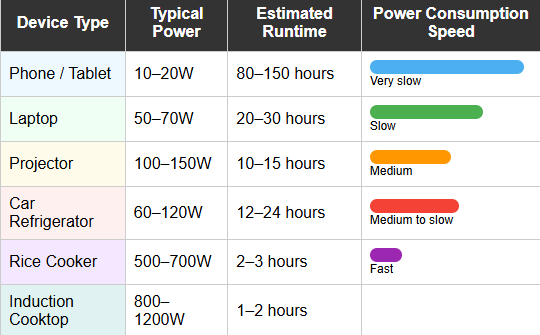
7.Reference Runtime (2000Wh Power Station, ~1600Wh Usable)
8. Calculating Runtime with Multiple Devices
Add all device wattages together:
Laptop 60W + Car fridge 100W + Phone 20W = 180W
1600Wh ÷ 180W ≈ 8.5 hours
When multiple devices run simultaneously, runtime drops faster than expected.
9. Can a Portable Power Station Run Overnight?
Yes—if total power draw is low.
Lighting, routers, phones, and a fridge can often run all night on mid-to-large capacity units.
10. How Long Will It Last During a Power Outage?
There’s no fixed answer.
If used only for essential loads—fridge, router, lights, phone charging—power drains slowly.
A 1000–2000Wh portable power station can often last overnight or close to a full day.
Knowing what counts as essential power makes a big difference.
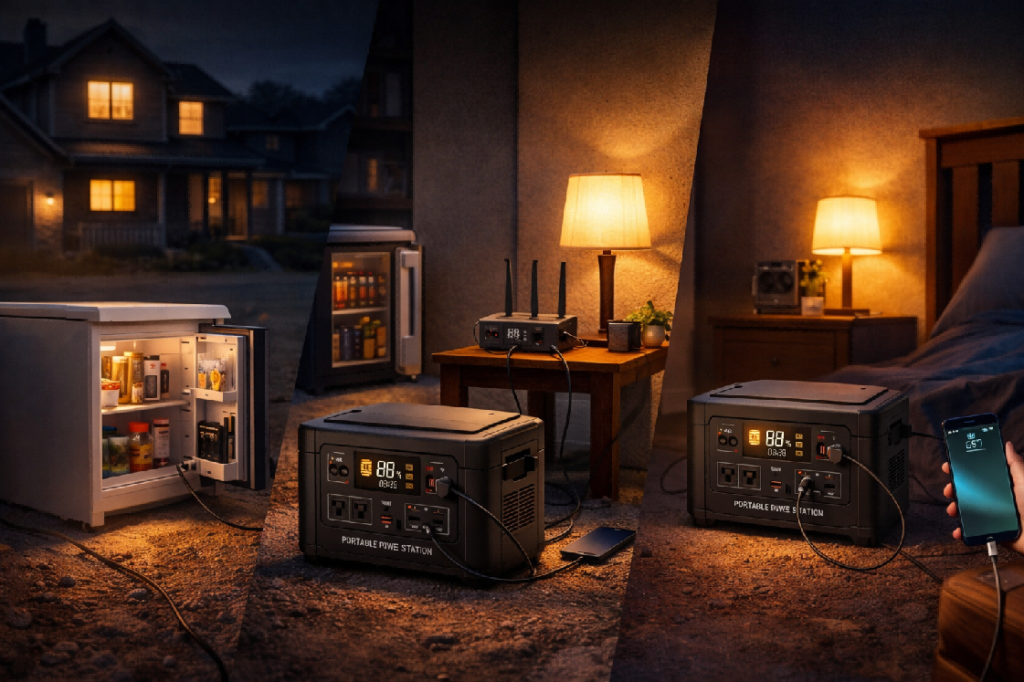
11. Example: Running a Refrigerator
- Power station: 2000Wh
- Usable AC energy: ~1600Wh
- Fridge rated power: 150W
- Average running power: ~80W
1600Wh ÷ 80W ≈ 20 hours
In real use, a fridge can run close to a full day.
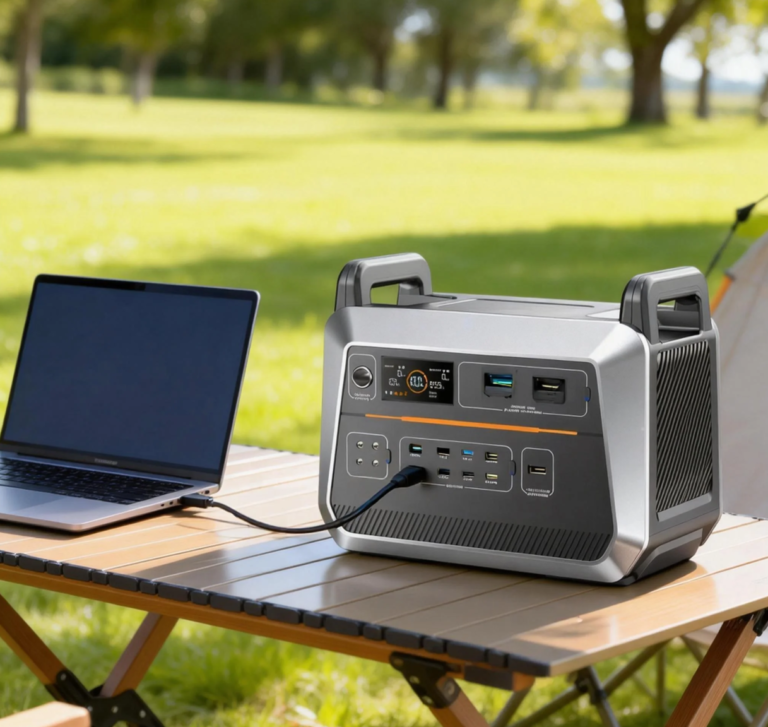
12. Example: Camping Power Usage
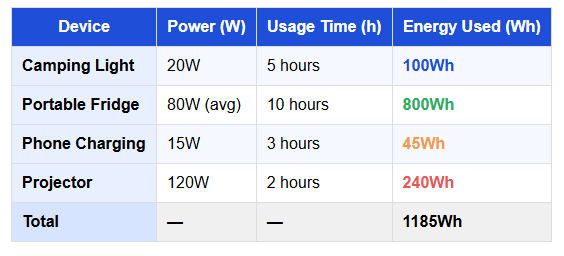
Typical camping setup:
Lights: 20W
Car fridge: 80W
Phone charging: 15W
Projector: 120W
Typical camping setup:
Lights: 20W
Car fridge: 80W
Phone charging: 15W
Projector: 120W
13. Battery Type and Its Impact on Runtime
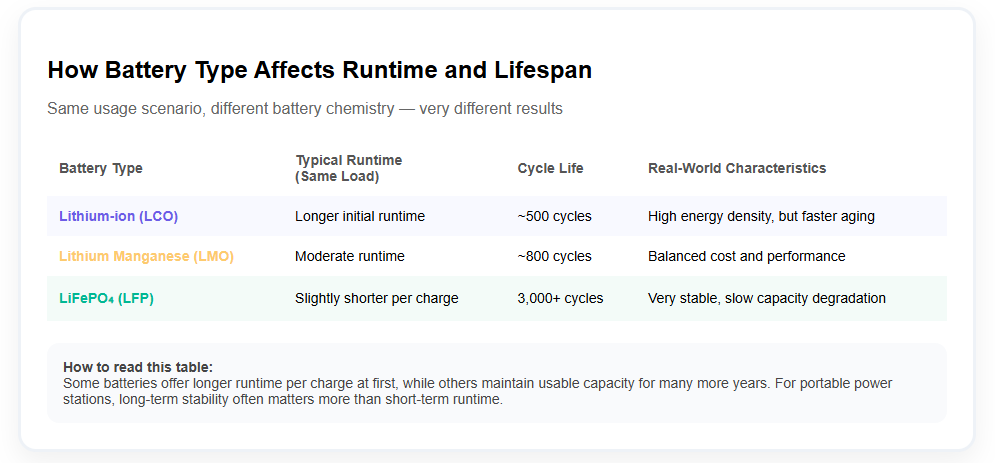
Different portable power stations use different batteries:
- Lithium-ion (NMC, LCO)
Lighter, fewer cycles, faster degradation - LiFePO₄ (LFP)
Heavier, safer, much longer cycle life
Battery type doesn’t change how much energy you get per charge—but it affects how consistently you can use that energy over years.
14. What Happens After 1–2 Years of Use?
Battery capacity slowly declines with use.
- Lithium-ion: noticeable runtime drop after 1–2 years
- LiFePO₄: much slower degradation
A small runtime reduction is normal and expected.
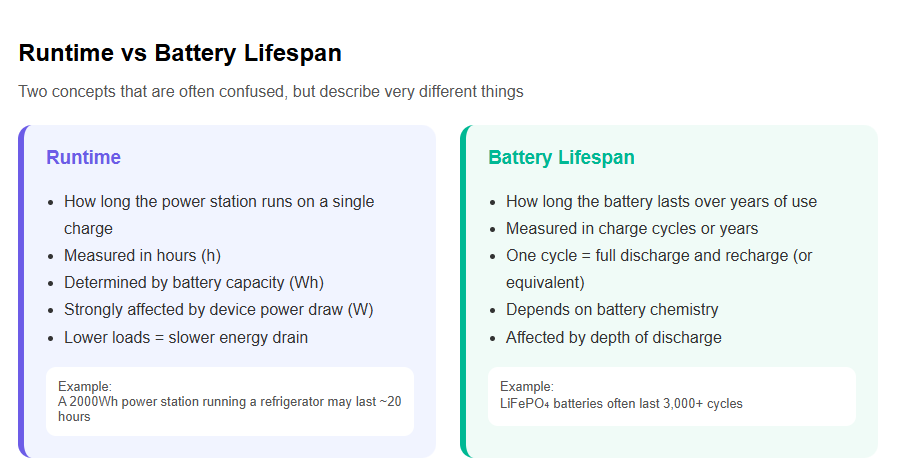
15. Runtime vs. Battery Lifespan
Runtime = how long one charge lasts
Battery lifespan = how many charge cycles it survives
They affect buying decisions in completely different ways and shouldn’t be confused.
16. Can Solar Panels Extend Runtime?
Yes.Using solar panels allows you to recharge while consuming power, effectively extending runtime. This does not harm battery lifespan and is a supported use case.
17. How to Extend Runtime in Real Use
- Prioritize DC outputover AC
- Avoid sustained high-power loads
- Reduce simultaneous device usage
- Use efficient charging habits
Good usage habits preserve long-term performance.
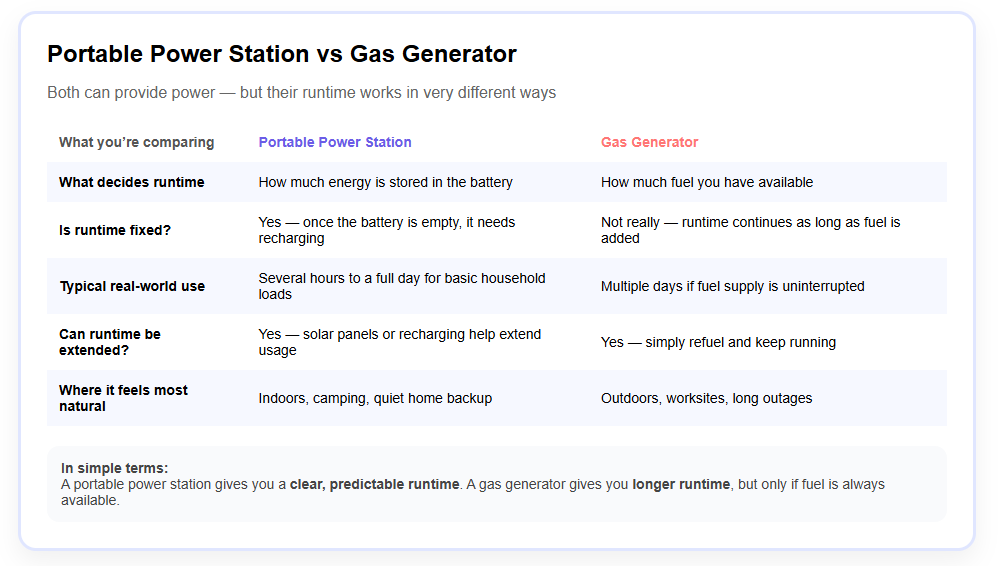
18. Portable Power Station vs. Gas Generator
They solve different problems.
- Portable power station: quiet, clean, limited by battery
- Gas generator: loud, fuel-dependent, theoretically unlimited runtime
Choose based on duration, noise tolerance, and power needs—not just runtime.
Final Thoughts
There’s no single answer to how long a portable power station will run.
What matters most is matching capacity to how you actually use electricity.
When the power station fits your real needs, runtime is usually right where you expect it to be. In future articles, I’ll continue breaking down real-world scenarios to help you choose—and use—your portable power station more effectively.