
Introduction: Why You Need a Portable Power Station for Tailgating in 2026
On Saturday morning, you load your chilled drinks into the mini fridge, toss the folding table and chairs into the trunk, and just then your friend texts: “What time will you get there?” You reply, “In one hour,” and suddenly remember: the little TV you brought last time died before halftime in the stadium parking lot.
If you’ve ever had a similar experience, you know that the biggest buzzkill at a tailgate isn’t losing the game — it’s losing power.
Whether it’s football season, the NCAA finals, or an outdoor concert, seasoned tailgaters know that a tailgate isn’t just a folding table and a bag of chips. You need a TV, a sound system, a running mini fridge, and sometimes even power for an electric grill. Put all of that together, and the power demand is far higher than what tailgate gear required just a few years ago.
And today, when people choose a reliable power source for tailgating, portable power stations have become the center of the discussion.
In this article, we’ll cover how to prepare stable power for tailgating — and which portable power station is the best choice for the job.
The Best Portable Power Stations for Tailgating in 2026
I’ll use my own experience to explain why the PIFORZ GT1500 is the best portable power station for tailgate parties.
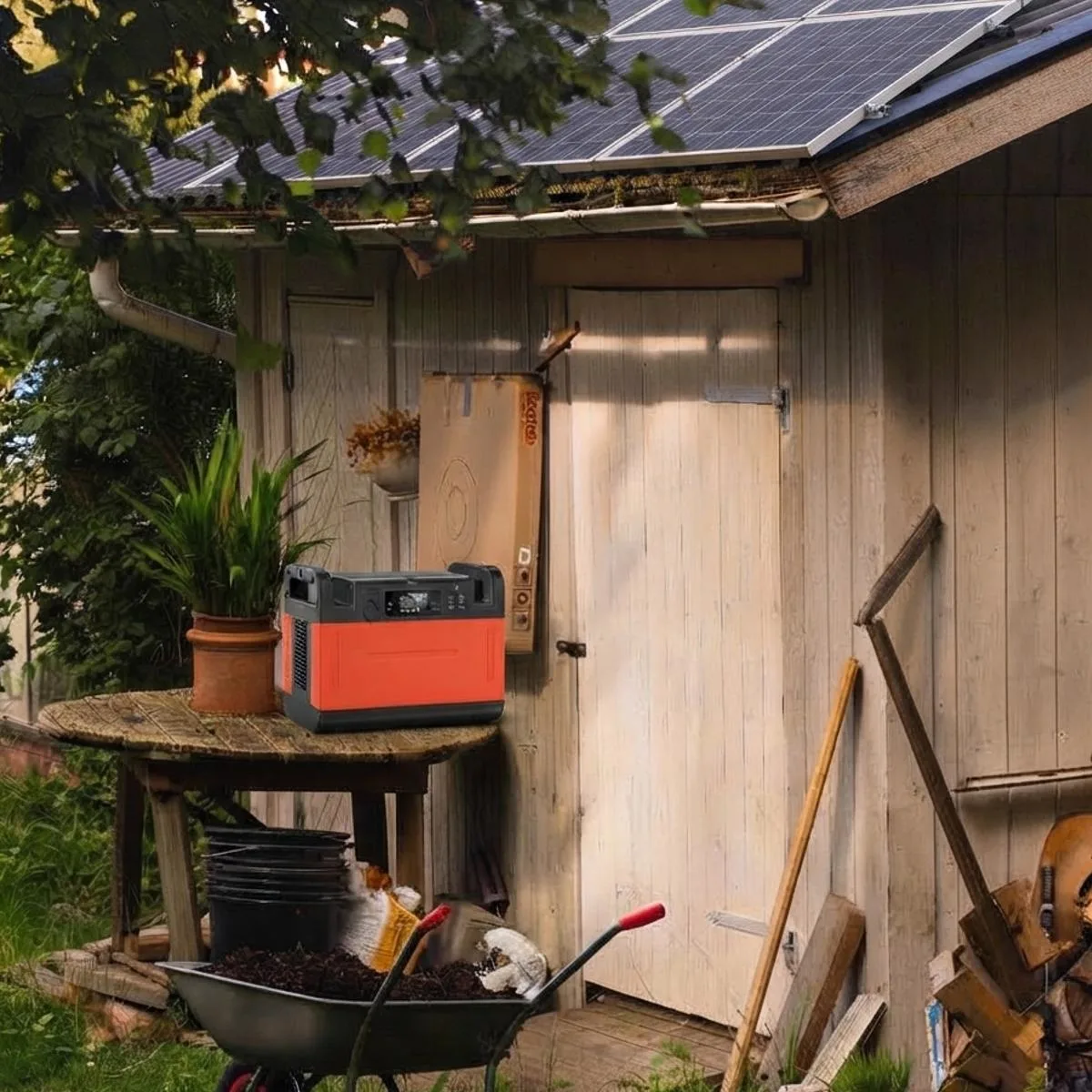
On May 17th, my friends and I hosted a tailgate party for the New York Yankees vs. New York Mets game, and I brought the GT1500 with me. Since it comes with a built-in handle and weighs around 16kg, I had no problem lifting it and placing it in the trunk by myself.
Its dimensions are 15.75 × 8.27 × 11.41 in, and even after loading a TV, folding chairs, and a cooler, my sedan’s trunk could easily fit the GT1500 without any struggle. That’s why it’s something we’re actually willing to take outdoors after purchasing.
We brought a 45-inch TV, a cooler, and a Bluetooth speaker, and we occasionally charged our phones. The game lasted a little over three hours, and the GT1500 still had about 20% battery left afterward.
It has two AC outlets and four USB ports, so I plugged the TV and cooler into the AC outputs, and the Bluetooth speaker and phone chargers into the USB ports. Even when my friends wanted to charge their phones, the outputs never felt crowded.
It also uses LiFePO4 batteries, which maintain their capacity for up to 3500 cycles before noticeable degradation.
The tailgate trend in 2026 is clear: more stadiums are restricting fuel-powered generators, battery technology in portable power stations is becoming mature, and 1000Wh+ units are becoming mainstream. That’s one of the reasons we recommend products like the GT1500.
So take it with you to your next tailgate party—it will significantly enhance your outdoor experience.
What You Really Need for Game Day Power
When people prepare a power source for their first tailgate, the most common mistake is buying a power station based solely on the wattage printed on the device labels. Then once they arrive, the TV goes dark after ten minutes, or the fridge runs out of power before it even finishes cooling. Real power needs are nothing like what you calculate at home.
Typical Tailgating Devices & Their Power Consumption
Here’s a wattage chart for common devices you’ll actually use in real tailgating scenarios:
| Device | Running Power | Startup Surge | Estimated 4-Hour Consumption |
| 32″ TV | 30–60W | None | ~200Wh |
| 50–55″ TV | 80–120W | None | ~400Wh |
| 65″+ TV | 120–180W | None | ~600Wh |
| Bluetooth Speaker (Small/Medium) | 20–40W | None | ~80Wh |
| Outdoor PA Speaker (High Power) | 50–100W | None | ~300Wh |
| Mini Fridge (Compressor Type) | 40–60W running | 200–300W surge | ~200Wh (intermittent) |
| Thermoelectric Cooler | 50–70W continuous | None | ~250Wh |
| Phone/Tablet Charging | 5–15W per device | None | Negligible |
| Small Electric Grill | 600–1200W | None | ~3000Wh |
Don’t be fooled by how low a TV’s wattage looks — a full four-quarter game plus pre-game warm-up easily runs 4–5 hours.
However, a fridge doesn’t run continuously; its compressor cycles on and off, so the actual power consumption is only about 30–50% of the theoretical number.
As for heating devices like electric grills, they start at around 600W and can burn through 600Wh in just one hour — enough to drain a 1000Wh power station by half almost instantly. That’s why if you want to power an electric grill, you’ll need a large unit with at least 3000Wh.
How Long Do You Need Power?
At this stage, what we need to consider isn’t just how long the game lasts, but how long the entire tailgate event runs from start to finish. Typically, we arrive 2–3 hours before kickoff to set up, prep food, and play music. About an hour before the game, you might turn on the TV for pre-game coverage. The game itself lasts roughly 3–4 hours. Afterward, you still need 30–60 minutes for traffic to clear, packing up, and getting ready to leave.
So the real requirement is 6–8 hours — not just the 3–4 hours of game time.
Using that duration as the estimate:
A 50″ TV running for 7 hours needs about 560Wh, a mini fridge running intermittently for 7 hours needs around 250Wh, a 20W speaker running for 7 hours needs about140Wh, and phone charging adds roughly 50Wh.
That’s a total of about 1000Wh.
Tailgating Environment Factors That Affect Power Needs
Aside from the power draw of your devices, there are a few other factors to consider:
Temperature effects:
In high summer temperatures, a fridge will cycle more frequently to maintain its cooling. In winter, if temperatures drop below 0°C, the usable capacity of lithium batteries decreases. In extreme temperatures, it’s best to place the power station near a cooler or use an insulating pad, or pre-warm the power station by keeping it inside a heated car before heading out.
Inverter losses:
There is always some loss when current passes through an inverter, typically around 10%–15%.
TV brightness:
At home, you might keep your TV brightness at around 30%, but outdoors for a game, you’ll likely turn it up to 100%. That increases the TV’s actual power draw compared to your normal indoor usage.
Because of all this, when choosing the battery capacity of a portable power station, you should add about 20% as a safety margin.
Portable Power Station vs Other Power Options
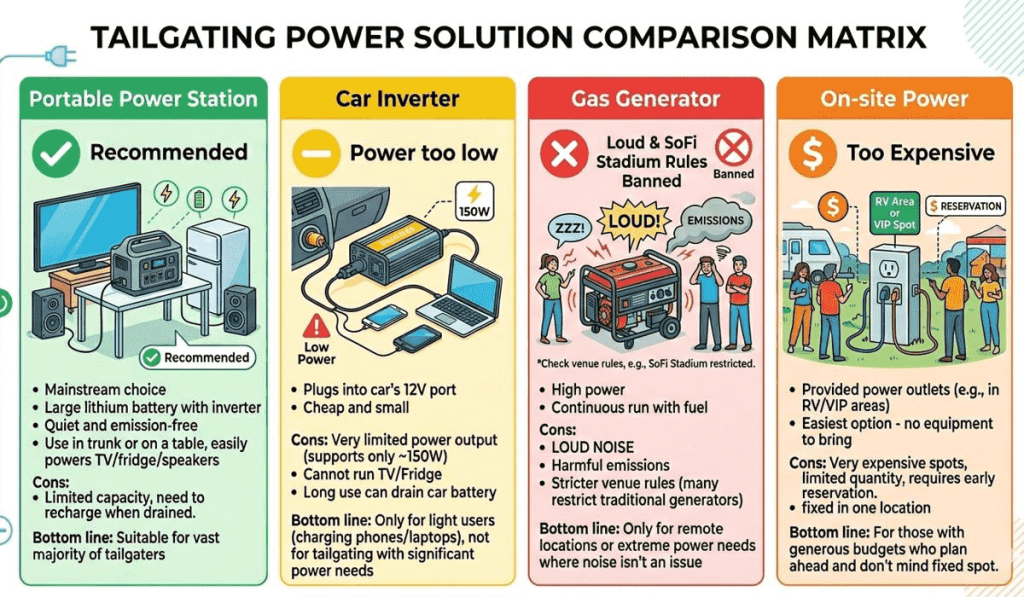
Portable power station
This is the mainstream choice for tailgating today. Essentially, it’s a large lithium battery pack with an inverter — it stores electricity and outputs electricity. Its advantages are that it’s quiet, emission-free, and can be used in the trunk or on a table. It can easily power a TV, fridge, and speakers. The downside is that the capacity is limited; once it’s drained, you need to recharge. It’s suitable for the vast majority of tailgaters.
Car inverter
It plugs directly into the car’s cigarette lighter port and converts the car battery’s DC power into AC. The advantages are that it’s cheap and takes up almost no space. The downside is that the power output is very limited — the cigarette lighter usually supports only around 150W, which isn’t enough to run a TV or a fridge.
And because it draws from the car’s starter battery, using it for too long while the engine is off may leave you unable to start the car. It’s suitable for light users who only need to charge phones or laptops, but not for tailgating situations where you need a significant amount of power.
Gas generator
This is the traditional option: high power, and as long as you have fuel, it can run continuously. The advantages are that it can power an electric grill, a large TV, or even an air conditioner.
The downsides are the loud noise and harmful emissions, and more and more venues are imposing stricter rules on traditional generators. For example, in the official guidelines of SoFi Stadium, the only allowed power equipment is “portable electric generators of 600W or less,” which means higher-powered, noisier, fuel-driven generators essentially don’t meet the venue requirements. BBVA Stadium goes even further, stating that portable generators cannot operate inside tents or cooking areas to avoid safety risks.
So gas generators are only suitable for remote locations where no one regulates their use, or for situations where you need extremely high power and don’t care about noise. For most campers, gasoline generators are already a thing of the past.
On-site power
Some venues provide power outlets in RV areas or VIP sections. The advantage is that it’s the easiest option — you don’t need to bring any power equipment at all. The downside is that the spots are expensive, limited in number, and need to be reserved well in advance. And you can only use the power at the designated location provided by the venue, so you can’t move around. This option is suitable only for those with a generous budget, who plan ahead, and don’t mind being fixed in one spot.
Quick Picks: Best Portable Power Stations for Tailgating
Best Overall for Tailgating
PIFORZ GT1500
It comes with a 1210Wh battery capacity paired with 1200W/2500W rated and peak output power. It easily handles the startup surge of a compressor fridge and has more than enough energy to last through an entire game plus the post-game celebration. It also includes an energy-saving mode: when the product is in a no-load state with DC enabled, or when the total load is below 5W, or when AC is on but the actual load is under 5W, it will automatically enter an 8-hour sleep mode.
So from the start of your tailgate party to the very end, it won’t have any problem keeping up.
Best Budget Tailgating Power Station
ALLPOWERS VOLIX P300
It has a 256Wh battery capacity with 300W/600W rated and peak output power. Considering its $99 price, it’s a good value. But it’s only suitable for light use — it can power a small TV and phones, but can’t run a fridge or last through an entire game. If you don’t want to spend a lot on gear and only go occasionally, this is a model you can consider.
Best for Tailgating + Home Backup Combo
BLUETTI Apex 300
With a 2764Wh battery capacity and 3840W output, this unit is essentially built for home use — you just happen to be able to bring it to the parking lot as well. It also features a modular design, so if the battery capacity isn’t enough, you can expand it. The base can stay at home as a backup power supply while the main unit detaches for on-the-go use. The downsides are that it’s expensive and heavy.
How to Choose the Best Portable Power Station for Tailgating
Output Power: Continuous vs Surge
The output power is determined by the inverter(200W vs 2000W: Choosing the Right Portable Power Inverter for Camping).The rated power refers to the maximum continuous load a unit can support, while the peak power refers to the short burst it can handle during sudden surges. In tailgating scenarios, most devices don’t have significant startup surges, so continuous power is what determines whether your power station can handle the load.
A 55-inch TV uses around 100W, a speaker system about 50W, and a fridge around 60W — totaling roughly 210W. In theory, a 300W power station would be sufficient. The only device you need to consider for surge power is a compressor-style fridge, which may spike to 200–300W at startup.
So you should leave some headroom — what if you want to add a small electric grill or swap to a bigger TV?
Battery Capacity (Wh): How Long Can It Run Your Tailgate
Battery capacity is measured in Wh (watt-hours), which determines how long your devices can run. A simple way to think about it: a 500Wh power station can run a 100W TV for about 5 hours.
But in a real tailgating scenario, you’ve also got a fridge, speakers, and phones to charge — plus inverter losses. So it’s recommended to start at 1000Wh, with 1200Wh or more being ideal.
Number of AC Outlets & Ports
This is the easiest place to mess up on-site. You bring a TV, a fridge, speakers, and phone charging cables, only to realize your power station has just one AC outlet. Once you plug in the TV, there’s nowhere to plug in the fridge. So it’s best to have at least two AC outlets.
Also, USB ports matter. Many devices now run directly on USB power—like Bluetooth speakers and phones—so they don’t take up an AC outlet. Ideally, you should have at least two USB ports, with one supporting 60W or higher PD fast charging.
Recharging Options
It’s also better if a portable power station supports multiple charging input methods. Generally, there are three common types: wall charging, car charging, and solar charging. The more charging options you have, the more “lifelines” you can rely on when your power runs out.
Weight, Size, Noise Level & Stadium Rules
These are the factors that directly determine whether you’ll actually be willing to take it out after buying it.
First, it definitely can’t be too heavy — if it’s too heavy for one person to carry, then it’s not suitable for outdoor use.
Second is noise. Unlike generators, portable power stations don’t produce loud roaring sounds while running, so you can quietly enjoy the entire game.
Then there’s size. A power station will take up some trunk space. Before buying, check its length, width, and height, and make sure that after packing your other gear, it will still fit in your car trunk.
Finally, venue rules — it’s important to check these in advance. Some venues may restrict power output or require equipment to be placed in designated areas.
Battery lifespan
Portable power stations are not disposable products. How long the battery lasts depends on two things: the cell type and the cycle life.
Most high-end portable power stations on the market now use LiFePO₄ batteries because they offer better thermal stability, higher safety, and most importantly, a cycle life of around 3,000–5,000 cycles.
Don’t Let a Dead Battery Ruin Game Day
Let’s go back to the scene at the beginning: the drinks are chilled, the folding chairs are loaded, and your friend texts, “What time will you get there?”
This time, there’s one more thing in your trunk—a reliable portable power station.
By 2026, portable power stations have already become the mainstream choice for tailgate parties. Whether you’re going with an all-around model like the GT1500, a budget-friendly option from ALLPOWERS, or a home-and-outdoor hybrid like the BLUETTI, the core principle is the same: don’t buy based on the device’s label—buy based on your real-world usage.